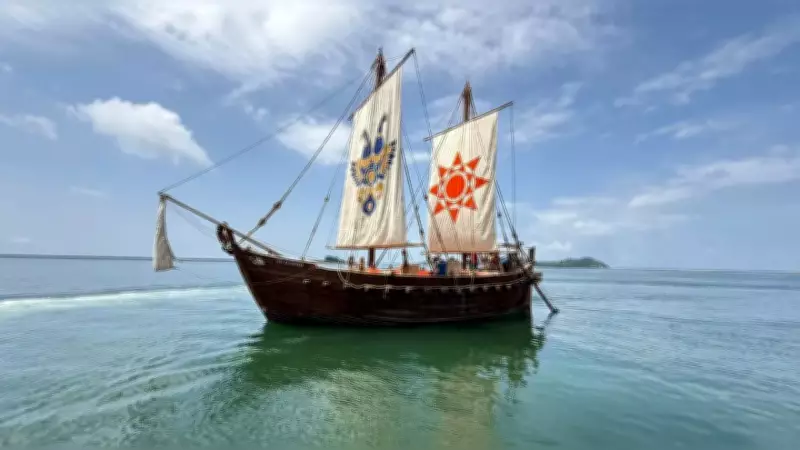
In a remarkable announcement that bridges past and present, economist and maritime history enthusiast Sanjeev Sanyal revealed on Monday that the next historic voyage of the stitched-hull vessel INS Kaundinya will retrace an ancient maritime trade route from Odisha to Bali on Kartik Purnima. This expedition promises to revive India's deep-rooted seafaring legacy, bringing to life traditions that have been overlooked for centuries.
Reviving Ancient Maritime Corridors
"The next voyage of INS Kaundinya will be from the east coast of India, most likely Odisha, to Bali—an ancient trade corridor that once connected India with Southeast Asia," Sanyal stated emphatically. He underscored the significance of Kartik Purnima, a time traditionally marked by traders and mariners setting sail across the Bay of Bengal, embarking on journeys that shaped regional commerce and cultural exchange.
A Lecture That Captivated Kolkata
Sanyal, who serves as a member of the Economic Advisory Council to the Prime Minister, delivered these insights during the Nathaniel Wallich Memorial Lecture. This lecture was instituted to commemorate the birth anniversary of the Indian Museum, which celebrated its 212th anniversary this year. His presentation, which masterfully wove together archaeology, history, and personal experiences at sea, held the audience spellbound.

"I was deeply struck by Sanyal's extraordinary story of recreating an ancient vessel and then truly living that tradition through a daring sea voyage. There could have been no better way to mark the birth anniversary of the Indian Museum than sharing this story with a Kolkata audience," remarked Indian Museum Director Sayan Bhattacharya, highlighting the event's profound impact.
The Vessel: A Testament to Ancient Craftsmanship
INS Kaundinya is an ancient-style sea-going vessel reconstructed using the stitching technique depicted in the Ajanta cave paintings. Currently undergoing a detailed technical examination at Muscat, Oman, the boat is being thoroughly checked for structural integrity and wear after its long voyage. "Once the examination and maintenance are completed, it will be brought back to India's east coast for the next expedition," Sanyal explained.
Built without nails or metal fastenings, the vessel reflects a shipbuilding tradition that prevailed during the Gupta period nearly 1,600 years ago, and possibly much earlier. Sanyal, who also served as the architect of the reconstruction, described the recently completed voyage as "no less than an adventure straight out of antiquity," emphasizing its authenticity and historical significance.
A Journey Back in Time
The 17-day journey covered 836 nautical miles (1,513 km) across open seas, undertaken with no modern equipment barring a compass and a few basic navigational tools. "We deliberately avoided modern aids to understand how ancient mariners thought, navigated and survived at sea," Sanyal said, shedding light on the expedition's experimental nature.
Adding to the authenticity was the use of a Harappan stone anchor, a design dating back over four millennia. Sanyal was accompanied by a small crew of highly experienced and exceptionally brave naval mariners, trained to adapt modern seamanship to ancient constraints, ensuring safety while honoring historical practices.
Correcting Historical Blind Spots
Explaining his motivation, Sanyal said the voyage was about correcting historical blind spots. "India has always been a seafaring civilisation with fleets ranging from large ocean-going vessels to smaller coastal boats. Unfortunately, colonial-era historians failed to see beyond the Chalukya period, effectively erasing our earlier maritime traditions," he asserted.
"This distorted our understanding of history and ignored evidence of Harappan trade voyages linking India with Mesopotamia," he added. By physically recreating ancient shipbuilding techniques and sailing forgotten trade routes, Sanyal emphasized that the project aims to challenge long-held assumptions and restore India's rightful place in global maritime history—one voyage at a time.
This initiative not only celebrates India's rich maritime heritage but also inspires a renewed appreciation for the ingenuity and courage of ancient seafarers, whose legacies continue to resonate in modern explorations.