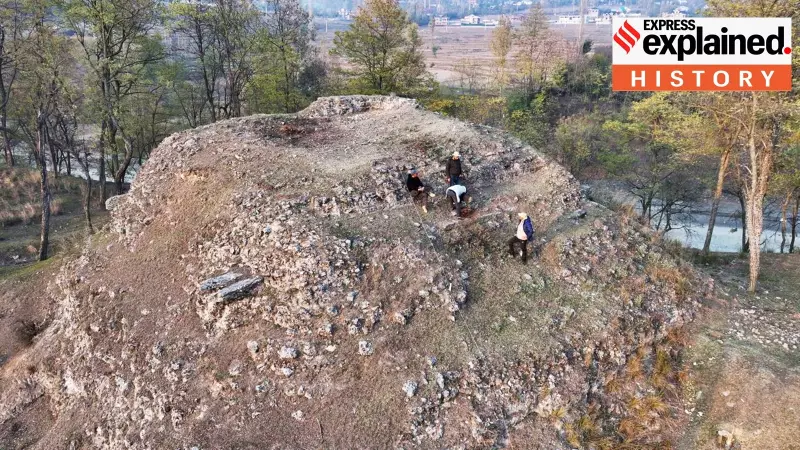
For generations, residents of Zehanpora village in North Kashmir's Baramulla district viewed the sprawling, undulating mounds covering 10 acres as a curious but natural part of the landscape. Today, these very earth formations are recognized as a monumental archaeological discovery: a 2,000-year-old complex of Buddhist stupas from the Kushan era, shedding new light on the valley's profound Buddhist past.
From Mounds to Monument: Unearthing a Hidden Legacy
The transformation in understanding began with systematic archaeological work. Dr. Mohamad Ajmal Shah, director of the excavation and part of a team from the University of Kashmir's Centre of Central Asian Studies and the J&K Department of Archives, Archaeology and Museums, spearheaded the effort. Initial mapping using drones and remote sensing revealed that the entire area is covered with man-made structures.
The site, which appears as a large, man-made plateau resembling a stupa base, had been bisected by a canal since the 1970s. "It was like a conspicuous archaeological site but remained unexplored," Dr. Shah explained. The team found evidence of a wooden super-structure that once rose above the mounds, which have been reduced in size over centuries but remain prominent.

A French Archive and a Prime Minister's Mention
The story of Zehanpora's recognition took an international turn in 2023. During a fellowship in France, Dr. Shah discovered a photograph in a traveller's archive at a museum that depicted the site. The image, likely taken by British travellers journeying from Lahore and ancient Taxila into Kashmir, clearly showed three stupa-like formations.
This connection gained national prominence in December 2025 when Prime Minister Narendra Modi highlighted the discovery in his Mann ki Baat address. Following this, Ministry of External Affairs spokesperson Randhir Jaiswal posted on X, noting that what seemed like unusual rock formations matched the archived image, underscoring the cultural legacy of Jammu and Kashmir.
Kashmir: The Cradle of Mahayana Buddhism
The Zehanpora site is a significant piece in the puzzle of Kashmir's Buddhist history. While popular belief credits Mauryan Emperor Ashoka with introducing Buddhism to the region, texts like Kalhana's Rajatarangini suggest it was prevalent even earlier. Kashmir's role evolved dramatically under the patronage of Kushan rulers, particularly Emperor Kanishka.
Kashmir became a crucial centre for the evolution and spread of Mahayana Buddhism. This sect, which took root in the valley, was later carried by Kashmiri missionary monks across the Silk Road into China and Central Asia. The dialogue on Buddhism between the Indo-Greek ruler Menander and the monk Nagasena is also believed to have occurred in this region, strengthening its philosophical standing.
The sheer scale of the Zehanpora complex, unmatched by other known sites in the region, promises to illuminate details about ancient trade routes that passed through Kashmir and the extent of Buddhist influence. Excavation, paused for winter, is expected to extend beyond the planned three years due to the site's vastness.
A Living Heritage Across the Valley
Zehanpora is not an isolated relic. It joins a network of sites that map Kashmir's rich Buddhist landscape. In northern Kashmir, sites like Kanispora, Ushkur, and Parihaspora show strong Buddhist links. Harwan in central Kashmir's Srinagar is a major Buddhist complex, while southern areas like Semthan, Hutmur, Hoinar, and Kutbal are dotted with archaeological evidence.
Collectively, these sites, through their structural and artistic remains, represent a heritage that demands sustained research and conservation. The discovery at Zehanpora moves a long-ignored mound from the periphery of local knowledge to the centre of a national conversation about India's, and specifically Kashmir's, indelible contribution to Buddhist thought and culture.