Keezhadi Excavation Report Standoff Intensifies as Archaeologist Rejects ASI Review
The ongoing conflict between the Archaeological Survey of India (ASI) and archaeologist K Amarnath Ramakrishna, who led the groundbreaking excavations at Keezhadi in Tamil Nadu's Sivagangai district, has reached a critical juncture. Ramakrishna has formally rejected an internal evaluation of his comprehensive excavation report and is demanding immediate publication of his original 982-page document without further modifications or delays.
Questioning the Review Process and Substance
In a detailed response to the ASI, Ramakrishna raised serious concerns about both the procedure and content of the 114-page review prepared by a five-member internal committee. He argued that the scrutiny of his excavation report deviated significantly from established academic practices and appeared fundamentally flawed in its approach.
The archaeologist questioned the legitimacy of the review document titled 'Critical evaluation and Recommendations for the Keeladi Excavation Report (2014–2016)', pointing out that one committee member's signature was conspicuously absent, marked merely as "on tour." More importantly, he noted that there appeared to be no unanimity among the committee members regarding their assessment.

Unprecedented Evaluation Procedure
Ramakrishna described the very act of establishing an internal committee to reassess the interpretation of an excavator's report as unprecedented in ASI history. "The procedure of setting up an internal committee to critically evaluate a report submitted by an archaeologist who had actually conducted physical excavation is unprecedented," he wrote in his response.
Traditionally, according to Ramakrishna, ASI reports undergo review only for technical aspects such as:
- Proofreading errors and grammatical mistakes
- Formatting lapses and paging issues
- Problems with drawings, photographs, or indexing
Instead of receiving a marked-up copy of his original report with specific comments—which he argued was the standard practice—Ramakrishna was presented with a separate 114-page document containing generalized observations.
Allegations of AI-Assisted Review
In one of the most striking allegations, Ramakrishna suggested that the review document might have been generated with artificial intelligence assistance. "The content, nature of the language, structure, and overall presentation... discloses non-application of scholarly human mind," he wrote, describing the evaluation as repetitive, mechanical, and monotonous in pattern.
He further elaborated that the committee "has not given any plausible reasons and valid justification requesting me to improve my report, that too, on my findings." The language of the evaluation, according to Ramakrishna, lacked the character of genuine scholarly critique that one would expect from archaeological experts.
Defending Keezhadi Chronology and Methodology
The internal committee had criticized Ramakrishna's report as "ambiguous, incomplete and underdeveloped," arguing that it mixed historical background and literary references without clear structure. They also questioned some interpretations, including the claim that Keezhadi was a "uni-cultural site," suggesting these were insufficiently supported by stratigraphic evidence.
Ramakrishna countered these criticisms by noting that the reviewers had never visited the Keezhadi site themselves. "It is so pathetic the internal committee... had never visited the site (Keezhadi) and never visualised the site's cultural formation," he wrote, emphasizing that the evaluation overlooked crucial first-hand knowledge derived from actual excavation work.
He defended his chronology of Keezhadi—which dates the site from approximately the 8th century BCE to the early centuries CE—as having been reconstructed "strictly in accordance... with the primary sources, namely cultural deposit, stratigraphical sequences and its material culture," following the ASI's own established methodology.

Political Context and Historical Significance
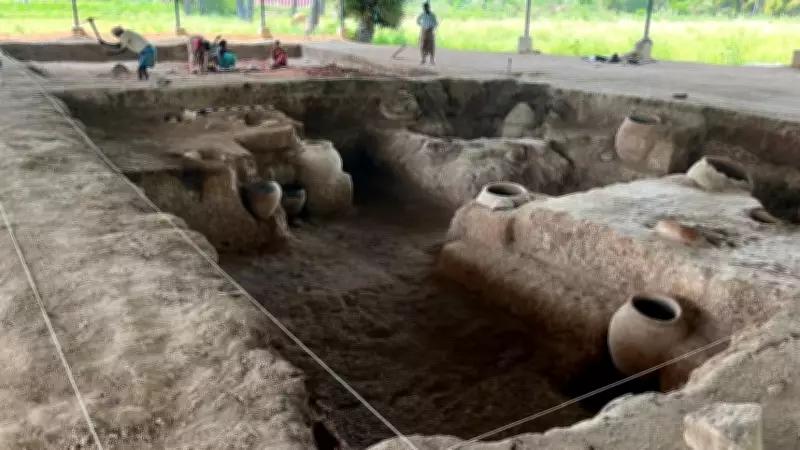
Over the past decade, Keezhadi has emerged as one of India's most politically significant archaeological sites. Located near Madurai, the excavations conducted under Ramakrishna's leadership between 2014 and 2016 revealed:
- Sophisticated brick structures and drainage systems
- Numerous terracotta artefacts and industrial remains
- Pottery with graffiti inscriptions
- Evidence suggesting an organized urban settlement during the Sangam era
These findings challenged long-standing assumptions that early urbanism in India was predominantly concentrated in northern regions. The discoveries have taken on additional significance within Tamil consciousness and identity.
Ongoing Impasse and Demands
Ramakrishna's relationship with the ASI has been strained since he was abruptly transferred from the Keezhadi project in 2017. Many observers in Tamil Nadu attributed this move to political considerations of the BJP-led Central government. Subsequent ASI statements appeared to downplay the site's significance, even as the Tamil Nadu State Department of Archaeology resumed excavations and recovered thousands of additional artefacts.
Two years after submitting his comprehensive report, the ASI asked Ramakrishna to "resubmit" it with corrections—a request he declined. Now, with his formal rejection of the internal review, the standoff has reached a new level of impasse.
Ramakrishna's final demand to the department was unequivocal: "The findings and conclusion... (are) final and there is no need or valid reasons to alter the said report... The same may be published at the earliest." The resolution of this conflict will have significant implications for archaeological practice in India and the interpretation of Tamil Nadu's ancient history.