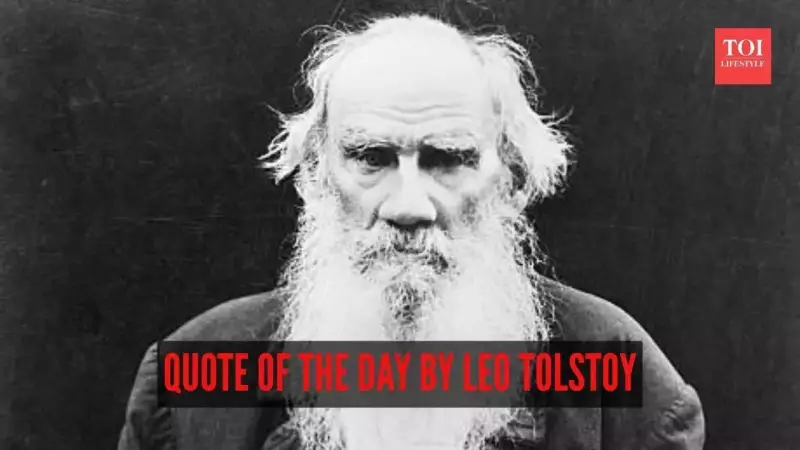
For readers across the globe, the name Leo Tolstoy evokes a sense of deep literary and philosophical reverence. More than just a novelist, he was a master of the written word, a moral philosopher, and a relentless seeker of truth whose one-liners continue to pierce through the noise of modern life. Born into a wealthy Russian aristocratic family in 1828, Tolstoy's early years were marked by comfort, but his worldview was radically shaped by a growing awareness of societal inequality and human suffering.
From Aristocratic Life to Artistic Genius
His experiences serving in the army exposed him to the brutal realities of war, which later fuelled the creation of his monumental works, most notably War and Peace and Anna Karenina. As he aged, Tolstoy underwent a profound spiritual transformation. He began to critically question the pillars of power, wealth, and organised religion, ultimately embracing a life guided by principles of nonviolence, compassion, and inner authenticity. This unique fusion of artistic brilliance and moral earnestness is what keeps his voice alive and relevant more than a century later.
The Power of Personal Change: A Tolstoyan Mantra for Today
In an era dominated by social media movements and outward criticism, one of Tolstoy's most famous quotes serves as a quiet yet powerful counterpoint: “Everyone thinks of changing the world, but no one thinks of changing himself.” This line is a direct call for introspection. It urges us to examine our own habits, unconscious biases, and daily acts of unkindness before attempting to correct the world. Tolstoy firmly believed that personal transformation is the essential foundation for any lasting social change—a principle that holds immense value in our personal, professional, and public spheres today.

Anna Karenina: A Timeless Mirror to the Human Soul
Among his literary masterpieces, Anna Karenina stands out for its devastatingly beautiful exploration of human emotions. The novel traces the tragic arc of its protagonist, Anna, a brilliant and beautiful aristocrat whose life unravels due to a passionate, illicit love affair. Readers often find her descent heartbreaking and frustrating, as she makes impulsive choices led by her heart, eventually sinking into profound despair. Tolstoy uses her story, contrasted with other relationships in the book, to delve into advanced themes of desire, duty, betrayal, and the eternal search for meaning.
The novel demonstrates how love can be both elevating and destructive, and how ignoring one's conscience leads to immense suffering. Its insights into marriage, loneliness, and the fragile nature of happiness remain strikingly poignant, proving the story's timeless appeal.
Exposing the Gap Between Words and Actions
A particularly profound line from Anna Karenina offers a sharp critique of societal hypocrisy: “I often think that men don't understand what is noble and what is ignorant, though they always talk about it.” This observation cuts to the heart of moral confusion. Tolstoy highlights how people in high society—and by extension, in our world—readily engage in lofty discussions about ethics, honour, and nobility, yet their understanding is often shallow. There exists a glaring gap between their words and their actions. Characters in the novel judge others, give grand speeches, and cling to social conventions, while simultaneously acting out of selfishness and hypocrisy in their private lives. This quote remains a powerful reminder to seek depth and authenticity in our moral compass, beyond mere talk.
The legacy of Leo Tolstoy is not confined to history books. It lives on in his powerful narratives and piercing quotes that continue to challenge, inspire, and guide us toward deeper self-awareness and genuine change, starting from within.