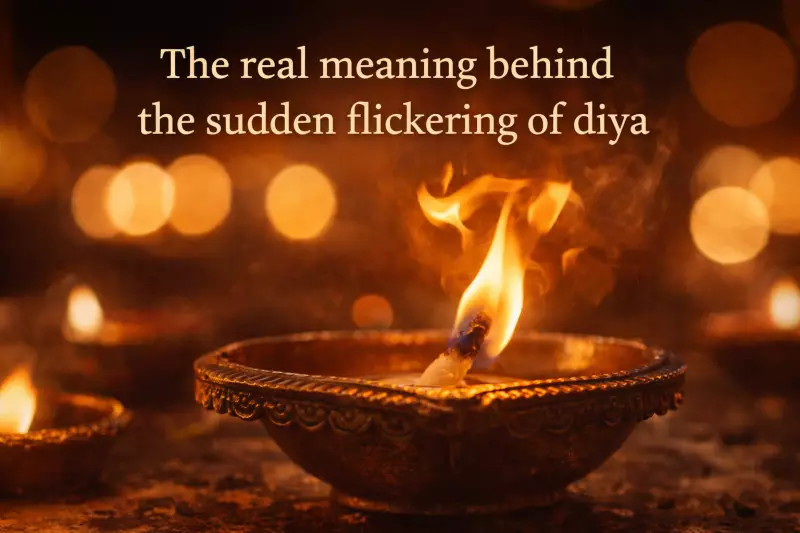
In countless Indian households, a diya's flame is more than just a source of light. Its gentle, steady glow represents presence, intention, and a silent prayer. So, when that flame unexpectedly flickers, bends, or trembles, it rarely goes unnoticed. The moment feels observed, pulling attention away from the mundane and into a space of quiet reflection. What shifts in that instant—the environment, or something within ourselves?
The Science Behind the Flickering Flame
Before delving into symbolism, the mechanics of a flickering diya are rooted firmly in science. The flame is an immediate and sensitive responder to its physical environment. Subtle air currents from a fan changing speed, a distant door opening, or even a shift in atmospheric pressure can cause it to dance. The quality of the oil, the length and composition of the wick, and the room's temperature all play crucial roles in the flame's stability.
Science expertly explains how the flame moves. However, it does not address why our minds latch onto these movements at specific, often poignant, moments and ignore them at others. This distinction between mechanism and perception is where the journey from observation to meaning begins.

When the Flicker Feels Timed: Spiritual and Traditional Interpretations
People seldom question a diya that flickers constantly in a drafty room. The inquiry arises when the wavering happens during deep prayer, moments of grief, silent meditation, or heartfelt conversation. Here, context is everything. In spiritual practice, inner stillness heightens awareness, making the smallest external movement feel significant.
Across diverse Indian traditions, common interpretive themes emerge. A lively, consistent flicker is often seen as active energy—a sign of movement and presence. A flame that suddenly grows taller and brighter during prayer is frequently interpreted as a reflection of one's focused intention or devotion.
Conversely, erratic, jumpy flickering in a seemingly still room is sometimes associated with unsettled energy. In such cases, elders might advise pausing, taking a calming breath, or gently relighting the diya. These interpretations are not designed to instill fear but to serve as reminders to return to a state of inner steadiness.
The Diya as a Mirror: Reflection Over External Message
One of the most profound spiritual insights is understanding that not every symbolic feeling is a sign from the outside world. Often, it is a reflection from within. An anxious mind may seek reassurance in the flame's behavior; a heavy heart might look for a sign of companionship. The diya becomes a mirror, reflecting the observer's inner state more than delivering an independent message. This explains why two individuals witnessing the same flicker can have entirely different emotional responses.
In many families, a flickering diya during remembrance rituals is softly linked to ancestral presence. It acts as a point of continuity, connecting generations. This belief endures not through proof but through the comfort it offers, a gentle acknowledgement without the need for absolute certainty.
The practice risks turning into superstition when observation morphs into anxiety—when every flicker is seen as an omen or warning. Traditional wisdom cautions against this. The core emphasis is always on bhav (sincere intention) rather than fixating on external signs. The diya's purpose is to center the mind, not unsettle it.
At its deepest level, the diya teaches the nature of impermanence and resilience. No flame is eternally static. True stability lies not in absolute stillness, but in the constant return to balance after each movement. The flickering flame reminds us that even devotion may waver and focus may shift, yet the light of awareness continues to burn. It asks not to be decoded with fear, but to be witnessed with calm, attentive presence. And often, that mindful witnessing is meaning enough.