In a nation where jewellery transcends mere ornamentation to become sacred offering and cultural identity, a significant gap exists in the documented social and design history of these adornments. Most existing literature focuses on royal opulence or specific regional styles, leaving the vast heritage of India's tribal and pastoral communities largely unexplored. A new publication seeks to rectify this oversight.
A New Chapter in Jewellery Documentation
Silver & Gold: Visions of Arcadia, published by Mapin Publishing, is a seminal work by renowned jewellery historian Usha R. Balakrishnan, created in association with the Amrapali Museum. This coffee-table book diverges from traditional narratives by delving into the archives of Rajiv Arora and Rajesh Ajmera, the founders of the Jaipur-based jewellery house Amrapali, established in 1978. It presents a captivating view of jewels from across India's diverse communities.
The journey began with a poignant incident in May 1980, when a barefoot couple walked into Amrapali's Jaipur office and sold a bag filled with traditional hair ornaments, earrings, necklaces, and toe rings. This encounter ignited a four-decade-long passion project for the founders, leading them to travel globally to collect ancient and traditional pieces. The book features approximately 200 items from a collection of over 1,000 pieces, with origins dating from the 1st century to the 20th century.

Unbroken Threads of Design and Symbolism
One of the book's central revelations is the near-unbroken tradition of jewellery design in India. An early photograph of an ivory plaque from Begram, Afghanistan, depicts carved, bejewelled figures believed to be from India. Strikingly, the beaded necklaces and disc-like earrings shown are familiar elements in today's jewellery vocabulary, found from mall stores to bustling markets like Delhi's Janpath and Mumbai's Colaba.
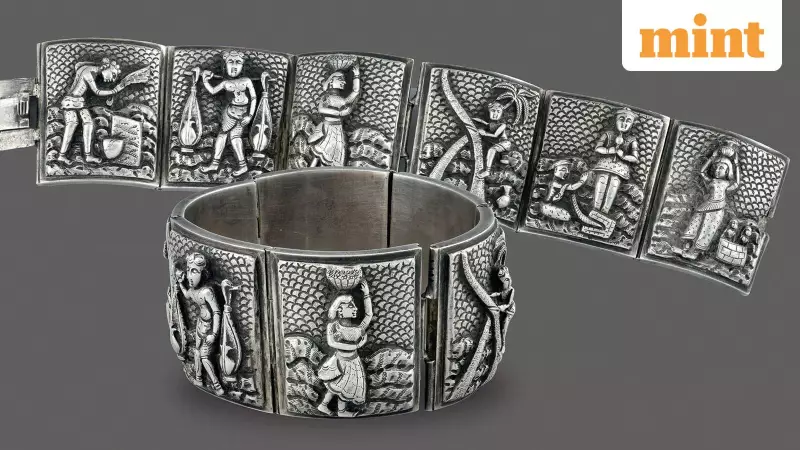
This continuity is further evidenced by comparing 19th-century enamelled silver earrings from Chamba, Himachal Pradesh, with those adorning a 9th-century sandstone sculpture of Rahu in Mathura, Uttar Pradesh. The resemblance is uncanny. Each piece in the collection, whether it's Assam's curvaceous nothengpi (ear plug) or a silver bracelet depicting 19th-century Tamil Nadu professions, underscores that jewellery was never solely about wealth.
These adornments served as visual representations of deep-seated beliefs. Cowrie shells symbolized fertility, while amulets featuring the sun, moon, and cobra offered protection from the evil eye. The book highlights the ayigalu or Shivadhara Lingam casket of Karnataka's Lingayat community. This pendant, designed as an egg-shaped casket holding a tiny lingam, is given to a child in an initiation ceremony, transforming the jewel into a sacred object of art.
A Race Against Time to Preserve Heritage
Balakrishnan, who spent five years travelling through villages to understand folk jewellery's significance, notes the incredible variety in design and material. Communities experimented with beads, ivory, glass, betel nuts, wood, and silver, often scaling designs innovatively due to the unaffordability of gems. She points to a historical exchange of ideas, evident in the commonality of amulet and bangle forms between India, Oman, and Ethiopia from the 15th-16th centuries.
Tragically, many of these craft forms are now endangered or extinct. The book notes that much has been lost, with oral transmission halting as communities adjust to modern life. Silver & Gold serves as a crucial record of this vanishing material history. While the book is visually stunning, it acknowledges a limitation: the lack of detailed documentation for each piece, a direct consequence of the historical oversight it aims to address.
From a nose ring declaring marital status to a chandelier-like chain for a horse or a necklace functioning as a portable shrine, these objects are not mere relics. They are vibrant chapters in India's cultural story, familiarizing us with traditions that are disappearing at an alarming rate. This book is a vital step in ensuring they are not forgotten.