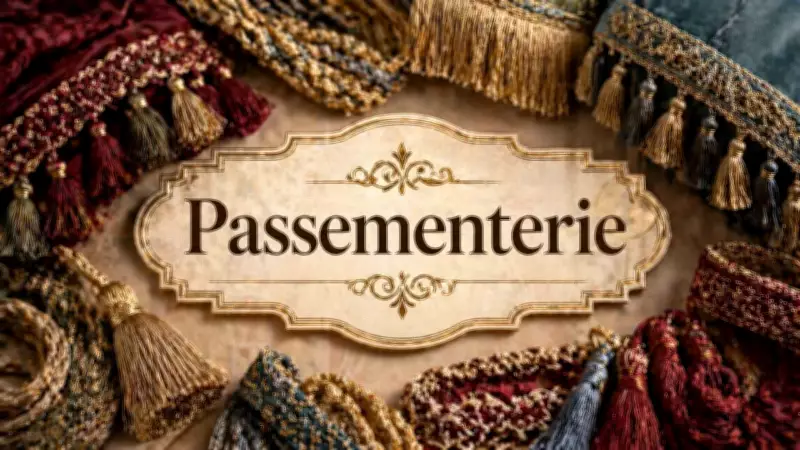
Many times, we overlook the small details in dressing that give both overall feel and character to a design. Examples include trims on curtains, tassels on pillows, and braiding. These little details are known as passementerie.
What Does Passementerie Mean?
Passementerie refers to decorative trimmings such as tassels, braids, fringes, and cords used in clothing, upholstery, and interior design. Through this term, one can acknowledge the artistry involved in creating ornaments using thread, cords, and patterns that enhance design, whether in fashion or interiors.
Pronunciation of Passementerie
Pronounced: pass-men-TUH-ree. Phonetic spelling: /ˌpæs.mənˈtɛr.i/. The stress falls on the third syllable, “TER.”

Origin of the Word Passementerie
Passementerie is a French term meaning ornamentation. Its origin is from the word “passement,” meaning lace or braid, with a suffix indicating the art or craft upon which the work is based. Passementerie has been used since the 16th century in both textiles and decorative arts, describing the craftsmanship involved in making these trimmings for fashion and interior design.

How to Use Passementerie in a Sentence
- The curtains were enhanced with elegant passementerie along the edges.
- Her dress featured delicate passementerie that added a refined touch.
- The designer specialised in traditional passementerie techniques.
- The cushions were decorated with rich passementerie and tassels.
Synonyms of Passementerie
- Trim
- Fringe
- Braid
- Cord
Antonyms of Passementerie
- Plainness
- Simplicity
- Minimalism
- Bare