The Viral Claim: A Passport for a Pharaoh 3,000 Years After Death
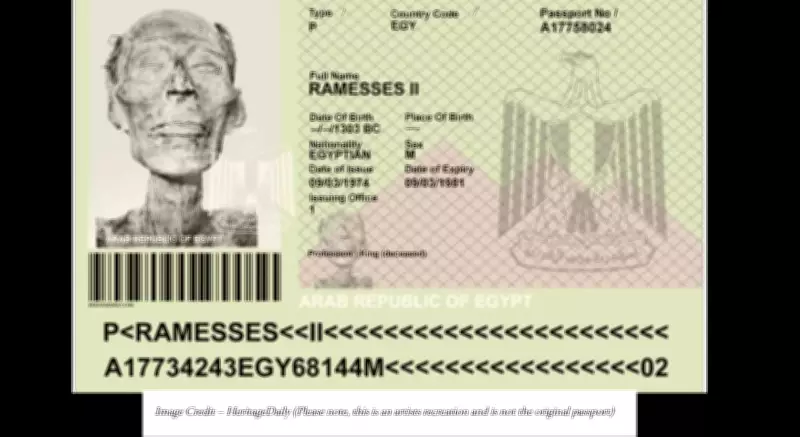
A widely circulated social media post has captured global attention by claiming to show the passport of Ramesses II, allegedly issued more than 3,000 years after his death to facilitate his mummy's flight to France in 1974. The story spread rapidly with a blend of fascination and disbelief, accompanied by an image purporting to be the passport itself.
The viral image presents a modern-looking Egyptian travel document featuring a portrait resembling the pharaoh's mummified face. Key details listed include his birth date as "1303 B.C.," an issue date of "Sept. 3, 1974," and most notably, his occupation recorded as "King (deceased)." The document's layout mimics standard passport formats with identification fields and formal typography, lending it an air of authenticity that has led many to accept it at face value.
The narrative accompanying the image states: "In 1974, Ramesses II was sent on a flight to Paris for preservation and maintenance work. But since French law required every person, living or dead to fly with a valid passport, Egypt was forced to issue a passport to the Pharaoh, 3,000 years after his death." This combination of bureaucratic absurdity and ancient history has proven irresistible to online audiences, though it cleverly blends fact with fiction.

The Historical Reality Behind the 1974 Journey
The core of the viral story contains genuine historical elements, but the full sequence of events is more nuanced than the simplified claim suggests. In 1974, the mummy of Ramesses II was indeed flown from Cairo to Paris following concerns about its deteriorating condition.
The chain of events began when French physician Maurice Bécaille was conducting research at the Cairo Museum, investigating the biblical exodus narrative and seeking to determine the cause of the pharaoh's death. After receiving permission to closely examine the mummy, Bécaille discovered that "under the bandages the remains were not in good shape, with parts destroyed by mysterious growths."
He proposed that French scientists could assist with preservation efforts, but Egyptian authorities initially resisted allowing such a historically significant figure to leave the country. The proposal only gained traction after reaching the highest political levels. French President Valéry Giscard d'Estaing raised the matter directly with Egyptian President Anwar el-Sadat during a state visit to Cairo in December 1973, formally offering France's assistance in restoring the mummy.
To comply with modern travel regulations, Egypt did issue Ramesses II an official passport as a bureaucratic necessity. As documented by sources including National Geographic, the actual document included his image and listed his occupation as "King (deceased)." This requirement has since become the most widely shared aspect of the historical episode.
The Image: Artistic Creation, Not Historical Document
While the passport itself genuinely existed, the image circulating across social media platforms does not depict the real document. A reverse image search reveals that the widely shared picture originated from an article published on the archaeology website Heritage Daily on March 25, 2020.
The site explicitly notes in a disclaimer that the image is "an artist's creation" and that the actual passport is not publicly available. The viral post therefore pairs a genuine historical anecdote with a fabricated visual, creating the misleading impression of documentary proof where none has been publicly released.
This distinction is crucial for understanding how historical facts can become distorted in the digital age. The artistic rendering, while visually compelling, represents creative interpretation rather than archival evidence.
Ramesses II: The Pharaoh Behind the Legend
Ramesses II, often called Ramesses the Great, ruled for 67 years during Egypt's 19th Dynasty (approximately 1279–1213 BCE) and is widely regarded as one of the most powerful and celebrated pharaohs of the New Kingdom period.
His military achievements include claiming a decisive victory over the Hittites at the Battle of Kadesh, though modern historians now consider it more of a stalemate that ultimately led to the world's earliest known peace treaty in 1258 BCE.

Ramesses II's legacy extends far beyond warfare:
- He maintained over 200 wives and concubines and fathered dozens of children
- He commissioned monuments across Egypt on an unprecedented scale
- Later generations referred to him as the "Great Ancestor"
- His body was originally buried in the Valley of the Kings before being moved by priests to protect it from looters
- It was rediscovered in 1881 in a royal cache at Deir el-Bahri alongside dozens of other mummies
- Today, his remains are displayed at the Egyptian Museum in Cairo
The pharaoh is also frequently linked, though without conclusive evidence, to the ruler described in the biblical Book of Exodus, which mentions "the children of Israel journeyed from Ramses" in its account of the Israelites' departure from Egypt. This connection has contributed to his enduring fascination across cultures and centuries.
The viral passport story, while partially factual in its bureaucratic details, ultimately demonstrates how historical narratives can be reshaped through digital sharing. The genuine requirement for travel documentation for the mummy's 1974 journey has been amplified by artistic license, creating a compelling but incomplete picture of this unusual chapter in archaeological preservation.