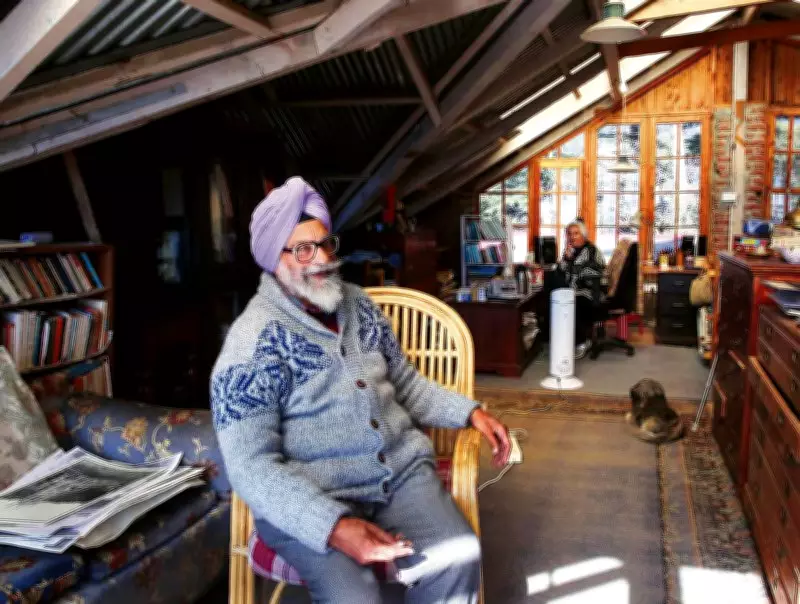
Birinder Malhans, affectionately known as Billy, was a true son of Himachal Pradesh despite being born to Punjabi parents in Amritsar in 1938. He studied at The Lawrence School in Sanawar. His father, Major General Joginder Singh, served as Chief of Staff of the Western Command in Shimla after a distinguished army career.
Billy was a fiercely individualistic and creative soul. He attempted conventional careers such as tea gardening in Assam, farming in Uttar Pradesh, cultivating land near the Nepal border, and managing an apple orchard in Himachal. However, his true passion lay in artistry and researching the temples and traditions of Himachal Pradesh.
Initially working with watercolours, he later developed a keen eye for detail and specialized in ink drawings of iconic architecture, from the Taj Mahal in Agra to Mandu Fort in Madhya Pradesh. Despite his talent, he remained humble, often gifting his unique artworks to appreciative family members rather than exhibiting them.

State governments commissioned him to immortalize tourist attractions, offering fresh perspectives on world-famous monuments. He once remarked, 'Everyone sees the basic structure; I try to focus on the detailing that is missed, or an angle that is not visible.' His coloured map of Shimla, commissioned in 1997 by the Himachal Ministry of Tourism, highlighted major attractions and residences of prominent Shimla personalities and once adorned many bureaucratic offices.
A Deep Fascination with the Taj Mahal
The Taj Mahal held a special allure for Billy, possibly inspired by his favourite musical piece, 'A Night at the Taj' by Ustad Vilayat Khan and Ustad Imrat Khan. His admiration for the former led him to offer his cottage in Chhota Shimla to the maestro in the mid-1960s while he considered making Shimla his home. Eventually, Ustad Vilayat Khan stayed at Parimahal, the former palace of the Jubbal royal family, for a few years. An unpublished work by Billy featuring etchings of the Taj Mahal stands as a testament to his research.
Extensive Research and Conservation Efforts
Billy travelled extensively across Himachal to document temple architecture and customs, amassing a vast body of research that remains largely unpublished except for a few articles. As the state convener for INTACH for decades, he was a highly respected figure, leading numerous restoration and conservation projects. He also served on the Himachal Pradesh government's heritage preservation and tourism committees.
Dr. Purnima Chauhan, former Secretary of Culture, recalled, 'He once told me that Chhatru, en route from Rohtang Pass to Chandratal Lake, was a starting point on the ancient Silk Route. I toured the area and we planned to present it to tourists. Billy scripted a concept note to get approval and funding.'
His elder daughter, Panita Virmani, shared plans to publish his research soon. 'He also wanted us to make his research available to students; we are planning to establish a space in his home in Chhota Shimla for this purpose.'
A Life of Simplicity and Connection
Billy was direct and without pretence, possessing an innate ability to connect with people from all walks of life. Old Shimla residents remember his daily stride to the Mall, walking over 4 km from his picturesque cottage. He was extremely sociable, and the open house parties he and his wife Sanjiv hosted in the 1970s and 1980s were legendary.
His death leaves a void in many lives. He was a true Shimla-ite, embodying the spirit of the hills. Respecting ecological constraints, he chose to live without a car, leading a simple yet fulfilling life, giving back to Shimla far more than he took. As Purnima Chauhan aptly said, 'He drew inspiration from the space he lived in.'