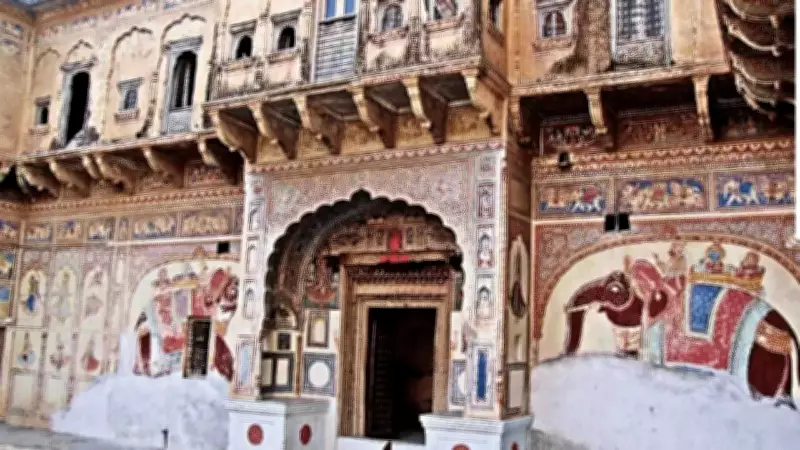
In the northeastern corner of Rajasthan lies Shekhawati, a region often eclipsed by Jaipur’s palaces, Jodhpur’s forts and Udaipur’s lakes. Yet, its dusty towns contain one of India’s most remarkable architectural landscapes.
The World's Largest Open-Air Art Gallery
Known as the “world’s largest open-air art gallery”, Shekhawati’s fresco-painted havelis were built by adventurous, wealthy Marwari merchant families. The Birlas, Poddars, Dalmias, Piramals, Rungtas, Khaitans all trace their roots here. Their homes were almost like public declarations of wealth, taste, piety, and modernity, rendered in lime plaster and pigment for the streets to see.
Silk Route To Raj Riches
Shekhawati’s fortunes were once tied to the Silk Route. Caravans laden with silk and spices passed through its desert towns, drawn by lower transit duties compared to Jaipur and Bikaner. For some time, this made Shekhawati a prosperous trade corridor. When neighbouring territories reduced levies at the behest of the British administration, traffic shifted, the local economy weakened, and the merchants were forced to look outward. By the mid-19th century, these families had spread across India, especially Kolkata, thriving as bankers, traders and industrialists under the expanding British economy.

Aman Nath, who ‘discovered’ Shekhawati in the 1970s and restored unlisted buildings, while bringing global tourism spotlight to the region, says, “The Marwaris’ rise in Calcutta was the result of strategic adaptation. They shifted from caravan trade in Shekhawati to commodity financiers and brokers in colonial Calcutta, thriving on Britain’s demand for raw materials and the distribution of factory-made goods deep into the hinterland. By the late 19th century, they had accumulated immense wealth, even as Shekhawati itself declined.”
Havelis as Canvases
Where Rajput rulers built forts to project power, the Marwaris of Shekhawati expressed their wealth through havelis, lavish mansions adorned with frescoes. Between 1860 and 1900, hundreds of these grand homes were constructed and painted, converging themes from myth, commerce and colonial modern life. Behind this explosion of art were the Chiteras, hereditary artisans drawn from Hindu Kumhars and Muslim communities.
“Fresco painting in India dates to the Ajanta Caves, around 1,400 years ago. Later, during Akbar’s reign, Italian missionaries contributed to palace interiors,” says Nath. He points out how, in the 16th century, Persian craftsmen introduced arayish, a lime-plaster technique polished with agate to create a marble-like finish. “In Shekhawati, wealthy traders funded elaborate frescoes on haveli facades and interiors, making such large-scale artistry possible,” adds Nath.
Forts featured limited frescoes in pleasure rooms and temples, often depicting presiding deities. Many paintings, though executed in fresco buono (on wet plaster, making them durable), have faded over time. On the other hand, the mansions of the Seths or the merchants, across nearly 150 villages in Shekhawati, became canvases. One can still see Krishna leela alongside British sahibs in motorcars, trains steaming across arid landscapes, gramophones, women with parasols — visual biographies of Shekhawati’s merchant elite, recording their rise from caravan traders to colonial intermediaries.
Grave Threat
Today, Shekhawati’s frescoes face a different threat; not time, but bulldozers. As ownership passed through generations, the upkeep of the mansions suffered. Many havelis crumbled, others were deliberately destroyed by land mafia with an eye on converting them into shops and workshops.

Nath says most havelis are now owned by large joint families with hundreds of stakeholders, making collective decisions nearly impossible. Disputes and ownership complexities prevent restoration, and buyouts are rarely feasible, leaving many structures in decay and disrepair. Mandawa, once the fulcrum of Shekhawati tourism, has seen iconic havelis, like the Radhakrishna Goenka and Ram Avtar Jhalan ki, razed. “These havelis are the backbone of Mandawa’s tourism economy. If they vanish, so will the visitors,” says Angad Mandawa of Castle Mandawa. In a town where tourism is tethered to its painted walls, every demolition is not just a cultural loss but an economic one, too, rippling through guides, hotels, drivers, craftspeople and shopkeepers.
Some families, like the Chokhanys, are rooted to their family heritage. The Chokhani Double Haveli, built 200 years ago, has been a pivot for foreign tourists. It is now recognised by Rajasthan Tourism as a must-see sight. Arun Kumar Chokhani, a fourth-generation descendant of Seth Daulataram ji, explains why many others fell into disuse. “Successive generations remained busy with their businesses and ownership became scattered. That’s how their interest in the havelis waned,” he said. The result is a sad story of locked courtyards, collapsing roofs, and flaking murals.
Uncertain Road Ahead
After intense lobbying by the heritage hotel industry, the Bhajan Lal Sharma-led BJP government in Rajasthan has recently identified 615 havelis across Shekhawati as heritage assets. District collectors and local officials have been instructed to block property transfers, while a Rs 200 crore restoration fund has been announced in this year’s state budget for conservation of these havelis.
Unlike forts carved from stone or palaces clad in marble, these painted walls are fragile canvases, susceptible to fading, peeling and human interference. Restoration is not simply construction work; it is conservation that requires stabilising plaster, matching pigments, preventing moisture, documenting what remains before it disappears.
Nath says, “Preservation will require more than money. Urgent documentation, careful restoration and sustainable tourism models are key to incentivising local communities to protect rather than sell off their heritage. Without a living economic reason to keep havelis standing, the pressure would be compelling to monetise land through demolition.”
Ilay Cooper, who surveyed and photographed these havelis for decades, captures the predicament in his book, ‘The Painted Havelis of Shekhawati’: “Some young Marwaris in Calcutta or in Delhi have never been to the homeland. Some are uncertain of their town of origin. The family still holds a property there, but it is of little value. The share in a crumbling painted haveli has, with each generation, become smaller. The joint owners never agree what should be done with it.”