The Last Echo of Hooves in Srinagar's Modern Streets
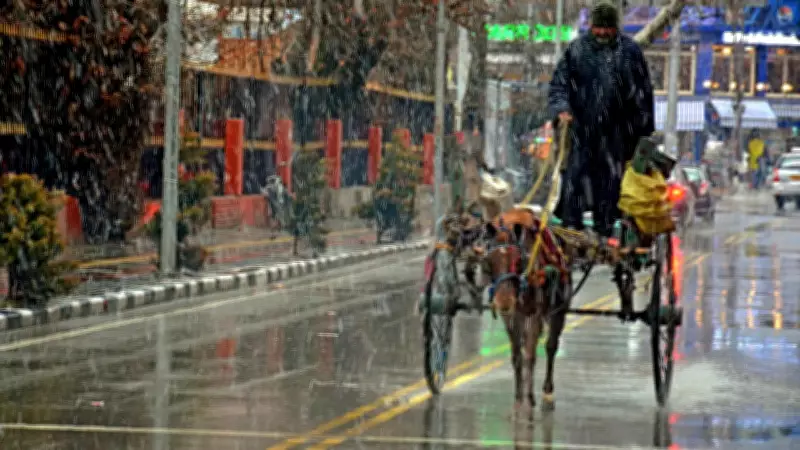
In the heart of Srinagar's bustling old city, where the cacophony of honking cars and revving engines dominates, a solitary sound cuts through the noise: the steady clip-clop of horse hooves on asphalt. This is the world of Ghulam Rasool Kumar, a 70-year-old tonga driver who has become a living bridge between Kashmir's past and its hurried present.
A License From Another Era
Kumar holds a fragile paper license dated 1968, issued when he was just 12 years old during the administration of late Chief Minister Ghulam Mohammad Sadiq. "I had a licence from 1968. I was 12," he recalls, clutching this artifact from what he calls "Sadiq sahab's time." After driving his horse cart for nearly two decades, Kumar abandoned the trade in 1986 when it ceased to be financially viable, joining the many who left behind Srinagar's equestrian heritage.
The Unexpected Comeback and Sudden Fame
Last year, Kumar made a surprising return to Srinagar's roads, piecing together his trade with a fine black horse from Sopore in north Kashmir and a brightly canopied cart from Anantnag in the south. Almost overnight, he transformed from a forgotten figure into a local curiosity. Tourists eagerly climbed aboard his carriage, social media influencers filmed reels with his tonga as a backdrop, and photojournalists trailed him through the narrow lanes of the old city.

Even former Chief Minister Omar Abdullah took notice, posting about Kumar on social media platform X. For many younger riders, Kumar's service represents more than mere transportation—it's "memory on wheels," a tangible connection to a Kashmir that existed before smartphones and traffic jams.
Personal Tragedy and Historical Memory
Kumar's journey is punctuated by profound personal loss. As he guides his horse along the Bohri Kadal-Sekidafar stretch, he points out, "This road was not a road, it was a stream called Nallah Mar." Near the Nawa Kadal bridge, his words slow to a halt, overcome by silence. "My two sons drowned in this river," he reveals quietly. "The river has taken both my sons."
Yet he continues, his voice steadying as he contrasts past and present: "There were vehicles then, but not like today. Few people owned cars." His memories extend to a time when tongas lined stands across Srinagar, when the tourist reception center bustled with horse carts, and when ministers considered such rides a "luxury."
The April Setback and Resilient Return
Kumar's revival faced a severe challenge following the Pahalgam terrorist attack in April, which caused tourists to vanish and his earnings to dry up completely. He was forced to stop operating once again. But earlier this month, demonstrating remarkable resilience, Kumar returned to Srinagar's streets, refusing to let his trade "die quietly."
He operates on a unique principle, charging no fixed fare and telling riders simply, "Pay what you wish." This generosity reflects both his connection to tradition and his understanding of the tonga's changed role in contemporary Kashmir.
Navigating Modern Traffic With Ancient Technology
Tall and lean behind black spectacles that make him appear younger than his years, Kumar navigates Srinagar's traffic with careful deliberation. He acknowledges the practical limitations of his vehicle with a straightforward warning: "No brakes." Yet he finds that drivers show unexpected patience, softening their honks as they encounter his anachronistic carriage.
"People should be considerate," he requests, and remarkably, in a city known for its traffic tensions, they are. The spectacle of a tonga in modern Srinagar prompts curiosity rather than irritation, creating brief moments where the city's frantic pace slows to accommodate its own history.
The Last of His Kind
As bells jingle and hooves drum their slow, certain rhythm—a sound that once dominated Srinagar's roads from the 1930s through the 1960s—people call out to Kumar as "Last of the Tongas." In a city that has largely moved on from its equestrian past, he represents a stubborn persistence of memory.
Though modern traffic quickly swallows the echo of his passing, for those few fleeting minutes when his tonga rolls through Srinagar's streets, the city pauses to listen to its own history moving steadily forward, one hoofbeat at a time.