The Enigmatic Silence of Valluvar's Wife: Vasuki in Tamil Cultural Memory
In the rich tapestry of Tamil literary and philosophical heritage, the Thirukkural stands as a monumental work. Authored by the revered poet and philosopher Thiruvalluvar, this classic text comprises 1,330 concise couplets, each containing seven words, organized into three foundational books addressing virtue, wealth, and love. Celebrated globally for its profound ethical and moral teachings, the Kural has left an indelible mark on scholars, leaders, and thinkers across diverse fields.
Vasuki: The Idealized Wife in a Void of History
Yet, amidst the extensive discourse on Thiruvalluvar's wisdom, a peculiar and compelling figure emerges: Vasuki, remembered as his wife. She occupies a unique and somewhat uneasy space in Tamil cultural memory—widely celebrated, quoted, and upheld as a paragon of devotion and virtue. However, the historical ground supporting her narrative is notably thin, raising intriguing questions about her legacy.
Intriguingly, the Thirukkural itself maintains a complete silence on Valluvar's personal life, offering no mention of a wife, household, or familial ties. It is into this void that later generations appear to have inserted Vasuki, transforming her from a mere companion into an idealized symbol of obedience and virtue. Medieval and post-medieval commentaries, regional biographies, oral traditions, and folk narratives collectively mention Valluvar's wife Vasuki, weaving a tapestry of stories that define her character.

Legends and Narratives: Crafting the Perfect Wife
According to these later accounts, Vasuki, also known as Nagi, was the daughter of Margaseyan, a farmer near Kaviripakkam, and his wife Ambujam. Legend has it that Margaseyan offered his daughter in marriage to Valluvar after the poet miraculously cured his diseased crops. In a testament to her purported virtues, Vasuki is said to have turned a handful of sand into rice when asked to cook it, showcasing her divine-like abilities.
The stories surrounding Vasuki are varied, yet they consistently portray her as gentle, devoted, and self-effacing. While legends suggest that Valluvar and Vasuki had no children—a point never explicitly stated—it is noteworthy that Valluvar writes poignantly about the joy of children in the Kural, even comparing the sweetness of a child's babble to musical instruments.
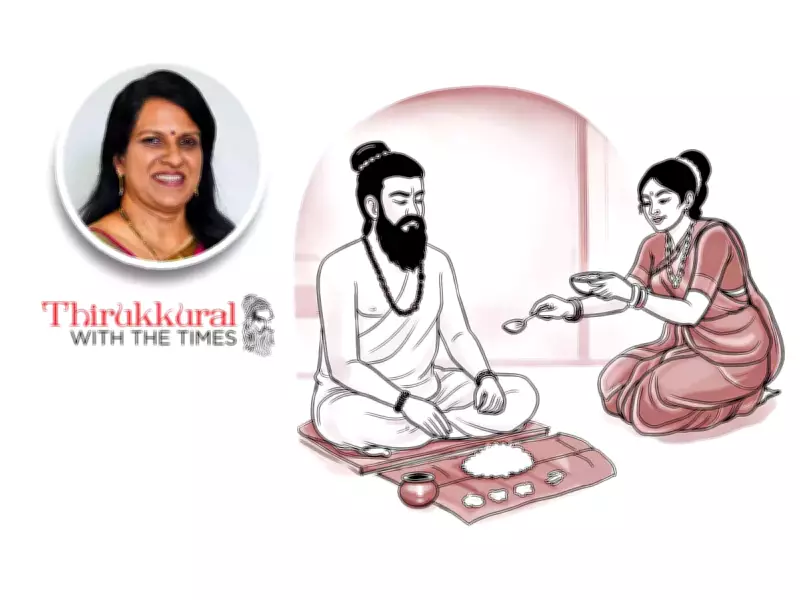
One particularly well-known anecdote illustrates her unwavering devotion: Valluvar instructed Vasuki to place a toothpick and a bowl of water beside his plate daily, though he never used them. Without question, she continued this practice. Only on her deathbed did he reveal that these items were meant to save any fallen grains of rice during serving. Relieved by this explanation, Vasuki is said to have passed away peacefully, her loyalty never faltering.
From Ethical Ideals to Domestic Expectations
These narratives may have roots in Valluvar's own conceptualization of an ideal wife, as outlined in the chapter titled 'Vaazhkkai Thunai Nalam'. Here, he describes a perfect wife as one who worships her husband and adheres to societal norms. In Kural 58, he poetically states: "Women of noble virtue bring great honour to those who cherish them; they create a world where divine grace resides." Over time, retellings have stretched this idea, transforming virtue into silence and devotion into a form of erasure.
Another familiar episode sharpens this imbalance: when Valluvar called out to Vasuki while she was drawing water from a well, she rushed to him, leaving the pail suspended mid-air until her return. This lyrical, almost divine image underscores an assumption made sacred—that a wife's immediate response is not only expected but exalted.
It is crucial to emphasize that none of these demands are recorded as Valluvar's own instructions. Instead, over centuries, society appears to have projected its expectations onto his moral authority, turning ethical ideals into rigid domestic rules. This raises profound questions about the intersection of culture, gender, and storytelling.

Questioning the Silence: What Did Vasuki Want?
The traditions surrounding Vasuki rarely pause to ask critical questions: What were her own desires? Did she ever voice her hopes? Was her silence a conscious choice, or was it imposed upon her? These narratives do not provide answers, perhaps because they were never intended to. Instead, they serve to reinforce idealized roles without exploring the individual behind the symbol.
In reflecting on Vasuki's legacy, it becomes evident that she deserves to be remembered not merely as a flawless symbol, but as a mirror—reflecting how devotion is praised, how silence is sanctified, and how easily imagery can slip into erasure when stories are told without considering who is allowed to speak. Her story invites a deeper examination of cultural memory and the ways in which women's voices are shaped, or silenced, in historical narratives.
As we delve into the lessons of the Thirukkural with figures like motivational speaker and diversity champion Bharathi Bhaskar exploring its depths, the enigma of Vasuki reminds us of the complexities inherent in interpreting ancient texts. Her silence echoes through time, challenging us to look beyond idealized portrayals and engage with the nuanced realities of history and culture.