The Viral Optical Illusion That's Baffling the Internet
Optical illusions possess a cunning ability to deceive the human brain, creating moments of certainty followed by doubt in one's own vision. This captivating quality fuels their addictive spread across online platforms. Among these, a particular viral puzzle has emerged, putting people's perceptual skills to the ultimate test.
Deceptively Simple Yet Incredibly Tricky
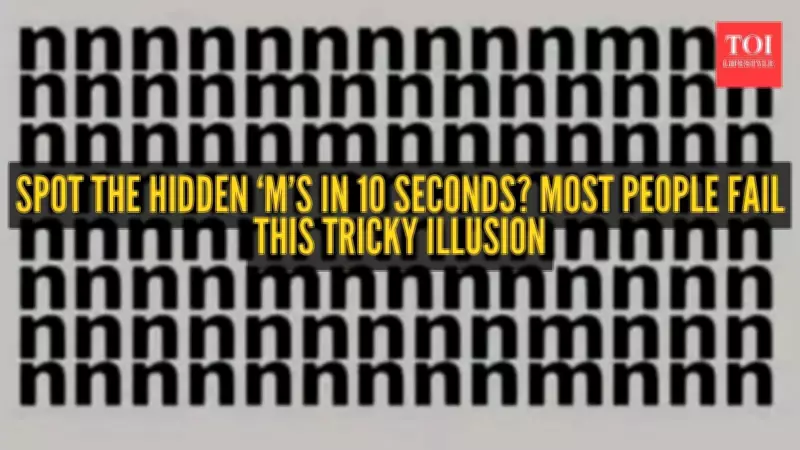
At first glance, this puzzle appears straightforward: rows and rows of the letter 'n' arranged in a grid. However, hidden within this sea of 'n's are a few 'm's seamlessly blending in, making them exceptionally difficult to spot. The challenge is clear: count how many 'm's you can find. But there's a twist—you have only about 10 seconds to do so if you aim to prove yourself a pro at this visual game.
Most individuals struggle because 'm' and 'n' look nearly identical, especially when densely packed together. This similarity tricks the brain into autopilot mode, assuming uniformity across the letters. It is at this point that the illusion triumphs, highlighting how easily our minds can be misled by visual patterns.

Strategies for Success and the Great Debate
If you find yourself stuck, experts recommend slowing down and examining each letter's shape meticulously rather than scanning quickly. The difference between 'm' and 'n' is subtle but discernible upon closer inspection. Now, what is the correct answer? This is where opinions diverge significantly.
Many people assert there are 8 'm's within the grid itself. Others contend it is 10, as they include the 'm's present in the accompanying question text. Both interpretations hold merit: if counting only the grid, the answer is 8; if considering all visible text, it rises to 10. This clever ambiguity adds an extra layer of intrigue to the puzzle.
Beyond Entertainment: Cognitive Benefits
Such puzzles are not merely idle pastimes; they actively enhance cognitive functions. By pushing focus, attention to detail, and the speed of visual pattern processing, they serve as effective mental exercises. Engaging with these challenges can sharpen perceptual abilities and improve problem-solving skills over time.
So, did you manage to spot all the hidden 'm's correctly, or did this illusion outsmart you as well? Share it with friends to see who can identify them first—it is a test that not everyone will pass, making it a fun and competitive activity.