In the fast-paced, ever-evolving landscape of the English language, some words are tools for communication, while others are vessels for memory. Myrrh belongs firmly to the latter category. This is not a word for casual conversation or digital shorthand. It carries with it the slow, deliberate pace of ancient times, when names were given to things of profound significance, not mere convenience.
The Substance and Its Solemn Legacy
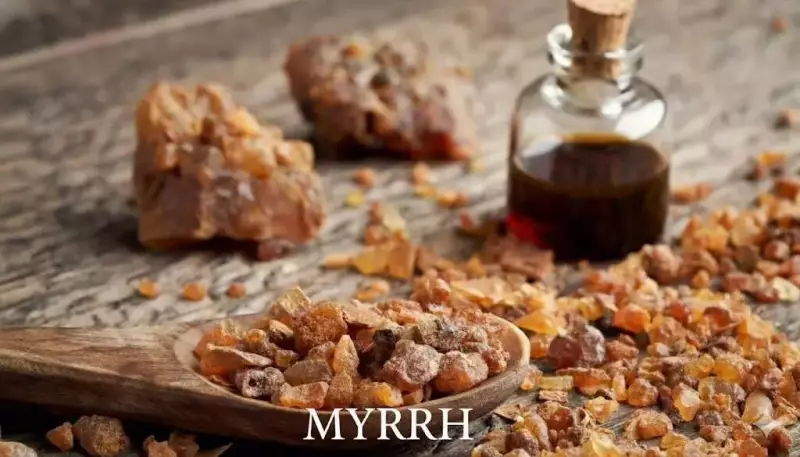
Myrrh is, at its origin, a natural resin. It is harvested from the sap of thorny trees belonging to the Commiphora family, which grow in the arid landscapes of East Africa and the Arabian Peninsula. The process is one of deliberate wounding: the tree is cut, the sap bleeds out, and it hardens upon contact with air into dark, brittle fragments. Its scent is distinctly bitter and medicinal, a far cry from pleasant florals.
From its earliest uses, myrrh was shrouded in gravity. It was never a substance for mere enjoyment. Ancient civilizations burned it as sacred incense, blended it into perfumes for ritual, and employed it in early medicinal and funerary practices. Its core associations were with preservation, purification, and preparation for what lies beyond. In modern English, myrrh has largely shed its physical utility, surviving almost entirely as a powerful symbolic word. It appears in religious texts, historical records, and literary works, serving as a metaphor for seriousness, finality, and the sobering truth that not all things which are fragrant are meant to comfort.

A Linguistic Journey Unsoftened by Time
The very name myrrh tells its own story. It traces its roots back to ancient Semitic languages, derived from a root that unequivocally means "bitter." This was not a metaphorical descriptor but a literal one, acknowledging the resin's sharp, unpleasant taste. The word travelled through history, entering Greek as myrrha, then Latin, and finally into English, remarkably unchanged in its essence.
In an age where language constantly adapts to become more user-friendly and streamlined, myrrh stands as a stubborn relic. It has resisted simplification, retaining its harsh phonetic edges, its challenging spelling, and its inherent resistance to ease. It is a word that has survived by refusing to change.
Cultural Weight and an Uncomfortable Gift
Myrrh mattered because generations believed it did. It was a commodity of high value, traded across continents on ancient spice routes, woven into the economies of Egypt, Greece, and beyond. Egyptians used it in their advanced embalming techniques. Greek scholars documented its purported healing properties.
Its most iconic moment, however, is etched in Christian tradition. Myrrh is named as one of the three gifts presented to the infant Jesus. While gold symbolized kingship and frankincense pointed to divinity, myrrh offered a profoundly different foreshadowing. It was traditionally associated with death and burial—a quiet, uncomfortable acknowledgment of mortality presented at the very dawn of a life story. This was a gift of deep, prophetic significance, not a celebratory one.
Today, myrrh is a cultural and linguistic residue. To speak the word is to invoke a time when language had tangible weight, intimately tied to scent, sacred ceremony, and collective belief. It reminds us that some words were coined not for frequent use but for eternal remembrance. Myrrh endures in our lexicon precisely because it still knows what it is: a bitter, beautiful anchor to a past where meaning was measured, slow, and deep.