The popular daily word puzzle, Wordle, recently chose 'white' as its word of the day, sparking unexpected and profound reflection. Far from being a simple, neutral descriptor of colour, the term 'white' now arrives laden with overt politics, deep cultural anxiety, and heavy historical residue. It has long outgrown its original job of describing snow or light and has instead become a powerful shorthand for identity, power, and grievance.
From Bright Light to Burdened Identity: The Etymology of 'White'
The linguistic roots of the word are, ironically, untroubled and clear. 'White' originates from the Old English 'hwīt,' which itself is derived from the Proto-Germanic 'hwītaz' and earlier Indo-European roots meaning "bright" or "shining." In its earliest uses, it was a purely sensory word, describing snow, bone, ash, and daylight. It told you what the eye could see, with no embedded ideology, hierarchy, or moral judgement. It was just about visibility and light.
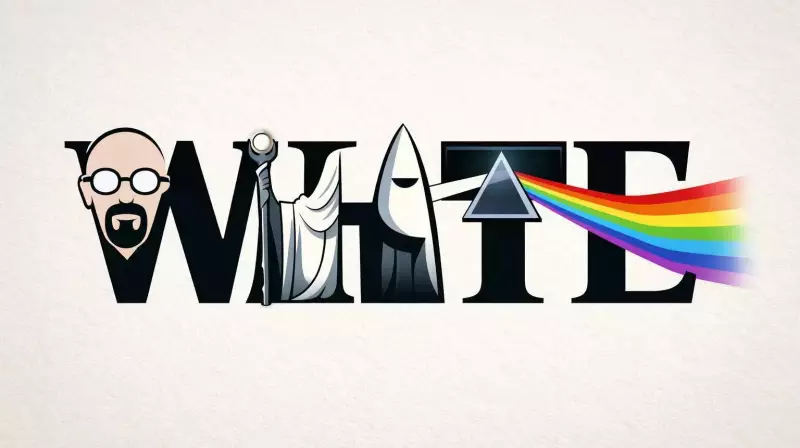
Scientifically, white holds a beautiful, inclusive truth. White light is the combination of all colours in the visible spectrum. When passed through a prism, it breaks obediently into the rainbow sequence of VIBGYOR (violet, indigo, blue, green, yellow, orange, red). In physics, white represents inclusion—everything arriving at once, with no single colour dominating. It is coexistence and revelation, not subtraction.

The Cultural Perversion: When a Descriptor Became a Diagnosis
Somewhere between religion, empire, and social structuring, this innocent descriptor began its fraught transformation. Brightness subtly slid into connotations of purity. Purity morphed into notions of goodness, and goodness quietly became associated with normality. In a dangerous leap, normality was positioned as superiority. White robes signified holiness, white space suggested order, and white pages promised renewal. The metaphors stacked up until the word was no longer observational but deeply aspirational and hierarchical.
By the time modern racial categories were formalised, 'white' had been cemented as the default, the standard against which all others were measured and often found wanting. It stopped merely describing people and began ranking them. What began as "everything together" in physics was weaponised in culture to insist on separation. This ideology, often manifesting as white supremacy, was never truly about colour. It was, and is, driven by anxiety about loss, dilution, and the fear of no longer being the unexamined centre of the story. A descriptor hardened into an identity, which then rigidified into a hierarchy.
Popular Culture's Prescient Warnings
Long before political discourse fully grasped the pathology, popular culture provided stark illustrations. In J.R.R. Tolkien's legendarium, Saruman the White falls not because he embraces darkness, but because he believes his clarity and authority entitle him to control. His whiteness represents a dangerous certainty. Similarly, in *Breaking Bad*, Walter White's descent is fuelled less by desperation and more by a profound sense of wounded entitlement—a man convinced his intelligence guarantees dominance, culminating in the threatening demand, "Say my name."
Even the visual grammar of the Ku Klux Klan repurposed the colour into a tool of terror, using white robes and hoods as both costume and camouflage, selling hatred under the guise of purity. These examples prove that once symbolism is weaponised, it carries immense power.
The confusion is now so entrenched that it strains modern language guides. The AP Stylebook capitalises 'Black' when referring to race, acknowledging shared history and identity, while keeping 'white' lowercase. This deliberate choice can produce oddly jarring sentences in news copy, revealing language's struggle to correct historical imbalances without pretending the past didn't happen.

In the end, the word 'white' did not fail us. We failed it. We loaded it with theology, hierarchy, grievance, and fear. We asked it to justify power, explain inequality, and soothe insecurities. No word can survive that immense workload unchanged. In physics, it still breaks cleanly into a spectrum of beautiful colours. In our cultural discourse, it arrives dense, politicised, and heavy. It began as a word meaning 'everything at once.' Somewhere along the way, we made it a problem.