In a striking glimpse into fashion's digital future, renowned designer Raghavendra Rathore begins his day by feeding an AI chatbot a personal monologue of over 50,000 words. This detailed input covers his life journey, the three-decade evolution of his eponymous fashion house, and the inspirations behind iconic creations like the Jodhpur bandhgala. Rathore envisions a time when his AI-trained avatar could conduct interviews with his exact voice and thought patterns. "It's thinking more like me today than it did yesterday," he observes, highlighting his four-year journey as a tech enthusiast experimenting with artificial intelligence.
Beyond the Sketchbook: AI as Archive, Partner, and Catalyst
For Rathore, AI serves multiple roles: a digital archive for motifs and suit silhouettes, a memory keeper tracking his past activities, and a creative "what-if" scenario generator. It acts as a "quiet design" partner that organizes scattered thoughts, refines choices, and suggests unexpected patterns. He cites a project where a client wanted his granddaughter's painting incorporated into a suit. Through AI collaboration, the team innovatively used the print as the garment's lining. "Used with intention, AI doesn't confine creativity. It stretches it," Rathore asserts, suggesting fashion will evolve by merging tradition with new intelligence.
This integration is accelerating globally. The year 2023 saw Marc Jacobs use a ChatGPT-generated note for a collection. By 2025, H&M featured digital model clones, Golden Goose launched an AI co-design service with Google, and Valentino used AI visuals in campaigns. In India and abroad, designers regularly post AI-model outfits on Instagram. Retailers like Zara employ app-based "stylist" bots to help shoppers. AI's role has shifted from mere prediction to actively steering fashion creation and commerce.

Indian Designers at the Forefront of the Tech Revolution
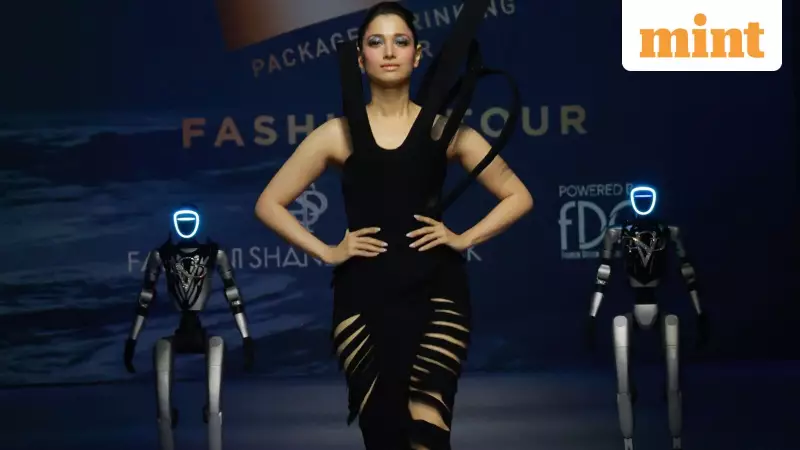
Designer duo Falguni and Shane Peacock explored this in their "Futureverse of Fashion" show in Gurugram on 16 November, featuring robot dogs and humanoids. Shane explains how AI slashes weeks of design iteration—sketching, 3D modeling, and fit adjustments—down to a single day. He also uses AI to check a sketch's uniqueness against 50 years of global fashion week archives.
However, application varies. While some leverage AI for creative processes, brands like Iro Iro and Genes Lecoanet Hemant use it for logistics and stock-keeping. Hemant Sagar notes AI's power for information and business analytics, questioning its need for a classic black sweater but acknowledging its speed in crunching numbers.
Education, Ethics, and the Sustainable Question
The National Institute of Fashion Technology (NIFT) has established VisioNxt Trend Forecasting Labs in Delhi and Chennai, funded by the Union textile ministry. These labs use AI to map consumption, predict trends, and evaluate fabrics. "AI is not an add-on; it is becoming a core competency," says Dean Noopur Anand. Globally, educators like Central Saint Martins' Matthew Needham see 70% of students using AI for essays, with design applications growing rapidly.
Yet, critical challenges loom. Over 100 billion clothing items are produced annually, with 65% discarded quickly. While AI optimizes production, experts like Orsola De Castro of Fashion Revolution doubt it inherently solves sustainability, noting existing systems are underutilized. Another major concern is design copying; a simple prompt could amalgamate motifs from Tarun Tahiliani, Anamika Khanna, or Sabyasachi. De Castro proposes an unremovable AI watermark for distinction.
Jaipur-based designer Bhaavya Goenka of Iro Iro uses ChatGPT for marketing copy but avoids it for design to preserve her brand's authentic, story-driven ethos. Rathore, when asked about AI-facilitated copying, reflects a broader philosophical stance: "I don't fear the machine. I fear human intention."
As AI permeates studios, classrooms, and shopping carts, the future of fashion hinges on how humanity chooses to wield this powerful tool—balancing unprecedented efficiency with irreplaceable human creativity and ethical responsibility.