

The Ultimate Fashion Industry Heist: How The Devil Wears Prada Forced Anna Wintour's Office Makeover
If you have ever watched the 2006 cult classic The Devil Wears Prada, you already know the drill. The withering glares, the casually tossed luxury coats, and that utterly devastating monologue about the exact origin of a cerulean blue sweater have become iconic moments in cinematic history. Starring Hollywood heavyweights like Meryl Streep, Anne Hathaway, and Stanley Tucci, the movie gave audiences a fictionalized, heavily scrutinized peek into the absolute pinnacle of the fashion industry.
Behind the Glossy Drama: A Set Design Too Perfect to Ignore
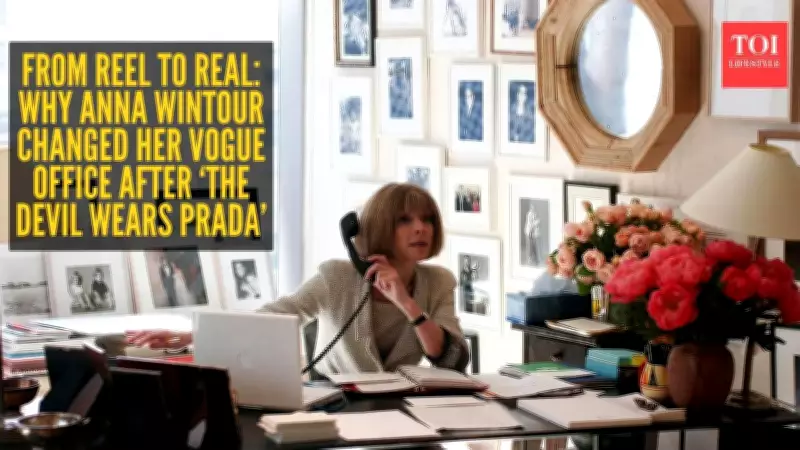
But behind the glossy, high-stakes cinematic drama lies a piece of behind-the-scenes fashion folklore that is almost too good to be true. It turns out, the production team nailed the aesthetic of the magazine's inner sanctum a little too perfectly. How perfectly? The movie's set design for Miranda Priestly's office was so eerily identical to the real-life workspace of Vogue editor-in-chief Anna Wintour that Wintour actually had her entire office completely redecorated immediately after the film was released.
The Great Vogue Sneak-In: A Mission of Memory and Precision
You would think a major motion picture would have a massive budget and a whole team dedicated to scouting locations. Not quite. Director David Frankel knew he had to make Miranda Priestly's office feel completely authentic, but he was working with surprisingly limited resources to capture that specific Vogue magic. Furthermore, getting official cooperation from the magazine was entirely off the table. So, they improvised in a way that would become legendary.

According to Frankel, the film's production designer, Jess Gonchor, actually sneaked into the real Vogue offices. He didn't use hidden cameras. He didn't even take photographs. It was an entirely surreptitious mission. Gonchor simply absorbed the layout, the lighting, and the commanding vibe of the room, and then went back to recreate it from memory. The resulting set was so terrifyingly accurate that Wintour apparently couldn't stand the idea of her private domain being broadcast to the masses. The moment the movie hit theaters, the real office got a massive facelift, a direct testament to the film's uncanny replication.
The Omertà of High Fashion: Breaking the Wall of Silence
Replicating the furniture was just one part of the battle. Capturing the actual behavior of the people who inhabited that world was a completely different nightmare. Screenwriter Aline Brosh McKenna faced an incredibly steep uphill battle when trying to find industry insiders to consult on the script. Simply put, nobody wanted to talk. McKenna admitted that she had enormous trouble finding a single person in the fashion world willing to speak with her. Why? Pure, unadulterated fear.
People were terrified of crossing Anna Wintour and Vogue. The threat of being permanently blackballed from the industry was very real, and nobody was willing to risk their career just to help out a Hollywood screenwriter. This culture of silence, often referred to as the omertà of high fashion, created significant obstacles for the film's authenticity.
"Make Them Meaner": The Insider Feedback That Shaped the Film
Eventually, the wall of silence broke. McKenna managed to find one solitary, unnamed source embedded within the industry who was willing to secretly read the draft and provide some feedback. Their main takeaway was brutally honest: The characters were entirely too nice. The anonymous insider pointed out a cold, hard truth about the upper echelons of the fashion world.
Nobody in that environment is nice, because they simply don't have to be. More importantly, they don't have the time to be nice. Armed with this critical piece of insider feedback, McKenna went back to the drawing board. She did another pass on the script, specifically tweaking the dialogue and interactions to make everyone just a little bit busier, a little bit colder, and significantly meaner.

It was a risky move, but one that clearly paid off. Even years after its release, The Devil Wears Prada isn't just remembered as a brilliant comedy. It stands as a terrifyingly accurate time capsule of fashion's most intimidating era - right down to the exact placement of the editor's desk, a detail that forced a real-world redesign and cemented the film's legacy in both cinema and fashion history.
