

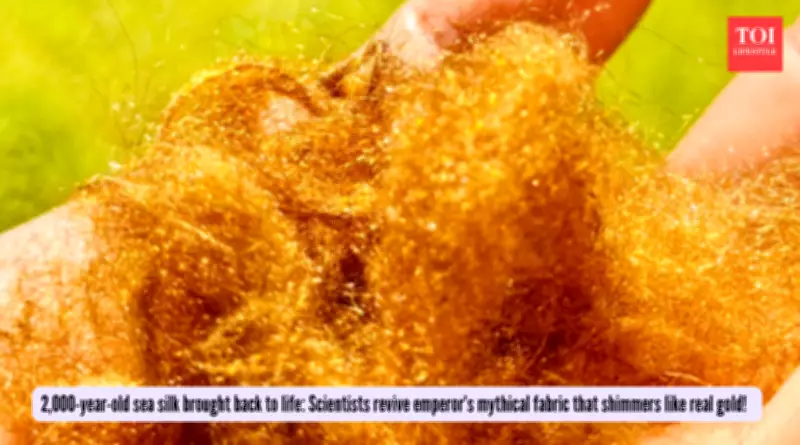
Scientists Revive Legendary 2,000-Year-Old Sea Silk Fabric
Imagine a textile so exquisite and rare that it was once reserved exclusively for emperors and popes. A fabric that requires no dye or paint yet possesses a natural, luminous golden shimmer, woven directly from the sea itself. For over two millennia, this mythical material, known as sea silk, gradually faded into the annals of history, its production halted as the Mediterranean shellfish that produced its precious fibers became endangered. Now, in a remarkable fusion of ancient craft and modern science, sea silk is making a stunning comeback.
The Golden Fiber of the Sea: What Is Sea Silk?
Often referred to as the golden fiber of the sea, sea silk is crafted from byssus threads. These are fine, incredibly strong filaments secreted by specific shellfish to anchor themselves to underwater rocks. Ancient Mediterranean communities once harvested these fibers, spinning them into ultra-luxurious garments that naturally glowed with a gold-like radiance.
No dyes, chemicals, or artificial enhancements were ever used. The shimmer originated entirely from the unique physical structure of the fibers themselves. Due to the rarity of the shellfish and the painstakingly slow production process, sea silk became a powerful symbol of status, privilege, and immense wealth throughout antiquity.

However, the primary species used for this craft, Pinna nobilis, suffered catastrophic population declines due to pollution, climate change, and overharvesting. Consequently, the European Union imposed a ban on its collection, effectively bringing the ancient tradition of sea silk weaving to a complete standstill.
The Scientific Breakthrough: Recreating History Sustainably
A dedicated team of researchers from South Korea embarked on a mission to resurrect this legendary fabric without endangering any species. Instead of targeting the protected Pinna nobilis, they turned to Atrina pectinata, a local pen shell clam species already farmed for food along Korea's coastline.
The byssus threads produced by this clam are remarkably similar to the ancient fibers. Scientists from POSTECH, led by Professor Dong Soo Hwang and Professor Jimin Choi from the Environmental Research Institute, meticulously collected these threads. After a careful cleaning process, they hand-twisted and spun the fibers into fabric. Laboratory tests confirmed that the newly created material closely matched the properties of historical sea silk samples.
Their groundbreaking findings have been published in the prestigious journal Advanced Materials under the title Structurally Coloured Sustainable Sea Silk from Atrina pectinata.
The Physics of the Golden Glow: Structural Color Explained
The secret behind sea silk's captivating golden shimmer lies not in chemistry, but in physics. The color is produced through a phenomenon known as structural color, the same natural optical effect observed in butterfly wings, peacock feathers, and soap bubbles.
Instead of relying on pigments, microscopic layered structures within the fiber bend and reflect light in specific ways, generating a permanent, iridescent golden hue. Researchers discovered that a special protein structure, referred to as photonin, forms tiny spherical layers inside the threads. These layers interact with light to create a glow that is inherently resistant to fading. This explains why preserved ancient sea silk garments can still appear radiant centuries after their creation.
Why This Revival Matters for Our Future
This scientific achievement holds profound implications for sustainable fashion and advanced material science. The byssus threads utilized in this experiment are typically discarded as waste by the seafood industry. Transforming this biological waste into high-value, luxurious textiles presents a dual opportunity: significantly reducing industrial waste while creating eco-friendly alternatives to conventionally dyed fabrics.

Structurally coloured textiles are naturally resistant to fading, explained Professor Dong Soo Hwang. Our technology enables color to endure indefinitely without the use of synthetic dyes or heavy metals. This opens exciting new doors for sustainable fashion and the development of advanced, environmentally conscious materials.
In an era grappling with the severe environmental impacts of textile pollution and fast fashion waste, the revival of this ancient, naturally brilliant fabric is more than a historical curiosity. It represents a promising step toward a more sustainable future—a future elegantly wrapped in the threads of history and powered by cutting-edge science.





