

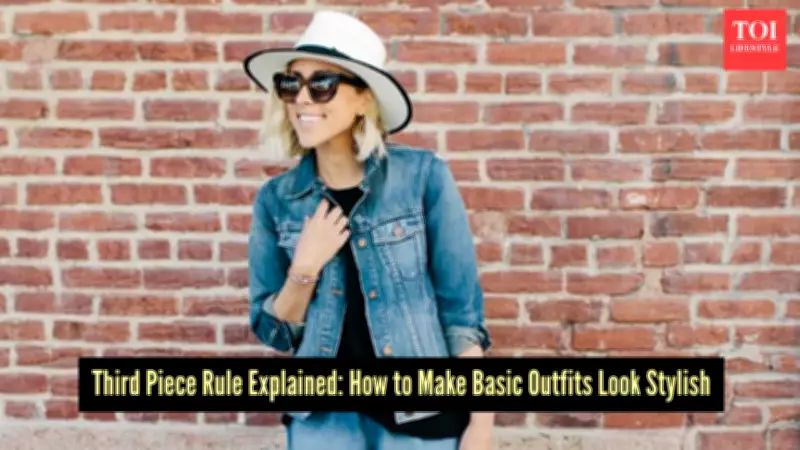
The Third Piece Rule: The Simple Fashion Secret to Elevate Your Outfit
Have you ever stood before a mirror, dressed in a nice t-shirt and your favorite jeans, yet felt your reflection was somehow underwhelming? Technically, you are clothed, but something feels flat. You observe a fashion influencer or a stylish colleague who exudes an effortless "vibe," even when wearing similar basics. The missing element isn't a larger budget or a designer wardrobe; it's often just a single, strategic addition. In the realms of editorial styling and retail psychology, this is known as the "Third Piece Rule." It's the industry secret that distinguishes those who merely wear clothes from those who masterfully style an outfit.
The Simple Math of Style
The concept is deceptively straightforward but revolutionizes how you construct a look. The rule asserts that every "finished" outfit requires three essential components. The first two are fundamental: your top and your bottom, which provide coverage and function.
- Piece 1: The foundation, such as a blouse, tank top, or sweater.
- Piece 2: The lower half, like trousers, a skirt, or denim.
Note: If you're wearing a dress or a jumpsuit, that single item counts as both Piece 1 and Piece 2 combined. The Third Piece is where the magic unfolds. This extra element—a layer, structural addition, or significant accessory—creates depth and transforms your ensemble. Without it, you're simply covered; with it, you're stylishly curated.

Wait, Do Shoes Count?
This is the most frequent query, and for fashion purists, the answer is a definitive no. Footwear is viewed as a biological necessity, whereas the Third Piece is an aesthetic choice that signals intentionality. For the rule to be effective, the third element typically needs to be worn on the body to frame the silhouette. We're referring to structural layers like a blazer, denim jacket, or trench coat. However, it doesn't always require heavy clothing. A substantial statement necklace, a silk neck scarf, or a corset belt also qualifies. The only caveat? Minimalist jewelry, such as tiny stud earrings or a thin chain, usually lacks sufficient visual weight to "count" as that transformative third element.
The Psychology of Effort
Why does this technique work so effectively? It boils down to visual mechanics. A simple top-and-bottom combination creates a flat, two-dimensional image. By adding a third piece—like draping a sweater over your shoulders in the Ralph Lauren aesthetic or incorporating a structured vest—you introduce texture, volume, and complexity. This effectively makes the outfit three-dimensional. Psychologically, it signals to observers that you didn't just grab the first two items you saw; it bridges the gap between loungewear and ready-to-wear, moving you from "utilitarian" to "curated."
Adapting to 2026: The Corpcore Influence
While this rule originated in retail training for brands like Banana Republic to promote add-on sales, it has evolved beautifully with contemporary trends. In 2026, where "Corpcore" dominates street style, the waistcoat or vest has emerged as the ultimate Third Piece. Worn open over a tee or buttoned up as a pseudo-top, it adds necessary structure without the suffocating heat of a full blazer—ideal for our warming climate. As "summer layering" becomes more challenging with rising temperatures, the rule has adapted. Heavy jackets of the past are being replaced by texture-based third pieces: linen scarves, crochet boleros, or even tech-wear harnesses. Ultimately, the Third Piece is the distinction between wearing clothing and wearing an outfit. Next time your look feels "boring," don't change your shirt; simply add one more thing.






