

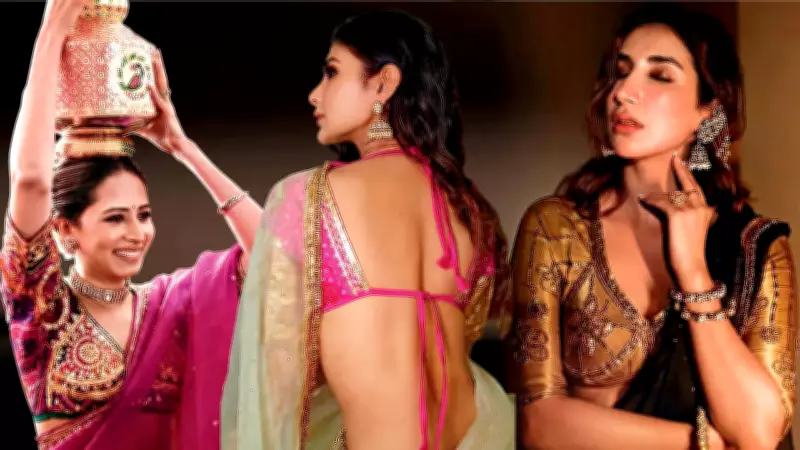
Once tucked away in the sandooks of the Shekhawati women of Rajasthan, the traditional aangi is finding a new generation of wearers. As younger consumers turn towards craft-led fashion, the aangi – a traditional fitted upper garment worn with the ghagra and odhni – is entering contemporary wardrobes without losing its regional identity.
Recently, at a Delhi concert, Rashmeet Kaur sported a bright pink aangi with cargo pants and a mirror belt, offering a modern take on the silhouette. Rashmeet Kaur swapped convention for cool, styling a vibrant aangi with cargo pants during a recent Delhi performance.
Carries Identity Through Its Silhouette and Craftsmanship
Usually crafted in cotton or textiles such as silk and mashru, the blouse is known for its snug silhouette, sculpted fit, back-tie construction, and gota and sequin work. “Beyond its functionality in Rajasthan’s hot climate, the aangi has long carried markers of community identity and occasion – from everyday wear among Shekhawati women to heirloom bridal pieces passed down through generations,” shares content creator Nishtha Gandhi, who notes that for many brides today, an aangi is a must-have in their trousseau.

“It’s great to see the aangi being recognised beyond its traditional roots,” says Kanchan Sangwan, co-founder of Aangiwali, adding, “It carries a very distinct identity. The revival has always been about retaining its authenticity while allowing it to evolve into a versatile, contemporary piece.” While the process and silhouette of the aangi remain traditional, the visual language adapts to feel more relevant today. It is being styled with more modern separates, making it relevant for a wider audience without losing its cultural essence.
It Was Never About Changing the Aangi, But for People to Appreciate It as It Is
Textile revivalist and designer Pankaj S Chadha, who recently showcased aangis in his heritage-inspired collection, traces the silhouette back to some of the earliest forms of the blouse, or kanchuli. “In its most authentic form, the aangi holds the magic of fitting the bosom like a glove,” he says. According to Pankaj, the original construction relied on fine handspun textiles that offered natural ease and elasticity. “Contemporary interpretations retain the original cut and embroidery finesse while introducing newer artworks and motifs inspired by traditional bootas. It is a step towards restoring its legacy,” he says.
Classic motifs such as phool, bel and jaal remain central to the craft vocabulary, while softer layouts, subtle colour shifts and fresh interpretations bring a contemporary touch, shares Kanchan. Adding, “We work closely with my mother, Indra, who has been associated with the craft since her childhood, to shape how modern women can relate to the aangi. For us, it was never about changing the aangi, but allowing people to appreciate it as it is.”
Style the Aangi Beyond Its Traditional Roots
The key is to keep the styling effortless and not overdo it, as the craftsmanship already stands out on its own.
- Style it as a statement top with denim, tailored pants or skirts, or layer it under oversized jackets for a more contemporary feel.
- Pair a cotton aangi with cargo pants, a Kutchi mirrorwork belt and boots for a more gender-fluid look.
- Style it with silver jewellery and vintage accessories instead of heavy sets.
- For eveningwear, opt for monochrome dressing with tonal skirts, dhotis, farshi salwars or shararas. Mix and match the blouse with handwoven separates in muted palettes to bring focus to the garment’s construction and detailing.
- For a wedding function, pair a brightly coloured silk aangi with an organza sari featuring a kiran border.
— inputs from Juhi Ali, celebrity stylist






