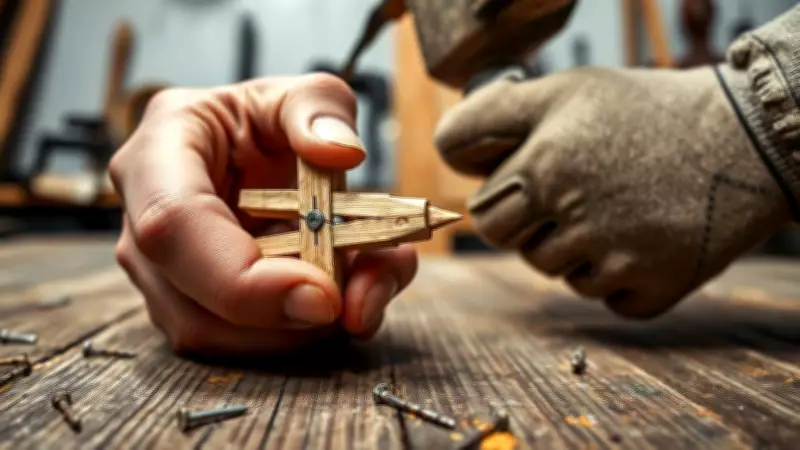
The Universal DIY Nightmare: When Hammer Meets Flesh
Every home improvement enthusiast knows this scenario all too well. You're perched on a ladder or crouched near baseboards, attempting to mount a heavy picture frame or secure shaky moulding. You carefully position a tiny nail between your fingers, take a steadying breath, and swing the hammer. Within moments, what should be a routine task turns disastrous.
The sickening thud of steel striking bone is a sound no DIYer wants to experience. While many accept bruised knuckles and smashed fingernails as inevitable hazards of home projects, a growing community of clever makers is discovering an unexpected solution hiding in plain sight: the humble clothespin.
The Real Medical Consequences of Hammering Accidents
What might seem like minor mishaps carry significant medical implications. Finger injuries represent the most common type of harm sustained during hammering activities. Medical literature documents cases like "Phalangeal Fracture Secondary to Hammering One's Finger," published in Cureus, which details how routine hammering can cause severe fractures and lacerations requiring professional treatment.

When holding a nail manually, your fingers occupy the direct line of impact. Even momentary lapses in concentration can transform a simple task into an emergency room visit. The physics behind these misses proves fascinatingly complex.
The Science Behind Hammering Inaccuracy
Research published in Frontiers in Computational Neuroscience, under the title "Hammering Does Not Fit Fitts' Law," examined the nature of our physical movements during repetitive hammering motions. Scientists discovered that accuracy depends critically on swing force and target distance.
Manual hammering requires balancing strength with pinpoint precision, leaving virtually no margin for error. Introducing a simple tool like a clothespin removes human vulnerability from this volatile equation, creating a safer working environment.
Why Clothespins Outperform Expensive Alternatives
This behavioral adaptation proves remarkably effective compared to costly equipment investments. While professionals might utilize pneumatic nail guns, these advanced tools carry their own dangers. A study in the American Journal of Industrial Medicine, "Serious Injury and Fatality Investigations Involving Pneumatic Nail Guns, 1985-2012," reveals that sophisticated technology still presents significant risks.
For most household projects, the clothespin method offers superior safety and efficiency. This cost-effective solution ensures more successful DIY endeavors while protecting your physical wellbeing.
Mastering the Clothespin Technique for Maximum Safety
Begin by selecting a sturdy wooden clothespin with a reliable spring mechanism. Insert your nail into the mouthpiece, holding it perpendicular to the clothespin body. This creates a stable base while keeping your hand several inches from the impact point.
Position the assembly against your work surface and deliver gentle initial taps until the nail stands independently. Once secured, remove the clothespin and continue hammering normally.
This approach proves particularly transformative when working with small finishing nails or in confined spaces where hands might obstruct visibility. It also preserves project finishes by eliminating "half moon" hammer marks and preventing surrounding paint damage.
Building Confidence Through Safer Practices
Adopting such straightforward safety methods boosts beginner confidence dramatically. When introducing tools to children or novice friends, starting with the clothespin nail holder eliminates primary safety concerns, transforming potentially intimidating tasks into enjoyable learning experiences.
The most effective DIY innovations often emerge from simple, sensible solutions requiring minimal investment. By repurposing household items, you can prevent unnecessary injuries while ensuring project success.
Next time you open your toolbox, remember to retrieve that forgotten clothespin. This unassuming accessory will safeguard your hands, making hammering activities more productive and considerably less painful.