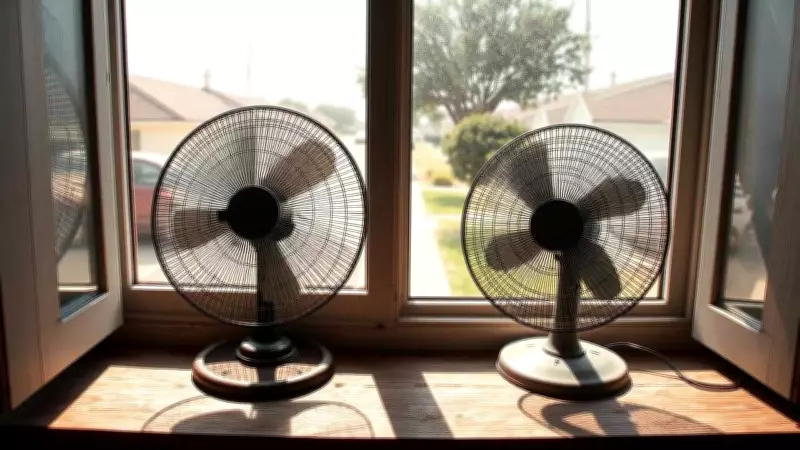
The Hidden Physics of Fan Placement: A Summer Cooling Guide
On a sweltering summer day, many of us have stood before a single box fan, wondering if it's truly cooling the room. The traditional advice suggests pointing the fan out a window to "blow" heat away, but the reality is more complex. This approach, while intuitive, often leaves people drenched and uncomfortable after just minutes, revealing that air movement involves intricate principles of pressure and temperature management.
Understanding Negative Pressure and the "Cup Effect"
When you direct a fan outward, it creates negative pressure, essentially forming a vacuum that forces the room to draw in air from elsewhere. This can be effective if another window in a cooler, shaded area is open to allow fresh air intake. However, research challenges this method's superiority. In a study titled An Improved FFR Design with a Ventilation Fan: CFD Simulation and Validation, scientists used computational fluid dynamics to analyze airflow patterns. They discovered that fans blowing inward tend to generate a cup-shaped airflow, which circulates air more thoroughly throughout the entire room volume, rather than merely pulling a narrow stream toward a window.
This inward airflow enhances heat transfer and accelerates evaporation, providing a cooling breeze that creates a wind chill effect, making warm days more bearable. In contrast, exhausting air outward may remove some hot air but often lacks this personal cooling benefit, leaving occupants without relief.

Strategies for Humid and Warm Conditions
In humid environments, simply replacing indoor air with outdoor air can be ineffective. For instance, if the outdoor temperature is 35°C and indoor air is 32°C, bringing in fresh air does little to cool the space. Research from the paper Airflow utilization in buildings in hot and humid areas of China emphasizes that in such settings, the focus should be on "convective cooling." This involves high-velocity air moving directly over skin to promote evaporation, thereby lowering perceived temperature rather than just the room's thermometer reading.
For humid conditions, positioning a fan to blow inward at occupants is typically the better choice. Additionally, leveraging the "stack effect" can enhance DIY ventilation. By placing a fan at a higher window to exhaust hot air and opening a lower window on the opposite side, buoyant air rises and exits, creating a natural cooling flow.
Timing and Optimization for Effective Ventilation
Timing is crucial for maximizing cooling efficiency. During the hottest parts of the day, use a fan to draw air into your home through the coolest, shadiest window. As evening approaches and outdoor temperatures drop below indoor levels, switch to cross-ventilation. Set up one fan to pull cool air in from one end of the house and another to exhaust warm air out the opposite end, creating a high-speed tunnel effect that can dissipate accumulated heat in minutes.
To boost your DIY ventilation efforts, consider these tips:
- Plan airflow routes in advance to ensure smooth circulation.
- Regularly clean fan blades and window screens to prevent dust buildup, which can reduce effectiveness.
- Place intake fans in shaded areas, such as under trees or overhangs, to avoid drawing in additional heat from the environment.
- Utilize window height strategically; hot air rises, so exhaust fans at higher windows work best with lower intake openings.
Think of your home as a living structure that needs to breathe during summer. By applying these science-backed strategies, you can create a more comfortable indoor environment without relying heavily on thermostats, saving energy and enhancing personal comfort.