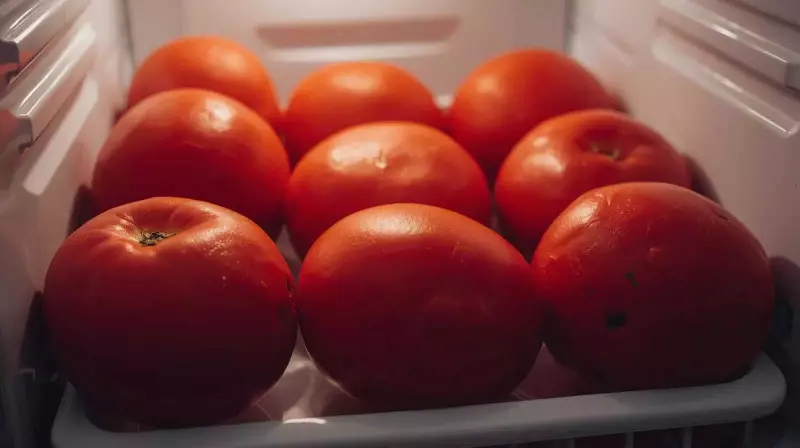
It's a common sight in kitchens from Delhi to Mumbai, and across the globe: tomatoes resting on countertops, destined for salads, curries, and sandwiches. We handle them without a second thought, slicing, seasoning, and often forgetting them until the next grocery run. Yet, a growing chorus of complaints laments the lack of flavour in today's tomatoes, even when they look perfectly red and ripe. The culprit, surprisingly, might be a trusted appliance in your home: the refrigerator.
The Silent Chemistry of Cold: How Fridges Dull Tomato Taste
We often blame the fridge without understanding why. It seems harmless, even logical, to use cold air to keep food fresh. However, tomatoes are not like other vegetables. They are living fruit that continue their biological processes long after being harvested. What happens to them inside a cold refrigerator is a slow, invisible chemical shutdown. There's no dramatic rot or foul smell, just a gradual dullness where sweetness fades and that distinctive, summery aroma never fully returns, even after the fruit warms up on the counter.
The true essence of a tomato's flavour isn't just about sugar or acidity. It's a complex symphony of hundreds of volatile aroma compounds that travel to your nose as you eat. Scientific research has consistently shown that storing tomatoes at low temperatures, typically around 4 degrees Celsius common in fridges, causes a sharp decline in these crucial compounds. The cold effectively presses pause on the chemical pathways that generate smell, with some shutting down entirely. Comparative studies between room temperature and refrigerated storage confirm that ripe tomatoes lose a significant portion of their volatile profile when chilled. The result? Even when the fruit appears flawless, people can distinctly taste the difference.

Is the Damage Permanent? The Uncertain Road to Recovery
This leads to a critical question: can a chilled tomato recover its lost flavour? The answer is not entirely reassuring. Research published in the journal Frontiers indicates that a short stint in the fridge—less than a week—might be partially reversible. Tomatoes stored cold for a brief period sometimes regained some aroma after spending a day at room temperature. However, this recovery was incomplete and uneven.
Certain key compounds failed to return, while others came back in diminished amounts, leading to a flatter, thinner overall flavour. The longer tomatoes remain in cold storage, the worse their recovery becomes. Once the aroma-producing pathways are disrupted for an extended period, simply warming the fruit does little to help. This explains the all-too-familiar experience of a tomato that looks perfectly ripe but tastes hollow and bland straight from the fridge. The damage is subtle but lasting.
Not All Tomatoes Are Equal: Variety Plays a Key Role
The impact of cold storage isn't uniform across all types of tomatoes. Heirloom varieties, prized for their rich taste, often start with higher baseline levels of sugars and aroma compounds. This means they have more flavour to lose when subjected to cold air. In contrast, many modern commercial tomatoes are bred primarily for size, yield, and long shelf life during transport, not for peak flavour. Their starting point for aroma is already lower.
Studies comparing dozens of cultivars have revealed massive differences in their volatile content. Some varieties lose dramatically more flavour when chilled than others. Sadly, some common supermarket tomatoes have such a low flavour baseline that they barely improve even at ideal room temperatures. This genetic reality, combined with the widespread use of cold storage in supply chains, explains why store-bought tomatoes so frequently disappoint. The refrigerator isn't the only problem, but it exacerbates an existing one.

So, where should you actually keep your tomatoes? For ripe tomatoes, the consensus is clear: room temperature is best. A cool spot on your kitchen counter, away from direct sunlight, at around 20 degrees Celsius allows the aroma compounds to stay active. Unripe, green tomatoes can also stay out, where they will continue to develop flavour as they ripen and soften. The refrigerator should be considered only in very specific scenarios, such as when you need to slow down spoilage for an overripe tomato that would otherwise go to waste. Even then, it's a conscious trade-off: you gain a little extra time, but you sacrifice taste. Tomatoes may be forgiving in their appearance, but their chemistry is not. Once the cold takes hold, the full, vibrant flavour rarely comes back.