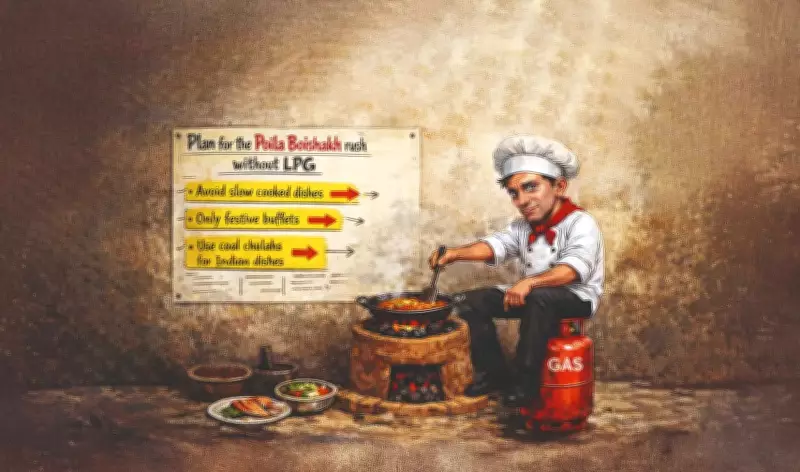
Kolkata's Food Industry Adapts to LPG Crisis Ahead of Bengali New Year
With severe LPG supply shortages gripping the city, Kolkata's vibrant restaurant scene and bustling street food stalls are undergoing a quiet but significant transformation in their kitchens. This rewiring comes just in time for Poila Boishakh, the biggest culinary moment on the Bengali calendar, as establishments scramble to maintain operations without reliable gas supplies.
Festive Pressure Builds as Gas Supply Falters
For over six weeks, Kolkata's food industry has been managing a slow-burning crisis that has now reached its peak with the Bengali New Year approaching. The festive season typically brings massive demand, but this year it coincides with unprecedented fuel challenges that are forcing creative adaptations across the sector.
Strategic Shifts by Major Restaurant Groups
Larger restaurant chains have responded with calculated strategies. Debaditya Chaudhury, director of popular chains Chowman and Oudh 1590, implemented a hybrid model early, reducing gas dependency while scaling up electric cooking alternatives. "Tandoors are being moved to electric or charcoal, while several Chinese items are being cooked on induction cooktops," he explains. "With our volume of sales, depending only on LPG would be impossible."

Chaudhury remains firm on pricing despite the operational challenges: "It's principally wrong to increase prices – we won't do that."
At the renowned 6 Ballygunge Place, the solution has been structural. Owner Swaminathan Ramani reveals: "We're going buffet-only, temporarily stopping à la carte options to control fuel consumption and streamline output." He adds that despite higher operational burdens, pricing has remained unchanged, acknowledging that "Kolkata is a price-sensitive market."
According to Sudesh Poddar, President of the Hotels and Restaurants Association of Eastern India, "Most restaurants in the city have shifted 70% operations to induction-based cooking as a stopgap measure."
Sector V: Ground Zero of the Crisis
In Sector V, where office workers and college students create daily lunch rushes, the crisis has hit with particular severity. Here, gas supply hasn't just slowed – it has stopped entirely.
"There is no LPG at all! Cooking on the stove has slowed down the entire process," says Saran, owner of Saran Sandwich Corner. Every order now takes longer, and queues stretch further as cooking efficiency plummets.
The financial barrier to obtaining cylinders has become prohibitive for small vendors. Raju of Kartik Fast Food and Tea explains: "If you don't have ₹10,000 to ₹20,000 in your pocket, you can't buy cylinders," making bulk procurement impossible for most street food operators.
Most stalls in Sector V have absorbed what costs they can and passed on the rest, resulting in price increases of ₹10 to ₹15 across food items and tea. "We have increased prices in order to sustain," admits Raju.
Many vendors near the Calcutta Stock Market recall empty promises from officials. Bidyut, a local vendor, says: "They said they'll help us with LPG cylinders but nothing was done."
Clay Stoves and Curated Plates: Traditional Solutions Return
Not every kitchen has turned to electric alternatives. Several restaurants have revived traditional mitti chulhas (clay stoves) for dishes requiring slow, sustained heat.
Sutapa Barua of Himur Heshel explains: "Mutton curries and bhorta, which benefit from long hours over a steady flame, are now being shifted to clay-based setups." Menus have been strategically trimmed to reduce cooking load, though certain Poila Boishakh staples remain indispensable.
Chef Ranjan Biswas of Saptapadi adds: "We've learnt to navigate this. During festivals, we rely more on electric stoves and alternative methods. This time, that dependence is higher, especially for slow-cooked dishes, which we've shifted to induction or traditional chulhas."

Street Food Adaptations with Minimal Price Hikes
In Dacre's Lane, famous for loud, cheap, and reliable lunches, the familiar hiss of gas burners has been replaced by the crackle of coal. Vendors now wait up to 25 days for cylinders that may never arrive, forcing most to quietly switch to coal chulhas and backup stoves rather than shut down completely.
A worker at Chitto Babur Dokan reveals: "Gas is being used as little as possible. Coal ovens are doing most of the work."
Several stalls have removed certain items from their offerings. Bappa Saha of Ramesh Babur Dokan says: "The Chinese section had to be closed. The Indian section is still running." Chop, beguni, and Chinese items have vanished from multiple locations.
Near the Calcutta High Court, South Indian food stalls face particular challenges. M Mohan Thevar of Jay Baba Bhutnath explains: "Without gas, we can't make everything at once. When there is a crowd, it becomes a big challenge to complete orders." Dosa prices have consequently risen from ₹40 to ₹45.
Sheikh Habib Ali of Metro Roll Centre emphasizes the minimal price adjustments: "Dacre's Lane is known for cheap, quality food. We've only increased prices by around ₹5."
Sweet Shops Make Hard Editorial Decisions
At Banchharam's, the crisis has forced difficult menu decisions. Ratan Das states: "Fifteen to 20 items are not being made and it will remain this way until things become normal." Only four to five varieties of sandesh are currently in production, with cashew-based sweets, sitabhog, korai shutir kochuri, and flavoured sandesh varieties disappearing from shelves through Nabobarsho.
For legacy sweet shops that double as restaurants, the instinct is consistent – protect product quality while absorbing costs. Moushumi Sircar of Balaram Mullick & Radharaman Mullick and Bonne Femme explains: "Poila Boishakh is too important for us to slow down. The LPG crisis is real, but we have tightened our operations."
Sircar adds: "We've made adjustments to optimise menus and kitchen processes to ensure customers don't have to pay more."
Across Kolkata, from high-end restaurants to humble street stalls, the food industry demonstrates remarkable resilience as it navigates this unprecedented fuel crisis while preparing for the most important culinary celebration of the Bengali year.