Star Anise: The Celestial Spice of Indian Kitchens
In the vibrant tapestry of Indian spices, where each ingredient tells a story of flavor and tradition, one stands out not just for its taste but for its breathtaking beauty. Star anise, with its distinctive star-shaped form, has long been synonymous with luxury and royalty in culinary circles. While the Indian spice box is renowned for its aromatic and medicinal treasures, star anise adds a visual and sensory elegance that elevates dishes like biryani and koftas to new heights.
A Botanical Marvel with Ancient Roots
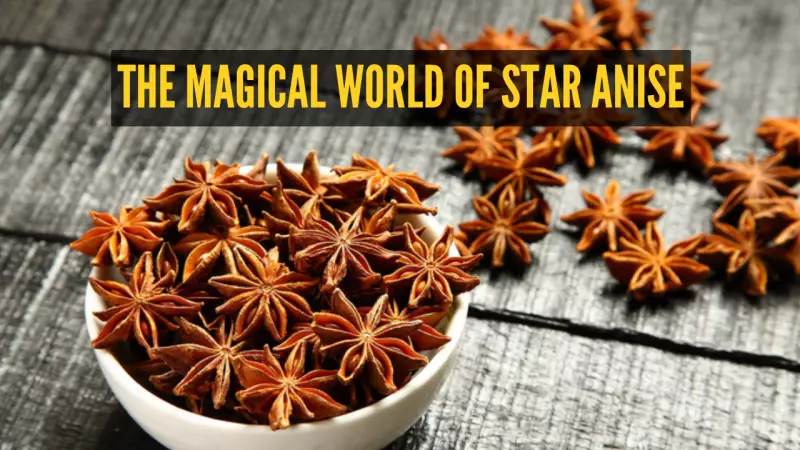
Known scientifically as Illicium verum, star anise is described as a dried, star-shaped fruit with a reddish-brown hue. Each "star" typically consists of 6-8 carpels arranged in a whorl, with each carpel shaped like a boat and containing a seed. These seeds are brown, compressed, ovid, smooth, shiny, and remarkably brittle. The genus name Illicium derives from the Latin word "illicere," meaning "to allure," a fitting tribute to the attractive fragrance of its branches and leaves.
Across India, star anise is known by various regional names, reflecting its deep integration into local cultures:

- Chakri Phool or Anasphal in Hindi
- Takkolam in Malayalam
- Badian in Marathi
- Anasphul in Oriya
- Anashuppu in Tamil
- Anaspuvu in Telugu
- Badyani in Urdu
From Chinese Origins to Indian Soil
Despite its widespread use in Indian cooking, star anise is indigenous to Southeastern China. It arrived in India during the medieval period, facilitated by flourishing maritime and overland trade routes connecting China, Southeast Asia, Central Asia, and India. Arab traders played a pivotal role in this exchange. Upon its arrival, star anise first found favor in the imperial Mughal courts, where it was incorporated into lavish dishes like pulaos, biryanis, and niharis. Over time, it embedded itself deeply into Awadhi cuisine, becoming a staple of royal kitchens.
In India, star anise is primarily produced in Arunachal Pradesh, where agro-climatic conditions mimic its traditional growing areas. It thrives in humus-rich, mildly acidic to neutral soils that are light to medium with good drainage, and can tolerate temperatures as low as –10°C.
Medicinal Powerhouse: More Than Just a Spice
A comprehensive review published in PMC highlights that star anise contains over 201 chemical constituents. The most widely studied components are star anise oil and shikimic acid, with the oil accounting for a significant proportion of the total. The fruit exhibits antibacterial, carminative, diuretic, and stomachic properties, making it useful for treating flatulence and spasmodic conditions.
In Chinese tradition, star anise has been used as a spice since the Song Dynasty (AD 960–1279) and as a medicine since the Ming Dynasty (AD 1368–1644). The Chinese Pharmacopoeia notes its main effects as "warming Yang and dispersing cold, regulating Qi and relieving pain." It was one of the first traditional Chinese medicines approved for dual use in medicines and foodstuffs by the Ministry of Health of the People’s Republic of China in 2002. Today, China remains the only country capable of large-scale anise production.
Culinary Applications: A Spice of Versatility
Star anise's licorice-like flavor, derived from its essential oil (SAO), has made it a global culinary star. In China, it is a key component of five-spice powder. In India, it is used to flavor vegetables, marinate meats, and enhance curries, confectioneries, spirits, and pickles. Beyond the kitchen, its essential oil finds use in perfumery, soft drinks, bakery products, and liquors.
The Mughlai and Awadhi Connection
Chef Gautam Kumar emphasizes star anise's significant role in Mughlai and Awadhi cuisine. "It was introduced to North India through Persian and Central Asian influences, gradually becoming part of the refined spice vocabulary that defines royal kitchens," he explains. In Mughlai cuisine, star anise is often infused into yakhni, kormas, nihari, and biryanis. Its subtle sweet-licorice aroma blends seamlessly with the richness of ghee and nuts, enhancing meat preparations.

Chef Kumar adds, "In Awadhi cuisine, the spice offers a gentle aroma that elevates techniques like dum pukht, making the dining experience more sensory." Star anise is not meant to be tasted distinctly but felt as an invisible thread of aroma that weaves together history, royalty, heritage, patience, and culinary finesse.
A Symbol of Elegance and Tradition
Star anise transcends its role as a mere spice; it is a symbol of elegance that connects ancient trade routes, medicinal traditions, and royal culinary arts. Its journey from Chinese forests to Indian kitchens underscores a rich history of cultural exchange. As it continues to grace dishes with its starry presence, star anise remains a testament to the enduring allure of spices that blend beauty, flavor, and wellness into every bite.