

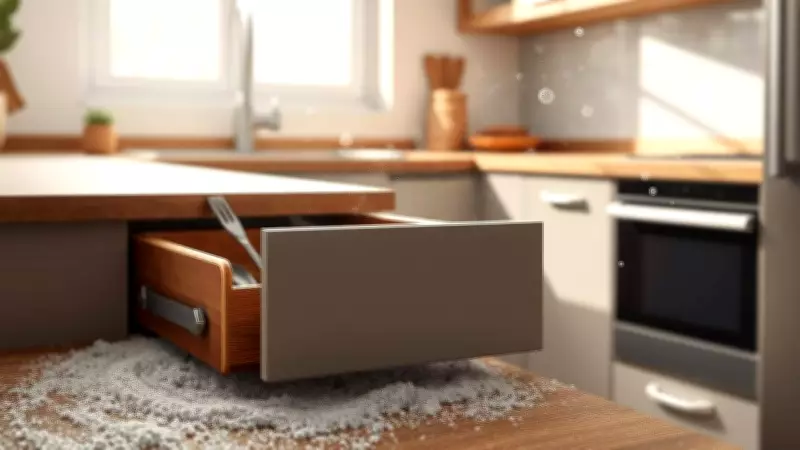
The Hidden Danger in Your Kitchen Drawer
When your kitchen drawer refuses to open, it might seem like a minor inconvenience that disrupts your entire day. Most people immediately suspect loose screws, warped wood, or heavy cookware pressing down on the rails. However, the real culprit is often far more subtle and pervasive—a thin, stubborn layer of dust accumulating on the drawer's rail system.
More Than Just Aesthetic: The Mechanical Challenge of Kitchen Dust
Kitchen dust represents more than just an unsightly nuisance. In the dynamic environment of a kitchen, dust transforms into a mechanical adversary rather than mere fibers from clothing. This dust consists of a complex mixture of dead skin cells, external contaminants, and microscopic droplets of cooking oils. When these particles become embedded in the narrow joints of drawer rails, they do much more than hinder smooth movement. They create a silent, persistent source of indoor air pollution, directly affecting the air quality you breathe while preparing meals.
The Secret War in Your Drawer: Electrostatic Forces at Play
As strange as it might sound, there's a fascinating connection between your kitchen drawer and gecko adhesive technology when it comes to dust accumulation. Research highlighted in the Journal of Electrostatics regarding gecko-inspired adhesion technology examines how dust builds up on complex surfaces. The core finding reveals that electrostatic forces enable tiny dust particles to cling to microstructures that closely resemble the intricate joint designs used in drawer construction. These particles don't merely stick to the joints—they actively climb and slide through them.

This explains why simply blowing air won't effectively resolve a jammed drawer. The dust has already firmly adhered to surfaces, significantly increasing friction each time you attempt to pull the drawer open. Every forceful tug causes dust particles to scrape away lubricant from the rails, creating an impure, thickened mixture. Beyond increasing resistance, this accelerates wear and tear, leading to drawer wobble often attributed to poor cabinet quality. This buildup also contributes substantially to indoor air pollution. Experts recommend regular cleaning using a vacuum with a narrow crevice attachment followed by gentle wiping with a damp microfiber cloth.
Dust Cleaning: Essential for Air Quality and Functionality
There's a critical health aspect to drawer dust that most homeowners completely overlook. According to a comprehensive literature review published in the Journal of Building Engineering, kitchens rank among the primary sources of volatile organic compounds and particulate matter due to cooking activities. These pollutants circulate throughout the kitchen and accumulate inside drawers, where they're disturbed each time you open them.
Maintaining cleanliness in these spaces extends far beyond basic tidiness—it involves actively managing elements that enter your home through its air circulation system. Specialists emphasize that consistent, thorough cleaning prevents these dust layers from becoming permanent fixtures in your home's structure. Begin by using a vacuum equipped with an appropriately narrow crevice attachment to remove the electrostatic dust layer. Follow this with a gentle wipe using a microfiber cloth slightly dampened with a mild degreasing solution to dissolve sticky residues.
Future-Proofing Your Kitchen Hardware
To break the vicious cycle of stuck drawers, you need a combination of technological foresight and disciplined hygiene habits. Drawing from the Journal of Electrostatics study, future kitchen hardware could potentially be designed to resist dust accumulation through specialized electrical charges. In the meantime, a simpler protective measure exists: ensure proper airflow throughout your kitchen to minimize dust concentration.
A crucial final recommendation involves lubrication practices. When struggling with a stubborn drawer, the immediate temptation might be to spray WD-40 into the track or apply grease liberally. While this might provide temporary relief in some cases, it ultimately attracts more dust to adhere to the now-greasy surface. Instead, opt for dry lubricants like Teflon or silicone-based products, which ensure smooth operation without creating sticky surfaces that trap additional contaminants.

