

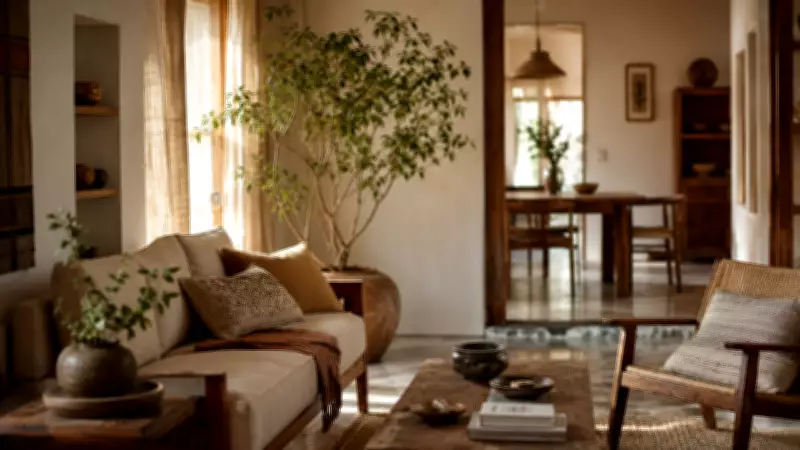
There is a moment many Indian homeowners recognise. You order a sofa because it looks good on Instagram. Six months later, it looks slightly off. A year in, the upholstery is pilling, the cushions have gone flat, and you are already browsing for replacements. The cycle repeats. And somewhere in that cycle, the home stops feeling like home.
In the US alone, consumers now throw out more than 12 million tons of furniture every year, a figure that represents a 450% increase since 1960. The global picture is no different in direction, only in scale. India is not immune. Around 10 million Indian households have already shifted toward sustainable and environmentally conscious home products as of 2024, according to market research.
Algorithm Homes
Social media and fast retail have normalised quick, frequent changes, while algorithm-driven aesthetics have made many homes look increasingly alike, regardless of who lives in them. You can scroll through thousands of home tours and see the same warm-toned linen curtains, the same cane furniture, the same arched mirror in the hallway. Beautiful, technically. But anonymous.

Smita Joshi, Vice President – Home Textiles and Export at Nesterra, Sutlej Textiles and Industries Limited (K.K. Birla Group), describes it directly: "There was a time when homes came together slowly. Furniture was saved up for, curtains were commissioned, art and objects were collected over years. Rooms were not styled for a photograph and then forgotten. They were allowed to evolve, and that is what gave them coherence and warmth."
What "Slow Interiors" Actually Means
The phrase "slow interiors" has been circulating in design circles for a while, but it is worth being precise about what it does. Joshi puts it well: "This is the real substance of 'slow interiors'. It is not a fixed aesthetic. It is a change in tempo and intent. A slow interior is built gradually, with fewer but more considered pieces, and with an expectation that they will stay. It values depth over constant refresh."
In practice, that shift is visible in the questions people ask before they buy. How will this fabric age? Will this piece still feel like it belongs several years from now? Can this sofa withstand real life and still look dignified? These are not the questions of someone browsing a flash sale. They are the questions of someone thinking about their home as a long-term project rather than a backdrop.
Indian homes are particularly well-suited to this sensibility, as Joshi notes: "Almost every family knows a chair, a trunk, a bed, or a textile that has travelled across houses and generations. Its value is less about material and more about the stories it holds." The slow-interiors instinct, for many Indian homeowners, is not a new philosophy borrowed from Scandinavian design discourse. It is a return to something already in the family memory.
Textiles at the Centre of the Shift
If the slow-interiors movement has a material pivot point, it is fabric. Paint and flooring are slow to change. Textiles are where a room breathes, shifts tone across seasons, and decides how a space actually feels to live in. "In a fast-interior mindset, textiles are interchangeable. In a slow-interior mindset, they are commitments," says Joshi.
The pandemic forced a version of this reckoning on everyone. When homes had to function as office, school, and refuge simultaneously, the difference between a well-made curtain and a cheap one became daily and visceral. Hard, glossy surfaces that had looked sleek in catalogues felt cold in extended habitation. Fabrics that trapped heat or dust quickly lost appeal. The home stopped being a backdrop and became an environment, and that changed what people wanted from it.
Sustainability is Pushing in the Same Direction
There is an economic and environmental logic converging with the aesthetic one. India's online home decor sector is forecast to expand by USD 4.39 billion between 2025 and 2029, driven in part by a rising preference for sustainable living and eco-consciousness.

But the shift is not purely about green credentials, as Joshi points out: "Many younger homeowners are uncomfortable with the idea of changing entire rooms on a whim. They prefer to invest in fewer, better pieces, maintain them well, and refresh selectively rather than constantly. For brands and manufacturers, this is not a marketing trend. It is a structural shift. Claims of durability, responsibility, and timelessness now have to be backed by design and construction that actually hold up over years, not just in the first season."
Are we entering the era of slow interiors? For a growing segment of Indian homes, Joshi believes, "the answer is already visible in what they choose to keep, what they choose to edit out, and what they refuse to replace casually. The task for those of us who work in this field is to meet that seriousness with products and ideas that deserve to stay."
That sounds less like a trend and more like a correction. One that has been a long time coming.
