5 Mysterious Places on Earth That Look Straight Out of a Sci-Fi Movie
Earth is a treasure trove of wonders, many of which surpass human imagination and knowledge. From forests with bizarrely bent trees to fiery craters that never extinguish, these enigmatic spots ignite endless curiosity and inspire countless campfire tales. They have long attracted adventurers, scientists, and dreamers, pushing the boundaries of what we believe about our planet. Here are five such mysterious places that wear a shroud of intrigue and mystery.
Crooked Forest in Poland
Located near Nowe Czarnowo in western Poland, the Crooked Forest is home to approximately 400 pine trees planted around 1930. Each tree trunk curves sharply at a 90-degree angle at its base, forming a distinct J-shape, with all trees uniformly pointing north. Scientists generally favor the theory that humans shaped these trees for purposes such as curved timber for boat parts or furniture, a project likely abandoned during World War II. Alternative explanations include heavy snow or tank damage, but the uniformity of the bends remains a compelling mystery that defies easy explanation.
The Bermuda Triangle 'Swallows' Ships and Planes
This infamous region in the Atlantic Ocean, spanning up to 500,000 square miles between Bermuda, Puerto Rico, and Miami, has been linked to the disappearance of over 20 planes and 50 ships since the 1940s, often vanishing without a trace. The loss of Flight 19 in 1945 has fueled numerous myths involving aliens, interdimensional portals, or magnetic anomalies. However, statistical analyses indicate that the incident rate here is no higher than in other busy sea lanes. Reports from organizations like NOAA and the Coast Guard suggest that human error, severe storms, and methane gas bursts likely account for most incidents. Despite debunking efforts, the legend of the Bermuda Triangle persists in popular culture.

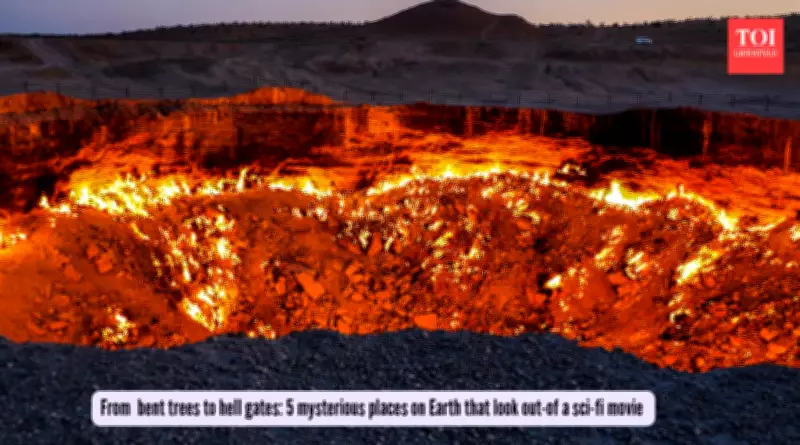
Door to Hell in Turkmenistan
In the Karakum Desert of Turkmenistan, the Darvaza Crater, measuring 100 meters wide and 30 meters deep, has been ablaze continuously since 1971. Soviet drillers accidentally tapped into a natural gas cavern and set it on fire to burn off methane, expecting the flames to subside within days. Instead, the crater still burns today, glowing with an eerie orange hue at night. Locals refer to it as the Door to Hell, and it attracts tourists despite restricted access. Scientists currently see no end in sight for this perpetual inferno, making it a stark reminder of human impact on nature.
Fairy Circles in Namibia
Namibia's arid grasslands are dotted with millions of fairy circles, which appear as bare red soil disks ranging from 2 to 12 meters in width, each encircled by a ring of grass. These patterns can vary in size from 4 to 35 meters and often repeat in hexagonal formations. Recent studies propose two main theories: one suggests that a particular species of termites digs underground tunnels that block plant roots, while another attributes the circles to water competition among grasses. The exact cause remains debated, adding to the mystique of these natural formations.
Lake Abraham Traps Icy Methane Bubbles
In Alberta, Canada, Abraham Lake presents a striking winter phenomenon beneath its summer turquoise waters. As the lake freezes layer by layer, methane gas bubbles from decomposing plants become trapped, forming unique white orbs suspended in the ice. Created by a dam in 1972, the lake's glacial silt enhances the luminous appearance of these bubbles. While the sight is breathtakingly beautiful, the flammable gas pockets pose a risk of explosion if disturbed, blending natural wonder with potential danger.