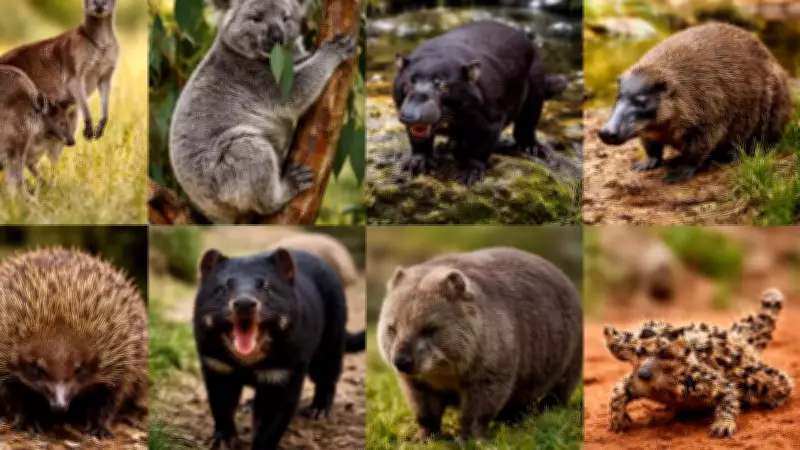
8 Unique Animals That Exist Only in Australia and Look Unreal
The land of Australia is home to some of the most exotic and fascinating fauna on the planet, primarily due to its long history of isolation from other continents. This unique geographical separation has driven evolution in distinct ways, resulting in animal species found nowhere else in the world. Remarkably, approximately 80 percent of Australia's mammalian and reptilian fauna is endemic to the continent.
From creatures that lay eggs to those that carry their young in pouches, Australia's wildlife presents an intriguing blend of familiar and bizarre traits. These animals range from adorable to primordial in appearance, each representing a unique evolutionary journey shaped by their specific environments. Here, we explore eight incredible animals that are native to Australia.
Thorny Devil
This small lizard inhabits the harsh Australian deserts and is easily recognized by its skin covered in sharp spikes, which serve as a defense mechanism against predators. A remarkable adaptation allows the thorny devil to collect water through channels in its skin, directing it directly to its mouth for hydration in arid conditions.

Quokka
Often dubbed the "happiest animal in the world" due to its perpetually friendly facial expression, the quokka is a tiny marsupial primarily found on Rottnest Island. It feeds on plants and appears cute and harmless, but it is important to remember that quokkas are wild animals and should be treated with respect.
Wombat
The wombat is a robust animal well-adapted for a subterranean lifestyle, equipped with strong claws for digging. It features an unusual backwards-facing pouch that prevents dirt from entering while it burrows. Nocturnal and herbivorous, wombats move slowly but with determination through their habitats.
Tasmanian Devil
Endemic to Tasmania, the Tasmanian devil is a carnivorous marsupial known for its screeching vocalizations and powerful jaws, which make it an effective natural pest controller in the ecosystem. Unfortunately, its population is currently endangered due to the spread of contagious diseases.
Echidna
As a monotreme, the echidna shares the egg-laying trait with the platypus and has a body covered in spines similar to a hedgehog. It uses its pointed snout to hunt insects like termites and ants. Young echidnas, called puggles, develop in a pouch without spines initially.
Platypus
Often considered one of the most bizarre creatures on Earth, the platypus is a mammal that lays eggs and exhibits characteristics reminiscent of a duck, beaver, and otter. Notably, it is one of the few venomous mammals, adding to its unique biological profile.
Koala
Frequently mistaken for a bear, the koala is actually an arboreal marsupial that spends its entire life in eucalyptus trees. It survives solely on eucalyptus leaves and sleeps for 18 to 20 hours daily due to its low-energy diet. Despite their placid appearance, koalas are highly specialized with very specific dietary and habitat requirements.
Kangaroo
Perhaps the most iconic Australian animal, the kangaroo is a marsupial renowned for its powerful hind legs that enable it to leap great distances. Its young, known as joeys, develop in the mother's pouch. Kangaroos are incredibly resilient, thriving in diverse environments from deserts to grasslands.
These eight animals highlight the extraordinary biodiversity of Australia, shaped by millions of years of evolutionary isolation. Each species offers a glimpse into the unique adaptations that have allowed them to survive and thrive in their respective niches, making Australia a true haven for wildlife enthusiasts and researchers alike.