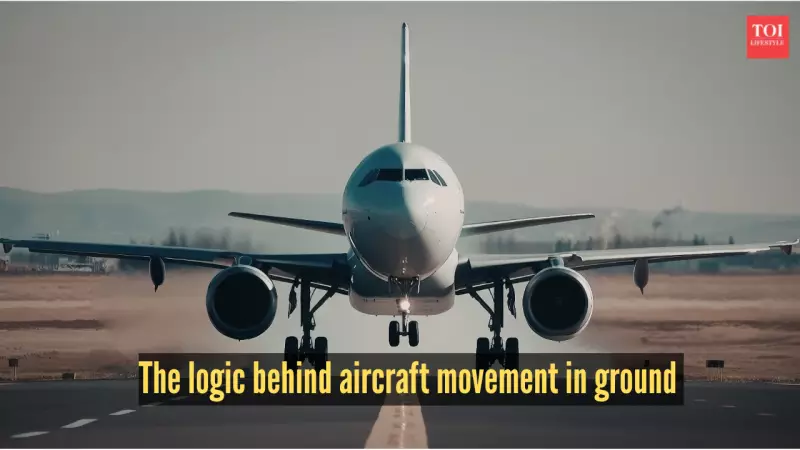
For most air travellers, the journey begins at takeoff and ends upon landing. However, a critical and complex phase of air travel unfolds silently on the tarmac, a meticulously orchestrated ballet of machines and humans that passengers rarely see. This is the world of ground movement, where every taxi, hold, and pushback is governed by strict rules of air traffic control, advanced technology, and precise human coordination to ensure safety and maximise airport capacity.
The Intricate Dance After Landing and Before Takeoff
When an aircraft's wheels touch down, the pilot's work is far from over. Clearing the runway as swiftly as possible is paramount, as runways are an airport's most scarce and valuable asset. Pilots immediately follow pre-defined taxi paths off the runway, directed by air traffic control (ATC) via standard routes that connect runways to aprons and gates. This efficient exit allows the next arriving or departing aircraft to use the runway immediately, keeping the flow of traffic seamless.
Navigating the maze of taxiways is guided by a universal visual language. Pilots follow yellow centre lines and signs with black text on yellow backgrounds. During night operations or in poor visibility, blue edge lights and green centreline lights become their beacons. These signals are standardized globally by the International Civil Aviation Organization (ICAO), ensuring consistency from Delhi's Indira Gandhi International Airport to any major hub worldwide.

Rules of the Road: Holding, Pushback, and Runway Safety
Ground controllers, a specialized branch of ATC, closely monitor all surface movement. Their instructions, which must be followed to the letter, include commands to stop, hold short of a runway, or yield to another aircraft. Hold short lines, which are painted markings on the pavement near runways, indicate where an aircraft must wait until explicitly cleared to cross or enter a runway. This rule is a critical defence against dangerous runway incursions.
At the gate, aircraft are stationary. The process of beginning a journey involves a pushback operation, where a specialized tug carefully reverses the plane away from the terminal. This procedure prevents damage to airport structures and ensures the safety of ground crew. Only after pushback is complete do pilots start the engines and request taxi clearance from ATC to begin their journey to the runway.
Technology and Traffic Management on the Tarmac
The management of ground movement is increasingly driven by technology. Most major airports, including India's busiest hubs, employ Surface Movement Radar (SMR) and GPS-based systems to track every aircraft and vehicle on the tarmac in real-time, even in challenging conditions like fog or heavy rain. These systems empower controllers to assess traffic flow, identify potential conflicts, and issue timely instructions.
Airport layout significantly influences movement. Large international airports utilise parallel taxiways and multiple holding points to ease congestion. During peak times or adverse weather, ATC may instruct departing aircraft to hold in designated positions, a process known as a ground hold. This manages the queue for the runway and maintains safe distances between aircraft.
In essence, the movement of aircraft on the ground is a sophisticated exercise in flow control. Every turn, stop, and clearance is a calculated component of a system that allows hundreds of planes to operate safely in shared, confined spaces. While it may seem routine or slow to passengers gazing out the window, this carefully choreographed progress across the asphalt is fundamental to the safety and efficiency of modern global air travel.