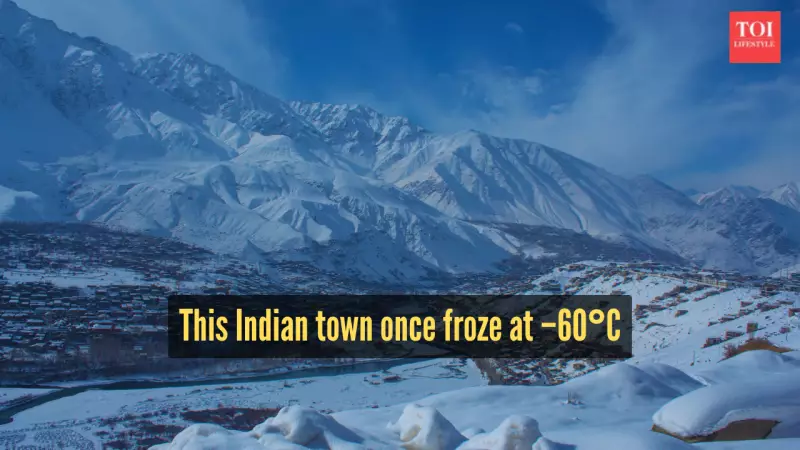
At first thought, it seems contradictory. India, a land famed for its sun-drenched coasts and relentless summer heat, is also home to one of the coldest permanently inhabited spots on the planet. Right now, the mercury has dipped to a biting -17°C, and existence here is a relentless test of human fortitude. This is Dras, a town that proudly, and chillingly, holds the title of the coldest place in India.
The Frozen Gateway to Ladakh
Nestled in the Kargil district of the Ladakh union territory, Dras sits at a staggering altitude of approximately 10,800 feet (3,300 meters). It lies strategically on National Highway 1, positioned between Zoji La and Kargil, which has rightly earned it the nickname 'Gateway to Ladakh'. The town is about 63 km from Sonmarg and 58 km from Kargil, serving as a crucial stopover during the fleeting summer months. Known locally as Himababs, Hembabs, or Humas—names stemming from the ancient term 'Hem-babs' meaning 'snow land'—Dras lives up to its icy etymology.
Winters here transcend mere cold; they are an extreme environmental force. Average winter temperatures hover around -20°C, constantly challenging the limits of human endurance. The combination of thin air at high altitude, which hinders the body's ability to retain heat, and piercing winds that strip warmth away in moments, places the human body under continuous strain. Everyday tasks become monumental achievements in such a climate.

Geography of a Natural Cold Trap
The profound cold of Dras is a direct gift of its geography. Encircled by formidable mountain ranges, the town is effectively shielded from warmer air currents. Meteorologists explain that these natural barriers act like walls, trapping dense, cold air within the Dras basin for months on end. This geographical isolation transforms the town into a natural cold trap every winter.
The world took note of Dras's extreme character in 1995, when temperatures reportedly plummeted to a bone-shattering -60°C. Such readings are extraordinarily rare outside the polar regions, placing this Indian town in the same league as the frostbitten settlements of Siberia.
Life in the Deep Freeze and the Summer Thaw
When heavy snowfall arrives, life becomes an even greater challenge. Roads remain blocked for weeks or even months, severing Dras's connection to the rest of Ladakh. The resilient residents prepare meticulously for this isolation, stockpiling food, fuel, and other essential supplies well in advance, knowing they may be cut off from external aid.
Architecture and diet in Dras are dictated purely by survival. Homes are constructed from stone and mud, designed not for style but to insulate and retain precious heat through nights colder than industrial freezers. The local cuisine is functional, hearty, and calorie-dense, providing the necessary fuel to combat constant heat loss.
Come June through August, a brief but dramatic transformation occurs. As the roads clear, the climate turns pleasant, and Dras sheds its frozen fortress appearance. For a few precious months, it becomes a picturesque destination for trekkers and tourists exploring high-altitude routes, a vibrant valley blooming with life before winter's inevitable return.
Strategically, Dras holds immense importance. Its rugged, punishing terrain and brutal weather were pivotal factors during the 1999 Kargil conflict, proving that in this region, the cold itself can be as formidable a foe as any conventional weapon.
In Dras, winter is far more than a season; it is a defining way of life, continuously redefining the very essence of human endurance and adaptation.