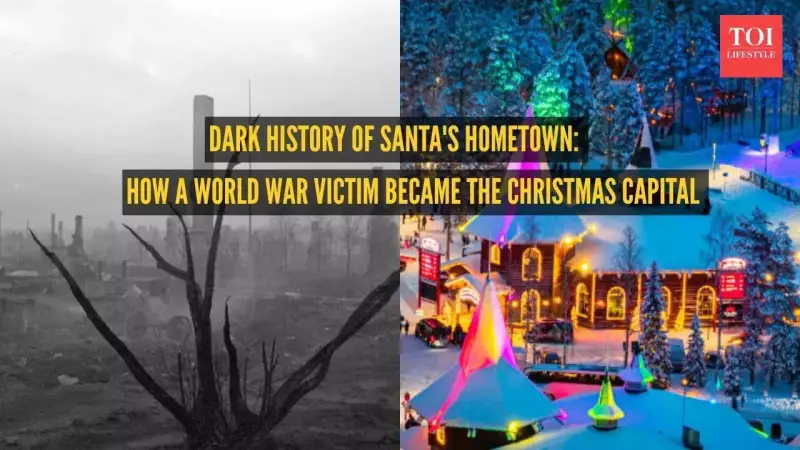
For millions, the name Rovaniemi conjures images of a magical, snow-blanketed paradise—the official hometown of Santa Claus. It's a place of elves, reindeer sleigh rides, and endless Christmas cheer. Yet, beneath this festive facade lies a layered history marked by colonial exploitation, devastating war, and an extraordinary story of survival and reinvention.
The Indigenous Roots and Colonial Erasure
Long before Santa Claus became its most famous resident, the region of Lapland was the ancestral homeland of the Sami people, Europe's only recognised indigenous group. For centuries, Sami culture and survival were intricately tied to reindeer herding, which provided everything from food and clothing to tools and shelter.
From the 17th century onwards, the expansion of Nordic nation-states gradually absorbed Sami lands. Borders were drawn, splitting communities across what is now Finland, Sweden, Norway, and Russia. Their languages and traditions were suppressed, with children taught that their indigenous culture was backward. By the time Rovaniemi began to develop as a town, the Sami presence had been systematically marginalised and disintegrated. Even today, Sami communities continue to fight for land rights, cultural recognition, and protection against mining and other intrusions.

Inferno and Ashes: The Second World War Devastation
The darkness over Rovaniemi deepened in the 20th century. In the 1930s, it was a quiet trading town of about 6,000 people. The Winter War of 1939-40 against the Soviet Union forced Finland into an alliance with Nazi Germany for protection. The Germans transformed Rovaniemi, doubling its population and building infrastructure, including an airfield—now marketed as "Santa's official airport."
When the tide of war turned, the retreating German forces enacted a scorched earth policy in 1944. They burned Rovaniemi to the ground and littered the area with landmines. The fire destroyed roughly 90% of the town, leaving returning residents, who had been evacuated to Sweden, with nothing but ashes.
Rebirth: From Ashes to Santa's Village
The task of rebuilding fell to Finland's celebrated architect, Alvar Aalto. Commissioned in 1945, Aalto drew inspiration from large-scale American projects to draft a master plan for Lapland. He started with housing and considered the impact of new hydroelectric plants.
His most iconic contribution was the "reindeer antler" street plan, superimposing the outline of a reindeer's head onto the town's topography. While his full zoning vision wasn't realised, he designed key civic buildings: a concert hall, town hall, and library.
The spark for tourism came in June 1950, when Eleanor Roosevelt wished to visit the Arctic Circle. A log cabin was built for her near the airport in just one week. This cabin became a tourist draw. Seeing the potential, local entrepreneurs officially established the Santa Claus Village in 1984, capitalising on Concorde flights bringing visitors to the Arctic. Although Finnish lore places Santa's origin in the remote Korvatunturi, the accessible village near Roosevelt's cabin became the beloved, heartily believed-in home of Santa.
Today, Rovaniemi welcomes over 600,000 visitors a year to its Santa Claus Village. For them, it is a place of pure joy and festive magic. For its residents, it stands as a powerful testament to resilience—a community that forged a symbol of global happiness from the ashes of its own destruction.