For most journalists, a work assignment is a straightforward task. But for some, it becomes a gateway to a far more expensive and personal quest. There exists a unique form of financial folly that emerges when a career in travel writing intersects with a deep passion for literature and history. This combination ensures that every professional trip morphs into an elaborate, self-funded excuse to chase ghosts from beloved books and iconic films.
The Modus Operandi: From Sensible Assignment to Extraordinary Detour
The method is consistent. A writer secures a sensible press trip or a junket for a professional review. They smile, agree to the itinerary, and immediately begin plotting their diversion. Because the "somewhere sensible" is always tantalisingly close to "somewhere extraordinary"—provided you look at the map with a certain squint and are willing to add days your budget can scarcely afford.
The pattern is costly: the assignment pays for the core trip, but the passionate side quests drain personal savings. It's a trade-off between financial prudence and the irresistible pull of standing where history, both real and fictional, unfolded.

Chasing Lawrence of Arabia in a Porsche
A prime example began with a dream assignment: test-driving a Porsche 997 Turbo Cabriolet on the scenic English country roads of Berkshire, near London. The professional response was simple: drive the car and review it. However, a sign for the Bovington Tank Museum in Dorset, over 100 kilometres away, triggered a memory.
Two years prior, the writer had stood in London’s Imperial War Museum, captivated by T.E. Lawrence’s Brough Superior SS100 motorcycle. The display noted Lawrence—the legendary Lawrence of Arabia—died in a crash near Bovington in 1935. Now, a mere 40 miles separated him from that fateful spot.
Thus began a two-day, self-funded detour. The powerful Porsche became a time machine, leading to a gentle, unremarkable curve on a Dorset road. A small plaque marks where Lawrence swerved to avoid two boys on bicycles, leading to the fatal accident. As cars passed obliviously, the writer stood there, visualising that final, tragic moment—a connection no car review could ever provide.
The Great Escape: A Frantic Dash to Poland
Sometimes the diversions are more extreme. Another assignment involved a Skoda Yeti in Prague for just one afternoon. Instead of circling the suburbs with other journalists, the writer fed coordinates into the GPS and drove 187 kilometres to Żagań, Poland, to the site of the infamous prisoner-of-war camp, Stalag Luft III.
This was the setting for the real-life events immortalised in Paul Brickhill’s book The Great Escape and the classic 1963 film starring Steve McQueen. The childhood obsession demanded a pilgrimage. Walking the path of the famous "Harry" tunnel and standing at the exit point—which fell short of the forest by mere metres, a miscalculation that led to the execution of 50 men—was a visceral experience. Hope, measured in inches, became tangible.
When History Beckons Across Borders
The compulsion knows no geographical bounds. A group trip with Dutch Tourism to rebrand Amsterdam as family-friendly instead sent the writer on a solo historical mission. Remembering the Netherlands as the theatre for Operation Market Garden in September 1944, he hired a car and drove over 200 kilometres to Nijmegen, Eindhoven, and Arnhem.
Inspired by Cornelius Ryan’s book A Bridge Too Far and the star-studded 1977 film, he visited every bridge and memorial. The John Frost Bridge in Arnhem—the "bridge too far"—now hosts traffic jams instead of the fierce firefights depicted in the story.
Even a motorcycle test ride in London spiralled into a trans-Channel expedition. With a Royal Enfield Classic 650, the writer embarked on a costly trip via ferry to Belgium. He rode from Dunkirk to Brussels, and then another 160 kilometres to Bastogne and the Ardennes—the site of the World War II Battle of the Bulge. Standing in a preserved foxhole, he tried to imagine the terror of a 19-year-old soldier waiting for relief, a scene made real by HBO's Band of Brothers.

The Transatlantic Literary & Culinary Trail
The pattern repeated across the Atlantic. A fully hosted trip to New York from Mumbai was financially prudent for four days. But New York's proximity to history-rich New England proved irresistible. Abandoning caution, the writer rented a car and drove north the moment the official programme ended.
The journey was a tapestry of American legend: walking Boston's Freedom Trail past Paul Revere’s house; visiting the Trapp Family Lodge in Stowe, Vermont, founded by the real-life von Trapps of The Sound of Music fame; tasting the original burger at Louis’ Lunch in New Haven, Connecticut; touring America’s oldest brewery, Yuengling, in Pottsville, Pennsylvania; and visiting the C.F. Martin guitar factory in Nazareth, where instruments for legends like The Beatles were crafted. These were the very guitars John Lennon and Paul McCartney strummed in Rishikesh while composing the White Album.
The Lesson in Every Detour
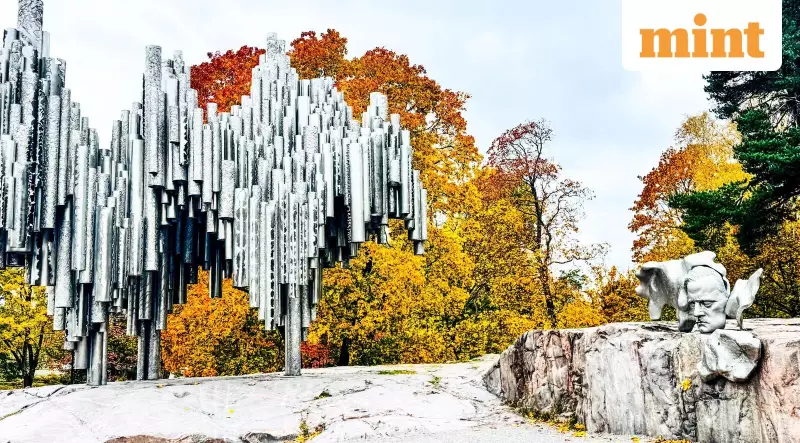
From a seven-hour layover in Zurich spent racing to the Reichenbach Falls (where Sherlock Holmes battled Moriarty) to a Helsinki stopover dedicated to finding the hotel where composer Jean Sibelius conceived Valse Triste, the mission is relentless. In London, the writer has dined at Simpson’s in the Strand because Holmes did, and visited Gordon Square, home to Indian-origin spy Noor Inayat Khan.
Each place teaches the same lesson: the extraordinary hides in plain sight within the ordinary, waiting for those who know the story. A road, a bridge, a building—they transform into doorways to the past when you carry their narrative. The printed word and celluloid dreams become tangible.
This hobby is a constant drain on finances. Every work trip inflates in cost with added days, rental vehicles, and extra accommodation. Yet, the writer concludes that these self-funded expeditions represent the best money he will never have. Because in those moments of standing where a story—real or fictional—unfolded, he ceases to be a mere tourist and becomes a witness to history’s enduring echo.