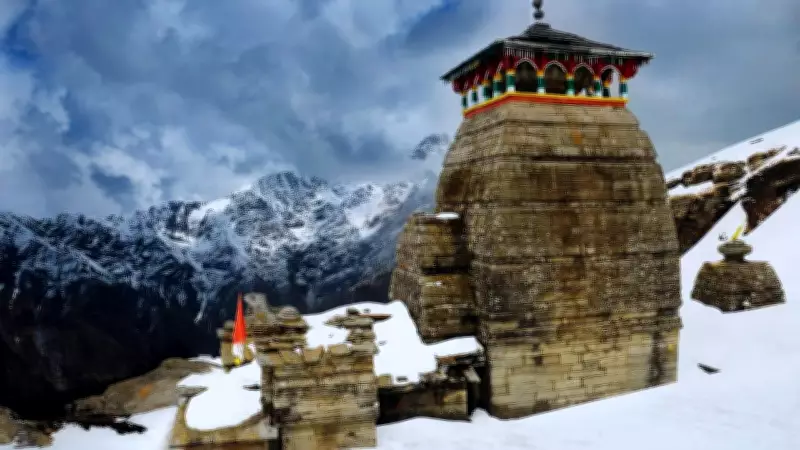
Tungnath Temple: More Than Just the World's Highest Shiva Shrine
Some temples are accessible by car, while others require your body to adapt to altitude, your breathing to slow, and your pace to sync with the mountains. Tungnath Temple undoubtedly belongs to the latter category. Situated at an elevation of 3,680 meters in Uttarakhand, it holds the distinction of being the highest Shiva temple globally. However, reducing Tungnath to mere statistics fails to capture its true essence. This sacred site is part of the revered Panch Kedar pilgrimage circuit, comprising five holy temples with deep roots in Hindu tradition.
Tungnath Beyond the "Highest" Designation
Literally meaning "Lord of the Peaks," Tungnath is no ordinary shrine randomly placed in the Himalayas. It forms an integral part of Garhwal's sacred geography, with legends tracing its origins to the post-Mahabharata era when the Pandavas sought Lord Shiva's forgiveness. According to tradition, each Panch Kedar temple represents a different body part of Shiva, with Tungnath marking where his arms appeared.
The temple itself is modestly built in traditional North Indian Himalayan architecture, designed compactly to withstand harsh weather conditions. What truly strikes visitors isn't its monumentality but its humble scale against the overwhelming Himalayan landscape. Tungnath doesn't dominate; rather, it allows the surrounding grandeur to take center stage.

Strategic Location and Geographical Significance
Tungnath occupies a unique position in Rudraprayag district, perched on a ridge separating the Mandakini and Alaknanda river valleys. This location places it at a natural boundary, surrounded by high-altitude grasslands and framed by majestic peaks including Nanda Devi, Chaukhamba, Kedarnath, and Neelkanth on clear days. The altitude and positioning dictate everything from rapidly changing weather patterns to human movement in this sacred space.
The Journey to Tungnath: A Transformative Trek
Unlike many pilgrimage centers, Tungnath remains inaccessible by road. The journey begins at major entry points like Rishikesh or Haridwar, followed by a scenic drive through Devprayag, Rudraprayag, and Ukhimath to reach Chopta—the base camp situated at 2,600-2,700 meters within the Kedarnath Wildlife Sanctuary.
From Chopta, pilgrims embark on a 3.5 to 5 kilometer trek that gains approximately 1,000 meters in elevation. While technically suitable for beginners with its stone-paved path, the continuous ascent presents physical challenges, typically taking 2-4 hours to complete.
What distinguishes this trek isn't its difficulty but its transformative nature:
- Travelers ascend through diverse ecosystems—from dense forests to open meadows and finally along ridges
- Frequent stops occur not from fatigue but to absorb constantly changing vistas
- The journey unfolds in profound silence, encouraging contemplation
Chandrashila Summit: The Ultimate Extension
Approximately 1.5 kilometers beyond Tungnath lies Chandrashila Summit at 4,000 meters, offering one of the Himalayas' most accessible panoramic viewpoints. This steeper section, often snow-covered, places visitors directly before an uninterrupted Himalayan horizon. Many trekkers find this final stretch completes their spiritual and physical journey, connecting all elements of the Tungnath experience.
Diverse Visitors, Shared Experiences
Tungnath attracts three primary visitor categories, often overlapping:
- Pilgrims undertaking the Panch Kedar yatra for religious fulfillment
- Trekkers seeking altitude experience without extreme difficulty
- Travelers pursuing perspective through nature's grandeur
The temple serves as more than a religious destination—it's where mythology, adventure, and personal reflection converge against the Himalayan backdrop.
The Tungnath Experience: Sensory and Spiritual
Approaching Tungnath brings noticeable physiological changes: breathing becomes conscious, pace naturally slows, and visitors adapt to the mountain's rhythm. The temple complex itself features simple stone structures, prayer flags, and small shrines, but the environment creates the true experience:

- Clouds passing at eye level
- Constant gentle winds
- Distinctive sounds of bells, chanting, and footsteps
- Rapid weather transformations that can obscure views within minutes
Optimal Visiting Seasons
May-June: Clear skies and accessible trails during peak season
July-September: Scenic but often cloudy with monsoon rains
September-October: Ideal conditions with clear views and fewer crowds
December-March: Heavy snowfall closes the temple, with deities relocated to lower altitudes
Like other Panch Kedar temples, Tungnath remains accessible only until autumn months.
Tungnath transcends its "world's highest Shiva temple" label through a journey that connects altitude, mythology, and scenery through deliberate movement. Visitors don't simply arrive—they progress through terrain challenges, pace adjustments dictated by the mountains, and gradual transformation. Ultimately, Tungnath becomes not just a destination but part of a larger, quieter journey that lingers long after descent.