Imagine walking through a lush forest in Alberta, Canada, unaware that the ground beneath your feet is a vast cemetery holding the remains of thousands of dinosaurs. This is the incredible reality at the Pipestone Creek bone bed, one of the most concentrated dinosaur fossil sites ever found on Earth.
A Monumental Discovery in Northern Alberta
The story of this prehistoric graveyard began in 1974 when a local science teacher named Al Lakusta made a startling find along the banks of Pipestone Creek. He discovered a ledge densely packed with ancient bones. This site, located near Wembley in northern Alberta within the Wapiti Formation, sparked decades of scientific excavation.
Major digs were conducted by the Royal Tyrrell Museum in the late 1980s, and research continues today under the stewardship of the nearby Philip J. Currie Dinosaur Museum. The scale of the find is what truly stuns researchers and visitors alike.

A Single-Species Tomb of Epic Proportions
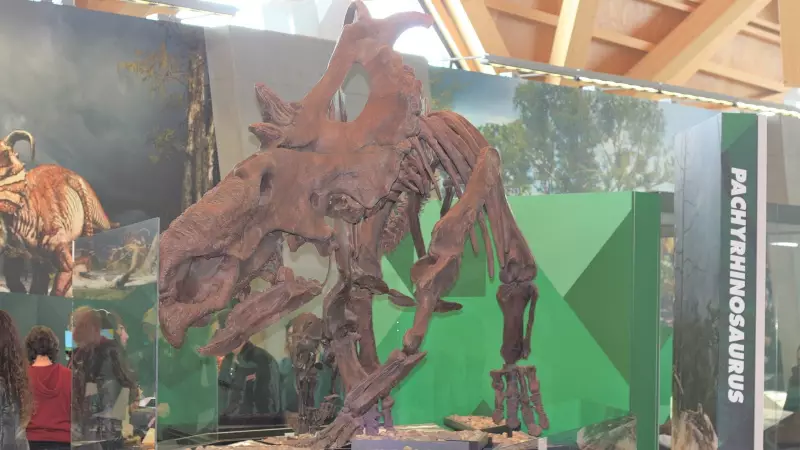
What makes Pipestone Creek exceptional is its sheer density and remarkable uniformity. Unlike other fossil sites with mixed species, this entire bone bed is composed of fossils from one specific type of dinosaur: the Pachyrhinosaurus lakustai, a horned ceratopsian distantly related to the more famous Triceratops.
Palaeontologist Professor Emily Bamforth, a curator at the Philip J. Currie Dinosaur Museum, emphasises the site's significance. She notes there are upwards of 10,000 individual dinosaurs preserved here, making it one of North America's densest bone beds.
"We're talking 100 to 300 bones per square metre, and the site stretches back into the hill for at least a square kilometre," Bamforth explained. "It's a hugely dense bone bed that is very, very large – and that makes it tremendously significant."
The Pachyrhinosaurus was a massive creature, measuring 6–8 metres in length and weighing between 2–4 tonnes. Its most distinctive feature was a large, bony boss on its snout instead of a pronounced horn. Fossils found range from adults to babies, indicating these animals lived and moved in tight-knit, massive herds.
The Catastrophic Event and Modern Exploration
So, how did so many of these dinosaurs end up in one place? Scientists, including Prof. Bamforth, theorise that a sudden, catastrophic flood occurred 72 million years ago. Monsoon rains or a powerful storm surge likely swept an entire megaherd into the creek channel, drowning them simultaneously. Their rapid burial in sediment led to the extraordinary preservation seen today.
Evidence also shows that scavengers like the fearsome Albertosaurus later fed on the remains, leaving clear bite marks on the bones. Today, researchers employ new technologies like 3D scanning and DNA analysis to learn more about life in this ancient ecosystem.
For modern-day explorers, the adventure is just beginning. Located merely 19 km from the bone bed, the Philip J. Currie Dinosaur Museum in Wembley serves as the gateway to this ancient world. The museum offers a range of immersive activities:
- Guided fossil tours and hikes to the site.
- Hands-on public excavation programs at Pipestone Creek.
- Educational paleontology programs designed for all ages.
Visitors can literally walk in the footsteps of giants, following fossil trails and connecting with a world that vanished millions of years ago. This unique destination blends rigorous science with public engagement, making the distant past accessible to everyone.