The year 2025 was a whirlwind of political drama, captured in a series of powerful photographs that defined the global landscape. From the return of a familiar figure to the White House to surprising diplomatic gestures and violent public unrest, the year's visual narrative was one of seismic shifts, power plays, and raw emotion.
A Year Dominated by Trump's Shadow
The political theatre of 2025 was, in many ways, orchestrated by Donald Trump. His inauguration as America's 47th president on January 20 set the tone, a surreal moment for many despite his victory in the November 2024 election. The event also produced an iconic, if unofficial, political image: tech titans Elon Musk, Sundar Pichai, Jeff Bezos, and Mark Zuckerberg seated together, symbolising the convergence of immense technological and political power.
Trump's influence extended globally through a series of tense encounters. His first White House meeting with Ukrainian President Volodymyr Zelenskyy on February 28 was notably fraught, with Senator JD Vance publicly confronting Zelenskyy and Trump later criticising the Ukrainian leader's attire. Later in the year, on October 13, Trump's primacy was on full display at the Gaza Peace Summit in Egypt, where he arrived late, keeping over two dozen world leaders waiting, before addressing them as they stood behind him.

The year also witnessed shocking violence within the US political sphere. On September 10, right-wing activist and Trump ally Charlie Kirk was assassinated during a campus event, a killing that was captured on video and sent shockwaves across the nation.
Diplomatic Carpooling and Shifting Alliances
Beyond Washington, compelling images emerged of new geopolitical equations. A significant moment was the Shanghai Cooperation Organization (SCO) Summit in Tianjin, China, on September 1. A photograph of Prime Minister Narendra Modi alongside Chinese President Xi Jinping and Russian President Vladimir Putin was widely interpreted as a message to the West.
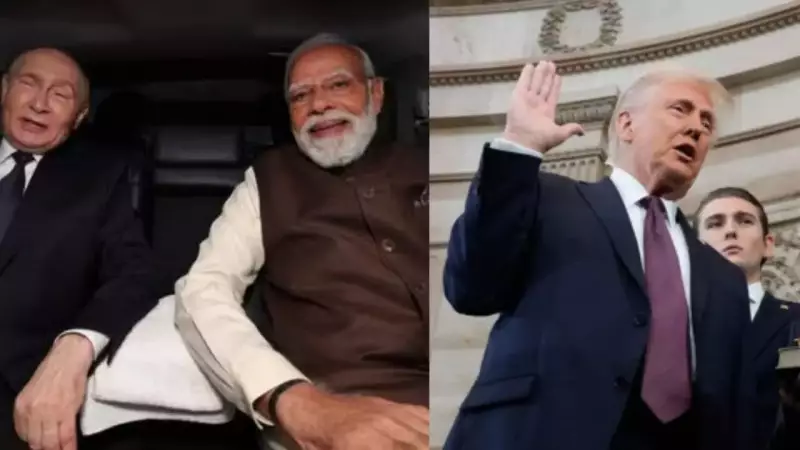
Even more notable was the personal diplomacy between Modi and Putin. The two leaders "carpooled" to the summit venue in Putin's bulletproof car. This gesture was reciprocated in early December during Putin's visit to Delhi, where PM Modi broke protocol to personally receive him and they travelled together in the Prime Minister's vehicle, marking "Carpool 2.0."
Putin was also central to another powerful image. His meeting with Trump on August 15 in Alaska, though ending without a breakthrough on Ukraine, was memorable for Putin's rare use of English, stating, "Next time in Moscow." Meanwhile, in Beijing on September 3, Xi Jinping projected strength by hosting both Putin and North Korea's Kim Jong-un at a massive military parade.
Protests, Resignations, and Regional Upheavals
The year was not just about statecraft; it was also marked by public anger and political exits. In Canada, a visibly dejected Justin Trudeau announced his resignation as Prime Minister on January 6, ending his 11-year premiership amid rising unpopularity.
Protests took creative and destructive forms. In Turkey on March 28, a demonstrator dressed as Pikachu became an unlikely symbol of resistance against the arrest of Istanbul's mayor. The most dramatic scenes of unrest, however, unfolded in Nepal. On September 9, protests escalated violently, culminating in the parliament building in Kathmandu being set ablaze, echoing earlier anti-government movements in Sri Lanka and Bangladesh.
The Middle East provided moments of fragile hope and deep tension. On January 19, emotions ran high as Hamas released three Israeli women—Romi Gonen, Emily Damari, and Doron Steinbrecher—the first hostages freed since the October 2023 attack. Later, on September 29, a White House photo showed Trump holding a phone as Israeli PM Benjamin Netanyahu offered an apology to Qatar's Prime Minister for Israeli strikes in Doha.

In a historic diplomatic move, Trump hosted Syrian President Ahmed al-Shara'a at the White House on November 10, marking the first US visit by a Syrian leader. Domestically, a surprisingly cordial meeting occurred on November 21 between Trump and his critic, New York City mayor-elect Zohran Mamdani, where Trump light-heartedly told him, "It's OK, you can just say yes," when asked if he still believed the president was fascist.
The year ended with a political homecoming in South Asia. On December 25, thousands in Dhaka welcomed Tarique Rahman, son of former Bangladeshi PM Khaleda Zia, back after 17 years in exile, positioning him as a likely future prime minister.
Looking Ahead to 2026
As the world turns the page, 2026 will be the second year of Trump's final term, giving him substantial time to continue shaping global events. Other world leaders, from Modi and Xi to Putin and emerging figures like Rahman, will also be vying to assert their influence. The coming year promises a fresh album of images—moments of conflict, diplomacy, and unexpected turns—that will further define our turbulent political age.