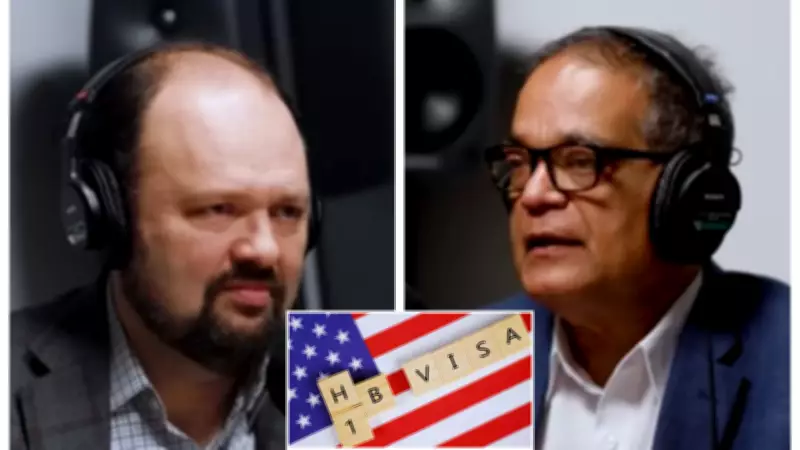
Amitav Acharya Challenges MAGA H-1B Narrative on US Job Theft Claims
In a compelling discussion on the New York Times podcast 'Interesting Times with Ross Douthat', renowned Indian-origin scholar and author Amitav Acharya has directly countered the prevailing MAGA narrative that H-1B visa holders from India are stealing jobs from supporters of former President Donald Trump. Acharya emphasized that this perception is a significant misconception, rooted in a misunderstanding of skill levels and economic dynamics between the two groups.
Skill Disparity and Populist Perceptions in US Immigration
Acharya pointed out that the skill sets of Indian H-1B visa recipients and the typical Trump support base are entirely different, making the notion of job theft implausible. "I can tell you that the Indian diaspora that gets H-1B visas are not taking any jobs from the kind of support base of President Trump. I think these are completely different levels of skill," he stated, underscoring the technical and specialized nature of many H-1B positions, particularly in sectors like Silicon Valley.
He acknowledged that the perception is a real problem, exacerbated by growing populism in the United States. "H-1B visa is partly how American companies recruited them. You have, what? Seventy percent until recently of H-1B visas. This obviously creates a perception. That’s a huge number," Acharya explained, noting that the visibility of this statistic has fueled public concern. "They think: Why should any particular minor ethnic group have a hugely disproportionate share of the visas?"

Acharya linked this to broader anti-immigrant sentiments, recalling how during the COVID-19 pandemic, Chinese individuals were blamed for bringing the virus, and now Indians are being targeted for job displacement. "So this is very political," he remarked, suggesting that the issue is often manipulated for electoral gains rather than based on economic reality.
India's Global Ascent and Diaspora Relations
Beyond immigration debates, Acharya highlighted India's emerging role as a global leader, contrasting it with China's ambitions. Having lived extensively in China over the past two decades, he observed, "in China, there’s an obsession with being No. 1. They won’t say it, they won’t admit it, but they compete with the United States to overtake the United States." In contrast, he argued that India does not seek superpower status in the same aggressive manner, positioning it favorably in the ongoing standoff between America and China.
When asked about India's expectations from its diaspora, Acharya succinctly responded, "Money." He elaborated that the diaspora serves as a significant export for India, contributing remittances and investments. "India has facilitated, in some ways, allowing people with Indian connections born in India to go back and live in India. So India definitely wants them," he added, indicating a strategic interest in maintaining ties with overseas Indians.
Call for Visa Reforms and Broader Perspectives
Acharya advocated for potential reforms in the H-1B system to address perceptions of ethnic favoritism. "I think that it can be addressed and I think maybe some reform there could be useful," he suggested, proposing alternative pathways for Indian professionals to enter the US. He reminded listeners that not all Indian immigrants historically arrived via H-1B visas, criticizing the narrow focus on Silicon Valley narratives.
In summary, Amitav Acharya's insights challenge populist rhetoric by clarifying the economic realities of H-1B visas, while also positioning India's diplomatic and economic strategies on the world stage. His analysis calls for a more nuanced understanding of immigration and global power dynamics, urging policymakers and the public to look beyond simplistic narratives.