

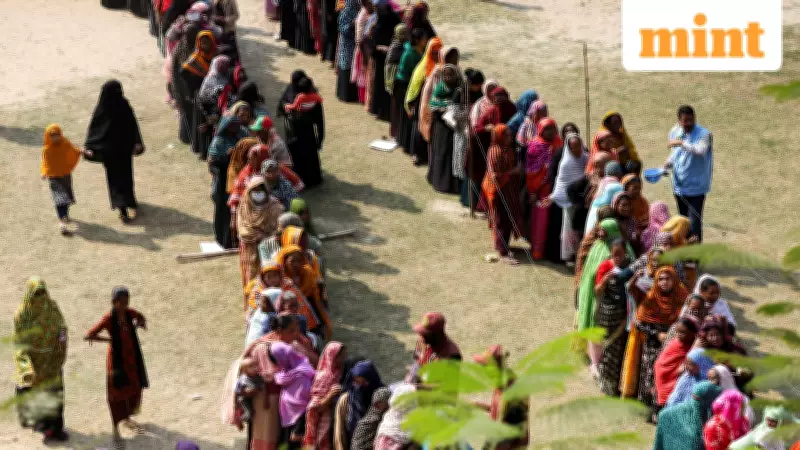
Bangladesh Votes in Historic Election and Reform Referendum
Bangladesh is witnessing a pivotal moment in its political history as citizens head to the polls today to elect a new parliament. This marks the first parliamentary election since the violent protests of August 2024 that led to the ouster of former Prime Minister Sheikh Hasina. Voting commenced at 7:30 AM local time and will continue until 4:30 PM, with counting set to begin immediately afterward. The election results are expected to be officially declared by Friday, setting the stage for a new government.
National Referendum on July Charter Reforms
In a parallel development, Bangladesh is also conducting a national referendum today, giving citizens the opportunity to vote on sweeping reforms to state institutions. This referendum centers on implementing the 'July Charter,' a reform framework drafted in the aftermath of the 2024 student-led uprising. The charter aims to establish good governance, democracy, and social justice through institutional overhauls, with the stated goal of preventing a recurrence of authoritarian and fascist rule, as reported by Reuters.
The interim government, which assumed power following Hasina's removal, approved an implementation order for the charter in November 2024, emphasizing that public approval was essential for enacting these key changes. The July Charter is not a historical constitutional document like the 1972 Constitution but rather a post-uprising reform blueprint initially advocated by student leaders and civil society groups. It was later integrated into the transition discourse under the interim government led by Muhammad Yunus.

What the July Charter Entails
Named after the July 2024 protests—which began over grievances related to the government job quota system and evolved into a broader anti-government movement—the charter represents a set of reform demands and democratic restructuring proposals. Its primary objective is to overhaul Bangladesh's political system, addressing allegations of authoritarianism, election manipulation, and institutional capture under the previous Awami League government.
In today's referendum, voters will decide on four major reform areas:
- Constitutional & Political Reform
- Electoral Reforms
- Judicial & Institutional Independence
- Youth Representation
These reforms include the creation of new constitutional bodies and the introduction of a bicameral parliament, where the upper house would require a majority vote for constitutional amendments. Additionally, the referendum covers the implementation of 30 specific charter reforms, such as term limits for prime ministers and enhanced presidential powers, alongside broader changes aligned with political parties' commitments.
Mechanics and Historical Context of the Referendum
The referendum is being conducted via secret ballot. If a majority votes in favor, a Constitutional Reform Council will be established to complete the reforms within 180 working days from its first session. This is not Bangladesh's first experience with referendums; the country has held three prior to the Hasina government abolishing the provision in 2011. A High Court reinstated it in 2024 after her ouster.
Historically, the 1977 and 1985 referendums asked citizens about their confidence in the then-presidents and their policies, while the third in 1991 inquired whether Bangladesh should transition from a presidential system back to parliamentary democracy. In all three instances, people overwhelmingly voted "yes."
Significance and Criticisms of the July Charter
The July Charter referendum has become central to Bangladesh's political narrative, especially as it coincides with the 2026 parliamentary elections. The student-led National Citizen Party and its allies have framed the vote as a mandate for implementing the charter's reforms, symbolizing a break from what protesters describe as the "two-dynasty" political system dominated by the Awami League and the Bangladesh Nationalist Party (BNP).

However, the referendum has faced criticism for bundling multiple reform proposals into a single yes-or-no question, which some argue denies voters the chance to decide on each reform individually. Critics, including those cited by Reuters, contend that this approach confuses voters by presenting a complex premise and limits their ability to fully understand and debate the reforms. Additionally, there has been backlash against the interim government and political parties for framing a "yes" vote as essential, which critics say shrinks space for dissent by implying that voting "no" equates to rejecting reform altogether.
Despite these controversies, the July Charter stands as a crucial reform blueprint aimed at transforming Bangladesh's political landscape after years of perceived authoritarianism. As the nation votes today, the outcomes of both the election and the referendum will significantly shape its future governance and democratic trajectory.





