

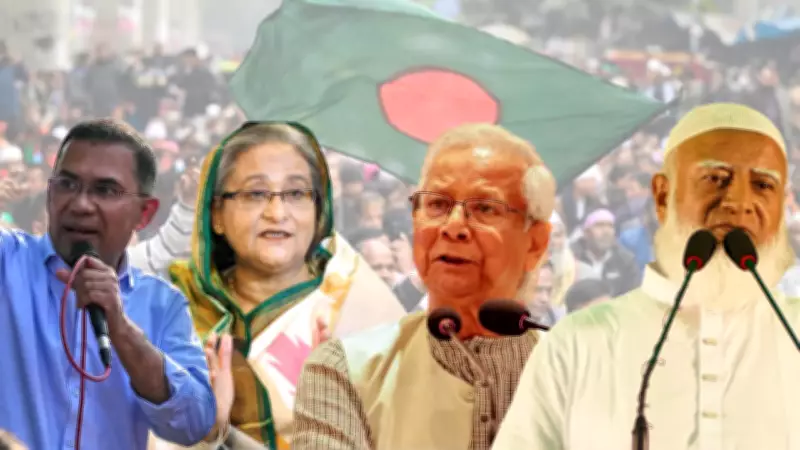
Bangladesh Votes in Historic Election After 2024 Uprising: A Nation at Crossroads
After months of intense violence, widespread street protests, and profound political upheaval, Bangladesh now confronts its moment of reckoning. What began in July 2024 as student agitation over public sector job quotas rapidly spiraled into a nationwide revolt against Sheikh Hasina's government, culminating in her dramatic resignation and subsequent flight to India. The unrest resulted in more than 1,000 fatalities and dismantled a political order that had been entrenched in Dhaka's politics for over a decade.
Now, on February 12, Bangladesh participates in its first general election since that historic uprising. This ballot will test not only the strength of its democratic institutions but also the direction of its national identity. Nobel laureate Muhammad Yunus, who assumed leadership after Hasina's ouster, stated that the interim government "will hand over the responsibility to the newly elected government with deep pleasure and pride."
Radical Political Reshaping
The political landscape has undergone a radical transformation. The once-dominant Awami League has been effectively sidelined, creating space for a resurgent Bangladesh Nationalist Party under Tarique Rahman and an emboldened Jamaat-e-Islami seeking renewed legitimacy. For Bangladesh, this represents a struggle to restore stability following a period of intense instability.

This election holds significant implications for a region grappling with growing instability, where governments have fallen and leaders have fled with remarkable frequency. For neighboring powers India, China, and Pakistan, this moment could potentially redraw the strategic balance across South Asia.
The Path to This Election
In 2024, widespread student protests erupted over public sector job quotas but quickly escalated into a nationwide revolt against the Hasina administration. By early July, protesters clashed violently with police in Dhaka and other major cities. The unrest peaked in early August when security forces opened fire on demonstrators.
On August 5, 2024, the situation culminated in the resignation of Sheikh Hasina, who immediately departed for India. Over 1,000 people lost their lives in the clashes—the deadliest violence Bangladesh has witnessed since its 1971 independence war. In the aftermath, a caretaker government was established, headed by Nobel laureate Professor Muhammad Yunus, best known for his microfinance initiatives.
This interim cabinet—comprising former bureaucrats, civil society figures, and student leaders—assumed power in late August 2024. It pledged to maintain order, prosecute crimes committed during the protests, and prepare for new elections. Among its initial actions was promulgating a provisional "July Charter" of reforms, advocating constitutional changes and term limits to curb executive power. A referendum on this charter is being conducted alongside the election.
By law, elections must be held by early 2026. Notably, the once-dominant Awami League has been effectively excluded, as the interim government banned the party in response to allegations of crimes during the protests. Instead, the electoral race centers on the BNP-led opposition coalition with Islamist allies and several smaller groups, including the new National Citizen Party founded by student activists.
Key Political Players
The Bangladesh Nationalist Party Under New Leadership
The Bangladesh Nationalist Party has been one of the two major political forces in Bangladesh for decades. Founded by President Ziaur Rahman in the late 1970s, it was led by his widow, Khaleda Zia, from 1984 onward. Khaleda served three terms as prime minister and remained a central figure in Bangladeshi politics despite legal troubles and house arrest in the late 2010s.
Her death in late December 2025 created a leadership vacuum. The party immediately selected her eldest son, Tarique Rahman, as acting chairman. Tarique had fled the country in 2007 amid corruption charges and lived in exile in London for nearly 18 years. His surprise return on December 25, 2025, proved dramatic, with thousands of BNP supporters greeting him as he positioned himself as the torchbearer of his mother's political legacy.

Tarique Rahman's re-entry has greatly energized the BNP base. He is widely expected to be the party's prime ministerial candidate if the alliance secures a majority. In his initial campaign speeches, Tarique emphasized themes of national pride and stability, criticizing Islamist rivals for exploiting religion and vowing to "uphold national sovereignty and work for women and young people."
The BNP's weaknesses have also become apparent. Khaleda's prolonged illness largely kept her out of politics since 2018, and the party's cadres have suffered under Awami League crackdowns in recent years. Its alliance building remains fragile, with other Islamist groups breaking away from Jamaat's alliance over seat disputes. Nonetheless, with the Awami League absent, Tarique's return has positioned the BNP as a frontrunner for power.
Jamaat-e-Islami's Resurgence
Jamaat-e-Islami represents Bangladesh's largest Islamist party. It was banned from elections and effectively outlawed after 2013, when courts ruled its charter violated the secular constitution. Many Jamaat leaders had been convicted for war crimes related to the 1971 Liberation War due to the party's support for Pakistan during that conflict.
This changed in mid-2025. On June 1, 2025, Bangladesh's Supreme Court restored Jamaat's registration in a landmark decision that came as the interim government promised inclusive polls. The court lifted Jamaat's election ban and overturned the conviction of one of its leaders, paving the way for its participation in the 2026 elections.
With Jamaat back in play, the Islamist party formally launched an electoral alliance, teaming up with ten other parties, including the Gen-Z-led National Citizen Party. Jamaat's platform remains rooted in Islamic principles, but the party has visibly rebranded itself for 2026. Party leader Dr. Shafiqur Rahman has emphasized social welfare and anti-corruption measures, steering away from its former hard-line image.
Jamaat has reached out to demographics it once ignored, fielding a Hindu candidate for parliament for the first time and publicly condemning recent attacks on minorities. Officially, Jamaat states it will govern under Bangladesh's existing laws rather than imposing immediate Sharia rule.
National Citizen Party: Gen Z Faces Defining Test
The National Citizen Party emerged from the blood and fury of July 2024. The student protests propelled a new generation of activists into formal politics. Formed in early 2025 and led by 27-year-old Nahid Islam, the NCP aims to break decades of dominance by the Awami League and BNP.
Its platform centers on tackling corruption, ensuring judicial independence, protecting press freedom, and reforming governance through the July Charter. The party has pledged justice for those killed in the uprising, lowering the voting age to 16, job creation through economic reform, and greater women's representation in parliament.
Yet translating street power into votes has proven challenging. Opinion polls ahead of the February 12 election suggest the NCP trails behind the BNP and Jamaat-e-Islami. Lacking funds and grassroots machinery, the party struck an electoral alliance with Jamaat in December, describing it as a "strategic" rather than ideological pact designed to prevent instability and electoral sabotage.
This move has triggered internal revolt, with at least 30 senior figures opposing the alliance and several resigning. Critics argue the partnership risks diluting the NCP's centrist identity and tethering it to Jamaat's controversial past.
Regional Implications and Strategic Stakes
A Complex Situation for India
Bangladesh's ties with India have long oscillated with domestic politics. Under Khaleda Zia's BNP governments, relations were often tense, with Khaleda positioning the BNP as a "protector of Bangladeshi interests against Indian domination." Her alliance with Jamaat exacerbated those frictions, as Jamaat elements in Bangladesh harbored extremists hostile to India during the early 2000s.
In contrast, Sheikh Hasina's Awami League governments worked closely with India, cracking down on anti-India militants and resolving various disputes. The revolutionary upheaval that removed Hasina has strained relations with India, as New Delhi viewed her as a reliable ally. The interim government has been openly critical of India's hospitality to Hasina, with Yunus's advisers complaining that India allowed "incendiary" remarks from Hasina's exile to go unpunished.
For New Delhi, Bangladesh represents far more than a neighbor; it serves as a strategic linchpin in South Asia's evolving geopolitical architecture. The two countries share a 4,000-kilometer border, deep economic ties, and common concerns including climate change and Rohingya refugees. India has historically attempted to maintain good relations regardless of which Bangladeshi party holds power.
A central strategic theme for India involves connectivity with its northeastern states. The Siliguri Corridor, commonly known as the "Chicken's Neck," remains crucial for India's territorial cohesion as the sole land link to eight northeastern states. New Delhi has invested in alternative logistics and security measures, including plans for an underground railway line to strengthen this corridor against disruption.
Access to Bangladeshi ports also intersects with India's broader Act East Policy, which aims to link India's northeast with Southeast Asian markets. Ongoing infrastructure cooperation, such as expanded rail and road links across the border, has been encouraged in diplomatic dialogues.
Stakes for Pakistan and China
Beyond ideology and geopolitics, both Pakistan and China remain sensitive to economic fallout in Bangladesh. The garment sector, the backbone of Bangladesh's export economy, remains fragile after tariffs and instability dented orders and investor confidence. A government that cannot reassure buyers or imposes unsettling policies will cascade economic pain through the region.
For Pakistan, Jamaat's rise would carry symbolic weight due to the party's historical links to Islamist politics in the subcontinent and its controversial position during the 1971 Liberation War. A stronger Jamaat presence in government could open warmer political channels between Bangladesh and Pakistan, potentially softening decades of distrust.
For China, Jamaat's rise presents a more complex equation. Beijing's interests in Bangladesh are overwhelmingly economic and strategic, encompassing infrastructure, energy, digital networks, and maritime access linked to the Belt and Road Initiative. China has become one of Bangladesh's largest trading partners and a key financier of major projects.
A Jamaat-influenced administration might not necessarily disrupt these ties, as Islamist parties have often shown pragmatic streaks in foreign policy when economic survival is at stake.
Economic Implications
Whichever party prevails, Bangladesh's economic health will shape the regional equation. The country's export-driven model, centered on garments, depends on stability, investor trust, and access to Western markets. Prolonged unrest or policy uncertainty would dampen growth and affect regional trade flows.
For China, Bangladesh serves as a gateway to the eastern Indian Ocean and a critical node in regional connectivity. For Pakistan, improved ties with Dhaka would signal diplomatic breathing space in South Asia. But neither capital can override Bangladesh's domestic priorities: jobs, inflation control, and social stability.
The Future of Bangladesh
Bangladesh's February 12 election represents not simply a transfer of power but a reckoning with the political order that has defined the country for nearly two decades. The uprising of 2024 shattered the dominance of one party but did not resolve deeper questions about identity, governance, and the balance between secular nationalism and political Islam.
For the BNP, this constitutes a bid for restoration under Tarique Rahman. For Jamaat-e-Islami, it represents a quest for renewed legitimacy after years in the wilderness. For voters, it presents a choice about stability, ideology, and the limits of executive power.
Beyond Bangladesh's borders, the implications remain profoundly strategic. India will seek continuity and security, China will guard its investments, and Pakistan will watch for diplomatic openings. The outcome will not simply decide a government but signal which direction a pivotal South Asian state chooses at a moment of regional uncertainty.
Ultimately, this election will reveal something more fundamental: whether Bangladesh emerges from crisis with a clearer democratic center or whether fragmentation and competitive nationalism become its defining features. In a region already unsettled by political churn, the direction Dhaka chooses will resonate far beyond its borders.





