

BNP Secures Decisive Victory in Bangladesh Elections as Jamaat Makes Border Gains
In a significant political development, the Bangladesh Nationalist Party (BNP) has achieved a decisive victory over the hardline Jamaat-e-Islami in the recently concluded national elections. However, the latter has managed to secure multiple parliamentary seats in constituencies situated along the sensitive India-Bangladesh border, creating a geopolitical pattern that mirrors the Bharatiya Janata Party's (BJP) own electoral gains in Indian border districts during the 2021 West Bengal assembly polls.
Border Constituencies Show Jamaat's Strategic Presence
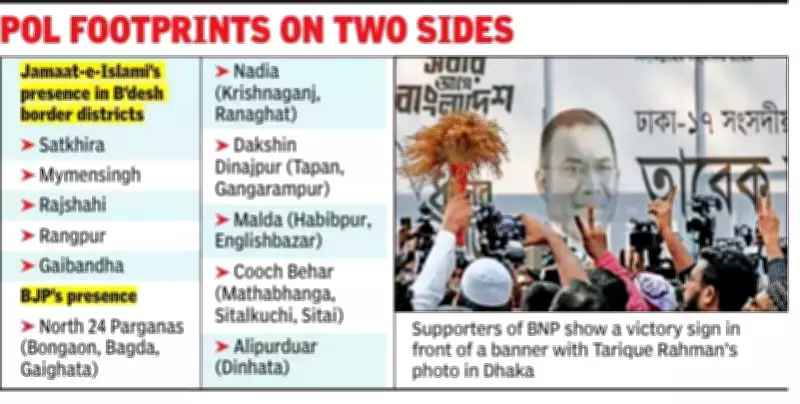
Large areas along the extensive India-Bangladesh border, spanning Indian districts including South 24 Parganas, North 24 Parganas, Nadia, Murshidabad, Malda, and Alipurduar, share geographical proximity with Bangladeshi constituencies where Jamaat-e-Islami has now won seats. This development is of particular concern to Indian security analysts given Jamaat's historical and ideological proximity to Pakistan.
Political observers note that five years ago, the BJP had similarly performed well in at least 16 assembly constituencies on the Indian side of this border stretch, covering districts such as North 24 Parganas, Nadia, Malda, and Alipurduar. The parallel electoral patterns on both sides of the border have raised questions about cross-border political influences and security implications.

Jamaat's Expanding Footprint Across Western Bangladesh
In the just-concluded Bangladesh elections, Jamaat-e-Islami has established a significant political footprint across the entire western part of the country. This includes key districts such as Satkhira, Sherpur in Mymensingh division, Naogaon in Rajshahi, Rangpur, and Gaibandha.
Awami League leaders indicated on Friday that Jamaat-e-Islami, which was previously banned in Bangladesh, has been systematically spreading its influence across large parts of the country over the past year. Salim Mahmud, former Member of Parliament from Chandpur (1), stated, "Jamaat-e-Islami is a radical outfit which believes in hardline ideologies that were never acceptable to democratic parties like the Awami League. Unfortunately, they managed to spread their organizational network across Bangladesh during the tenure of the interim government."
Historical Context and Political Resurgence
The political journey of Jamaat-e-Islami in Bangladesh has been marked by significant fluctuations. In the 2001 national elections, the party participated actively and secured 17 parliamentary seats in areas including Jessore, Khulna, Dinajpur, and Satkhira. However, by the 2008 elections, its presence had dramatically reduced to just two seats.
A major setback occurred in 2013 when the Supreme Court of Bangladesh cancelled Jamaat's registration as a political party. Despite this legal challenge, Awami League leaders pointed out that Jamaat continued its underground activities in regions such as Gaibandha, Rangpur, Chittagong, Sylhet, and Bogra.
One Awami League leader recounted, "When one of their senior leaders, Delwar Hossain Saidee, was given a death sentence by the International Crimes Tribunal, Jamaat and its student wing supporters responded by destroying households, temples, and shops in these areas. This violence prompted many Hindu families to flee their homes."
From Ban to Political Rehabilitation
While former Prime Minister Sheikh Hasina had imposed a complete ban on Jamaat-e-Islami during her tenure, the interim government lifted this prohibition in August 2024. Following this political rehabilitation, Jamaat resumed and intensified its political activities across Bangladesh, particularly consolidating its presence along the sensitive border regions with India.
During the 2026 national polls, the party ended up significantly strengthening its political presence in strategic areas including Satkhira, Kushtia, parts of Khulna, and Rangpur. These regions directly face the Indian states of West Bengal, Assam, and the crucial Siliguri corridor, making their political alignment particularly significant for regional security dynamics.

Indian Concerns and Diplomatic Implications
Union Minister Sukanta Majumdar expressed India's concerns regarding these developments, stating, "Bangladesh is a sovereign neighboring country. We expect the newly formed government to maintain law and order and ensure that minorities are not persecuted. However, Jamaat's electoral victories along the border of West Bengal and Bangladesh are indeed worrying. This pattern indicates that there has been strong radicalization on both sides of the border, which requires careful monitoring and diplomatic engagement."
The electoral success of Jamaat-e-Islami in border constituencies has raised important questions about cross-border political influences, regional security architecture, and the potential for ideological spillover effects. As Bangladesh transitions to a new government led by the BNP, Indian policymakers will be closely watching how the new administration addresses the presence of hardline elements in sensitive border regions while maintaining the historically strong bilateral relationship between the two neighboring nations.





