

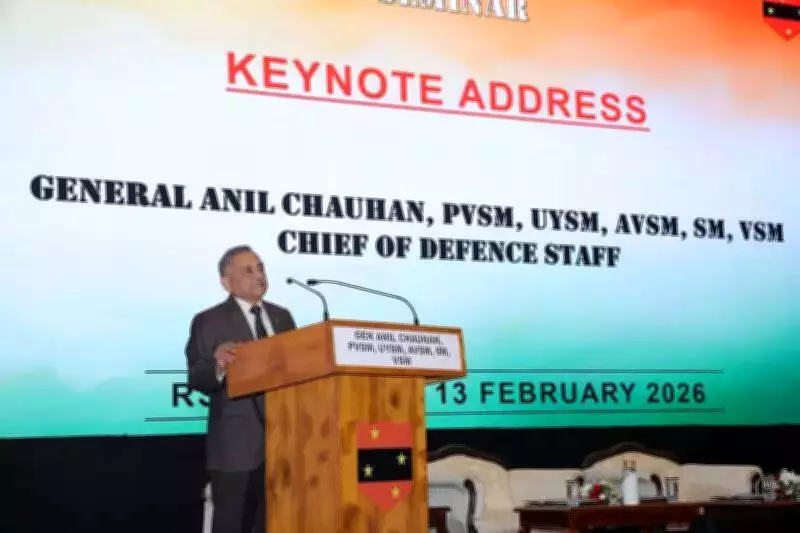
CDS General Anil Chauhan Highlights Fluid Global Alignments at Southern Command Seminar
In a significant address at a seminar organized by the Southern Command in Pune, Chief of Defence Staff (CDS) General Anil Chauhan issued a stark caution on Friday against relying on outdated notions of permanent friends or fixed adversaries. He emphasized that in today's rapidly evolving global security landscape, such traditional assumptions are becoming increasingly unreliable and potentially dangerous for national strategy.
The Erosion of Traditional Strategic Certainties
General Chauhan articulated that strategic alignments across the world are undergoing a profound transformation, becoming more fluid, transactional, and driven primarily by short-term national interests. This shift makes it exceptionally difficult to predefine allies, adversaries, or partners with any lasting certainty.
"In today's world, it is increasingly difficult to define who are your friends, who are your allies, who are your adversaries and who are your enemies," the CDS stated unequivocally. He underlined that this reality necessitates India being prepared mentally, structurally, and materially to act independently whenever national interests demand, without depending on assumed external support.

Partnerships Versus Indigenous Capability
While acknowledging the value of international partnerships, General Chauhan made a critical distinction, asserting that such collaborations cannot substitute for indigenous capability or strategic autonomy. "Partnerships are effective only when they align with national interests. They cannot replace the freedom of choice that comes from self-reliance," he explained, reinforcing the core principle of Atmanirbharta (self-reliance) as non-negotiable for India's security.
The Changing Character of Global Geopolitics
The CDS provided a detailed analysis of the shifting global dynamics, pointing to the rise of coercive nationalism and the weaponization of economic tools. He noted that trade networks, global supply chains, technology access, data flows, and critical resources are increasingly being leveraged as instruments of strategic influence and pressure.
General Chauhan observed that earlier optimistic assumptions of seamless globalization and international convergence are now giving way to a new era marked by fragmentation, deepening social polarisation, and competitive nationalism. This environment challenges the very foundations of predictable state behavior.
Norms Under Strain and New Battlefronts
Highlighting a departure from established international norms, the CDS stated that concepts like sovereignty and territorial integrity are being increasingly questioned. "Might is increasingly becoming right, and the rule-based order is under strain," he warned, painting a picture of a world where power dynamics are being recalibrated.
He further stressed that modern conflict has transcended the paradigm of declared wars. Today's security challenges are characterized by proxy warfare, sub-threshold operations, relentless cyber activities, and sustained information campaigns. Cognitive and information warfare, in particular, are emerging as central battle spaces designed to fracture societal cohesion and paralyze decision-making processes without triggering conventional military responses.
Redefining Victory in the Modern Age
In this complex context, General Chauhan redefined the concept of victory—Vijay. He argued that enduring victory cannot be measured through mere rhetoric or symbolic destruction. "Enduring victory lies in demonstrated evidence and verifiable outcomes, not in temporary damage to infrastructure or slogans of success," he asserted, calling for a results-oriented approach to national security.
The JAI Framework: A Path Forward
Linking this vision of victory to the seminar's theme of Jointness, Atmanirbharta, and Innovation (JAI), the CDS presented the framework as essential for addressing future security challenges. He elaborated that Jointness is not merely an organizational reform but a fundamental mindset requiring integrated planning across all military and national domains.

Atmanirbharta, he clarified, represents strategic autonomy and self-reliance, not isolationism. Meanwhile, Innovation must permeate every aspect—from military doctrines and leadership styles to training methodologies and institutional culture—to keep pace with rapid technological and tactical changes.
Drawing from India's strategic heritage, General Chauhan concluded that true victory involves overcoming internal vulnerabilities such as outdated doctrines, organizational silos, and colonial-era mindsets. "JAI is not just about defeating an external adversary. It is equally about victory over inertia, prejudice, and institutional comfort," he remarked.
Call for Self-Reliance and Independent Thinking
As global uncertainties continue to deepen, the CDS asserted that India's security preparedness must be firmly rooted in independent strategic thinking, robust indigenous capability, and the agility to adapt swiftly. In a world where alliances can no longer be taken for granted, self-reliance becomes the cornerstone of national defense.
Echoing this sentiment, Southern Army Commander Lieutenant General Dhiraj Seth emphasized that achieving self-reliance is paramount in the current security dynamics. "And therefore we need to emphasise this thought through seminars like JAI, where all stakeholders will come together and brainstorm their thinking to achieve the operational objectives of the force," said Lt Gen Seth.
The seminar witnessed participation from several senior Army officers representing all formations of the Southern Command, alongside distinguished Army veterans and academics, highlighting a collective commitment to rethinking India's defense posture in an unpredictable world.





