

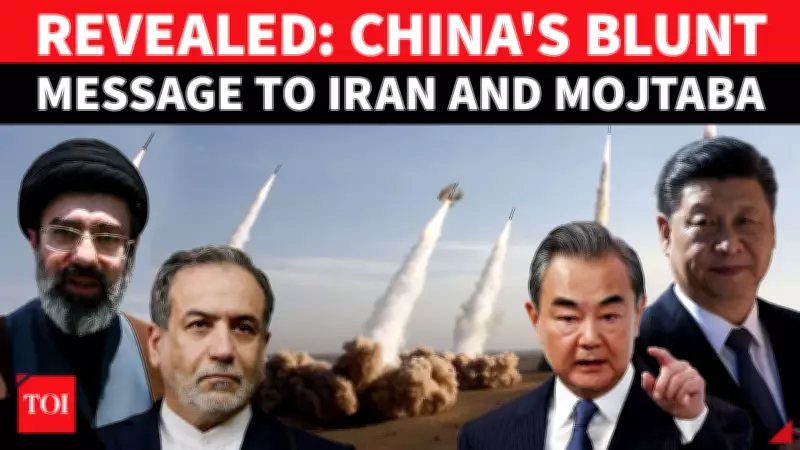
China's Strategic Plea for Peace Amid US-Iran-Israel Conflict
In a stark departure from the escalating military actions defining the current Middle East conflict, China has delivered a blunt and unambiguous message to the United States, Israel, and Iran: stop fighting. As tensions rage with missile barrages and military posturing, Beijing is advocating for a path of dialogue over destruction, framing its call not merely as diplomacy but as a critical strategic necessity.
The Core of China's Warning: Economic Survival at Stake
This intervention is deeply rooted in national interest. China's economy is profoundly dependent on stable energy imports, with a significant portion of its oil transiting through the Strait of Hormuz. This narrow maritime chokepoint, now a potential flashpoint in the conflict, represents a vital artery for global trade. A prolonged war or, worse, a blockade in the Hormuz Strait, doesn't just threaten regional stability; it poses a direct and immediate threat to Beijing's economic security and growth projections.
When Chinese officials call for talks and de-escalation, they are not simply playing the role of a neutral peacemaker. They are actively working to contain the economic fallout of a conflict that could disrupt global energy supplies and send shockwaves through international markets. The message is clear: continued hostilities are detrimental to all, with China's own prosperity hanging in the balance.

A Context of Escalation and Global Repercussions
This call comes against a backdrop of severe escalation. Reports detail Iranian missile attacks targeting Israeli cities like Tel Aviv and Haifa, claims of advanced weapon deployments, and a complex web of US and Israeli responses. The situation has grown so volatile that it has prompted discussions of US troop movements and raised fears of a wider regional conflagration.
China's warning underscores a broader global anxiety. A conflict that chokes the Strait of Hormuz would not only impact China but could trigger a worldwide energy crisis, affecting economies and consumers far beyond the Middle East. Beijing's stance highlights the interconnected nature of modern geopolitics, where a regional war has immediate global consequences.
The Diplomatic Path Forward
By publicly urging de-escalation, China is positioning itself as a key stakeholder demanding rationality. Its strategy involves:
- Publicly advocating for a ceasefire and a return to negotiation tables.
- Emphasizing the shared economic ruin that prolonged conflict guarantees.
- Attempting to leverage its diplomatic relationships to cool tensions.
This move is a calculated effort to shield its interests while presenting an alternative to the cycle of strikes and counter-strikes. Whether the warning will be heeded by the warring parties remains uncertain, but China has made its position and its priorities unmistakably clear. The stability of the Hormuz Strait is not negotiable for Beijing, making its call for peace both a moral appeal and an economic imperative.






