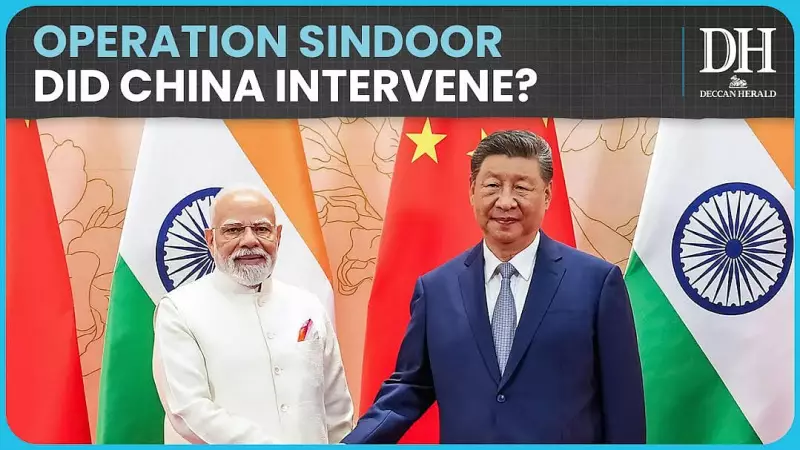
In a recent diplomatic development that has raised eyebrows in New Delhi, China has publicly claimed credit for facilitating a ceasefire in India's northeastern state of Manipur. The claim, made by Chinese Foreign Minister Wang Yi, refers to the period of relative calm following what is known as 'Operation Sindoor'. However, Indian officials have swiftly and firmly rejected this assertion, stating that the peace process is a purely internal matter.
The Chinese Claim and India's Firm Rejection
Chinese Foreign Minister Wang Yi, during a speech at an international forum, stated that China had played a constructive role in promoting peace talks in South Asia. He specifically pointed to the situation in Manipur, suggesting Beijing's efforts led to a ceasefire. This claim directly references the reduced violence after Operation Sindoor, a security action undertaken by Indian forces.
The Indian government's response was unambiguous. Official sources categorically denied any third-party involvement in the internal affairs of Manipur. They emphasized that the improvement in the situation was the result of efforts by the Government of India, state authorities, and the local communities. The Indian stance underscores a core principle of its foreign policy: non-interference in domestic matters.
Background: Operation Sindoor and the Manipur Context
Operation Sindoor was launched by Indian security forces to quell violence and restore order in Manipur. The state has witnessed ethnic clashes, primarily between the Meitei and Kuki communities, leading to significant loss of life and displacement. The operation aimed to enforce strict measures to curb the unrest.
The period following the operation saw a noticeable reduction in violent incidents, creating a window for dialogue and peace-building efforts initiated by the Indian government. The complex situation involves historical, ethnic, and socio-economic factors unique to the region, with no legitimate role for external actors in its resolution.
Diplomatic Undercurrents and Strategic Messaging
Analysts view China's claim as part of a broader pattern of strategic messaging. By asserting influence in India's neighborhood and even in its internal conflicts, Beijing aims to project itself as a major power capable of mediating regional disputes. This move comes amidst ongoing military standoffs and diplomatic friction along the India-China border.
The claim was made just before a scheduled meeting between Indian Defence Minister Rajnath Singh and Chinese Minister Wang Yi on the sidelines of the Shanghai Cooperation Organisation (SCO) defence ministers' meeting. This timing is seen as significant, potentially aimed at setting a narrative or gaining leverage in bilateral talks. India's firm rebuttal serves to counter this narrative and reaffirm its sovereignty.
The core facts remain: China has claimed a role in the Manipur ceasefire; India has rejected this claim entirely; and the situation in Manipur remains a sensitive internal issue for India to address through its own mechanisms.
This incident highlights the fragile nature of India China relations, where trust is in short supply. It reinforces India's position that stability in its regions is achieved through domestic resolve, not external mediation. The exchange sets a clear boundary as the two Asian giants continue to navigate their complex and often contentious relationship.