

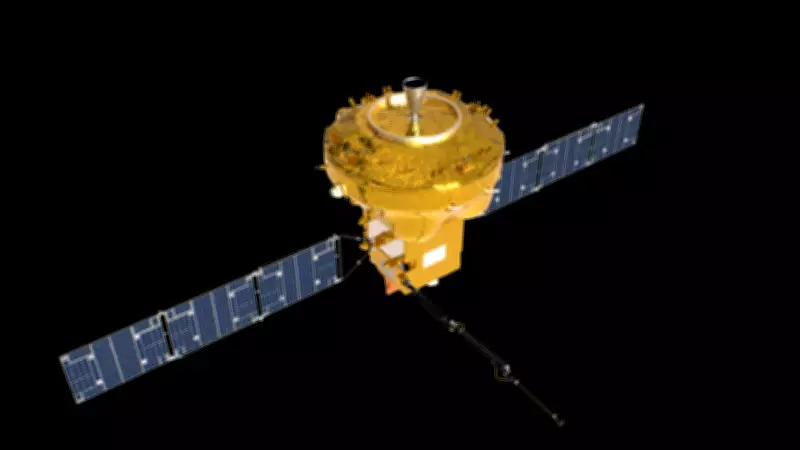
China-Europe SMILE Mission: A Pioneering Space Weather Collaboration
In an era where space exploration is often characterized by competition, a remarkable partnership between China and Europe has captured global attention. The collaborative initiative, known as the Solar wind Magnetosphere Ionosphere Link Explorer (SMILE), represents a significant breakthrough in international space research. This project focuses on investigating how solar activity affects Earth's magnetosphere and stems from years of cooperation between the European Space Agency (ESA) and the Chinese Academy of Sciences (CAS). Beyond being a successful engineering feat, SMILE exemplifies a shared commitment to exploring space for the benefit of all humanity.
SMILE Mission: Understanding Space Weather and Earth's Protective Shield
The primary objective of the SMILE mission is to study the interaction between solar wind and Earth's magnetosphere—the invisible protective sphere surrounding our planet. Scientists at the National Space Science Center of the Chinese Academy of Sciences aim to understand how charged solar particles influence Earth's upper atmosphere. What sets this mission apart from others in the field is its multifaceted approach, incorporating X-ray imagery, ultraviolet observations, and in-situ measurements. Researchers assert that these methods will make Earth's invisible magnetosphere "visible" for the first time.
This investigation is critically important because space weather can have adverse effects on satellites, communication systems orbiting Earth, and even power stations on the ground. By enhancing our understanding of these phenomena, the SMILE mission could help mitigate risks to technological infrastructure and improve space weather forecasting capabilities.

China-Europe Space Collaboration: A Rare Scientific Partnership
Not only is the scientific scope of SMILE noteworthy, but its collaborative nature also makes it exceptional. This mission represents one of the relatively rare joint ventures between China and Europe in space exploration. Historically, ESA has collaborated with China on other space research initiatives, such as the Double Star mission, which also focused on studying Earth's magnetosphere. This long-term partnership has been described as "a significant advance for international cooperation in the exploration of outer space."
According to reports from China Daily, Europe contributed critical scientific instruments for the mission, while China provided the spacecraft platform and launch services. Final preparations for the launch took place at the European spaceport in French Guiana, highlighting the integrated nature of this international effort.
Why This Joint Space Mission Matters for the Future
The SMILE mission sends a powerful message about cooperation in a world increasingly divided by political tensions. Space agencies, though often constrained by national boundaries, demonstrate that sharing knowledge and resources can help overcome barriers. This type of collaboration is essential for addressing complex challenges in space science, as joint efforts enable missions that would be difficult for any single country to accomplish alone.
Furthermore, the SMILE mission is likely to set a precedent for future international cooperation in space exploration, particularly in studying planetary environments and deep-space objects. It may serve as a model for other nations seeking to collaborate on scientific endeavors. Ultimately, this unique partnership between China and Europe shows that scientific curiosity and the pursuit of discovery continue to unite the global community, transcending geopolitical differences.






