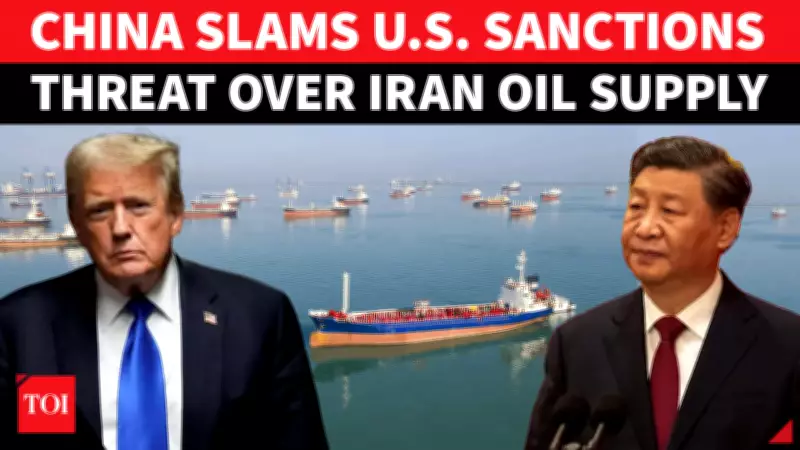
China's Foreign Ministry Condemns U.S. Sanctions Threat Over Iranian Oil
In a sharp escalation of diplomatic tensions, the Ministry of Foreign Affairs of the People's Republic of China has publicly denounced Washington's recent push for increased pressure regarding Iranian oil purchases. The Chinese government has categorically rejected the United States' sanctions threat, labeling the move as legally baseless and unilateral without proper United Nations backing.
Official Statement from Beijing
Spokesperson Guo Jiakun, representing China's Foreign Ministry, delivered a strongly worded statement opposing all unilateral sanctions imposed by the United States. Guo emphasized that such measures fundamentally undermine established principles of international law and create unnecessary friction in an already volatile region.
The Chinese spokesperson specifically warned that Washington's approach to sanctions could have far-reaching consequences for global maritime security and international relations. This statement comes at a particularly sensitive time when tensions have been steadily escalating throughout the Gulf region, with multiple nations expressing concern about potential conflicts.

Background of the Diplomatic Confrontation
The diplomatic exchange follows clear signals from the United States Department of the Treasury indicating that secondary sanctions could potentially target foreign financial institutions and companies involved in Iranian oil trade. These sanctions would extend beyond direct U.S.-Iran relations to penalize third-party nations and entities conducting business with Tehran.
China has maintained consistent economic ties with Iran, including significant oil purchases, despite various international sanctions regimes. The Chinese government views these economic relationships as legitimate bilateral engagements that should not be subject to external interference or unilateral pressure from other nations.
Broader Implications for International Relations
The confrontation highlights several critical issues in contemporary international diplomacy:
- The ongoing tension between unilateral sanctions and multilateral approaches through United Nations mechanisms
- China's growing assertiveness in defending its foreign policy and economic interests on the global stage
- The complex dynamics of Gulf region politics where multiple global powers have significant strategic interests
- The challenge of maintaining international law principles amid great power competition
This diplomatic exchange occurs against a backdrop of increasing maritime friction in strategic waterways, particularly around the Strait of Hormuz through which a substantial portion of global oil shipments passes. The Chinese statement reflects Beijing's determination to protect what it views as legitimate economic activities while challenging what it perceives as U.S. overreach in international affairs.
The development adds another layer of complexity to already strained U.S.-China relations, which have been marked by trade disputes, technological competition, and differing approaches to global governance. As both nations assert their positions regarding Iranian oil, the international community watches closely how this diplomatic confrontation might influence broader geopolitical alignments and economic relationships in the coming months.