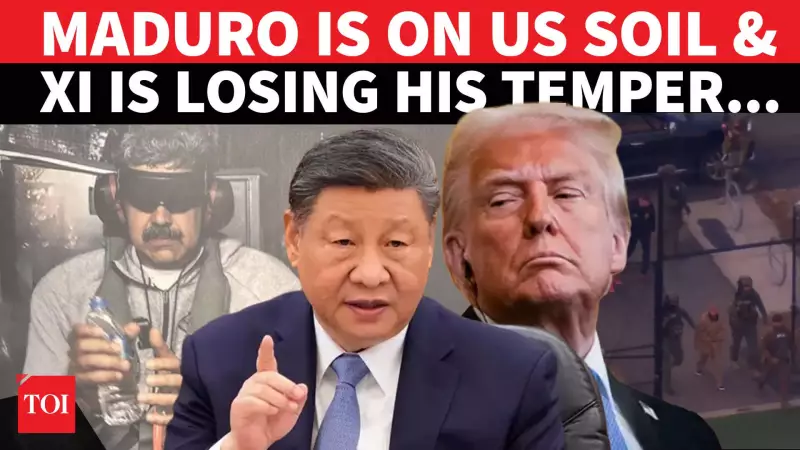
China has delivered a third and forceful warning to the United States, condemning Washington's large-scale military operation in Venezuela that led to the capture of the country's President, Nicolás Maduro, and his wife, Cilia Flores. The sharp rebuke, issued on January 7, 2026, accuses the US of overstepping its bounds and asserts that no nation has the right to act as the global "police or judge."
Beijing's Firm Stance on Sovereignty and Intervention
In its latest statement, Beijing strongly criticised the United States for its direct military strike on Caracas. The Chinese government reiterated its unwavering support for Venezuela's sovereignty and territorial integrity. It firmly rejected any form of military intervention in the internal affairs of another country.
China also extended its criticism beyond Venezuela, warning against continued US pressure on other South American nations. Beijing expressed its support for regional efforts aimed at maintaining Latin America as a zone of peace, free from external aggression and destabilisation.

Political Shifts and Provocative Remarks
The diplomatic clash unfolded alongside significant political developments within Venezuela. On the same day as China's warning, Delcy Rodríguez was officially sworn in as the interim president of Venezuela, marking the first day of her new office. This move aims to establish a continuity of governance following the dramatic capture of Maduro.
Adding fuel to the regional tensions, US President Donald Trump made provocative remarks concerning Colombia and Cuba. These comments have intensified fears among international observers of a potential escalation and wider instability spreading throughout the Latin American region.
Mounting Global Outrage and the Path Forward
China's vocal position adds to a growing chorus of global outrage concerning the US-led military action. The capture of Maduro, described by his supporters as a "prisoner of war," and the visible appearance of his wife with bruises during their first court hearing have become focal points of international debate.
The situation presents a critical juncture for diplomacy in the Western Hemisphere. With China drawing a clear red line and backing regional calls for peace, the international community watches closely to see if the crisis will de-escalate or trigger further confrontation. The principle of national sovereignty, championed by Beijing, is now at the heart of this geopolitical standoff.