

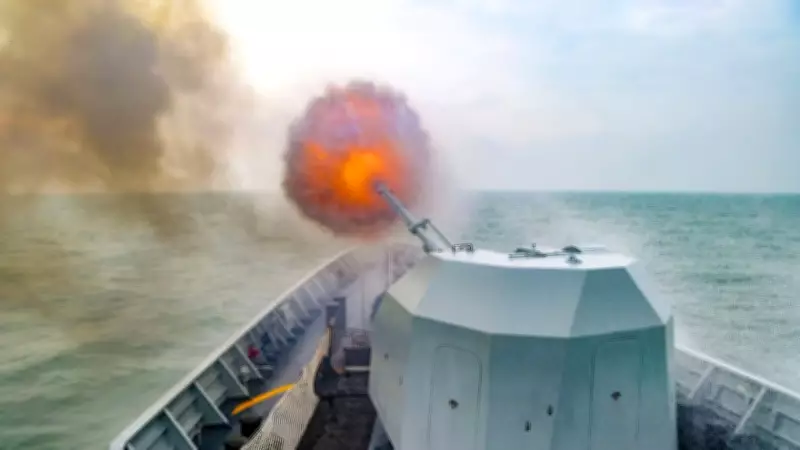
China's Revolutionary Hypersonic Missile: Game-Changer in Air Defense
Chinese researchers have achieved a breakthrough in military technology with the development of an ultra-small hypersonic glide missile that can be launched from a standard 80mm anti-aircraft gun. This innovation, detailed in a recent peer-reviewed study, represents a significant advancement in precision-strike weaponry that could transform modern air defense strategies.
Unprecedented Speed and Lethality
Once fired from the barrel, this revolutionary projectile accelerates to speeds approaching Mach 6, dramatically surpassing the velocity of conventional anti-aircraft shells. At such extreme hypersonic speeds, the missile can effectively engage fighter jets and drones at distances exceeding 20 kilometers and altitudes reaching approximately 10,000 meters.
The weapon's combination of miniature size and extraordinary velocity creates a formidable challenge for enemy aircraft, which may only detect the incoming projectile when it is about 3 kilometers away. This leaves mere seconds for defensive response, during which the missile continues traveling at approximately Mach 3.6.

Advanced Guidance and High Success Rate
Computer simulations demonstrate remarkable capabilities, showing the weapon can adjust its trajectory even when targets execute near-90-degree turns. The system reportedly achieves an exceptional 99 percent kill probability, making it one of the most reliable air defense weapons under development.
Researchers have implemented sophisticated guidance technology using multi-objective optimization and an advanced sliding-mode variable-structure guidance law. This innovative approach reduces maneuver load during the terminal phase by more than 90 percent compared to conventional methods while maintaining a smooth flight path.
Strategic Advantages and Deployment Potential
A typical anti-aircraft gun can fire approximately once per second, creating a high-rate-of-fire capability when combined with these hypersonic projectiles. With relatively low production costs and near-unlimited supply potential, these weapons could significantly alter air defense paradigms if widely deployed to replace medium- and short-range missiles.
"This system effectively blurs the boundary between traditional gunfire and missile-based air defense," explained the research team. "It combines the rapid firing rate of conventional guns with the extended reach and precision guidance typically associated with missiles."
Technical Innovation and Challenges
The research team, led by Professor Wang Xugang of Nanjing University of Science and Technology, published their findings in the Journal of Naval Aviation University. They described hypersonic guided projectiles as "a new generation of precision-strike weapons" that offer rapid strike capability, precision guidance, and high lethality.
However, the researchers acknowledged that extreme speed presents unique engineering challenges. During sharp or serpentine maneuvers, traditional guidance methods can struggle, potentially leading to missed targets. To address this limitation, the team developed an innovative two-stage guidance system:
- Mid-course phase: Plans an efficient flight path for optimal trajectory
- Terminal phase: Makes precise adjustments to securely lock onto targets
Understanding Speed Categories in Modern Warfare
The development highlights the growing importance of hypersonic technology in modern military applications:
- Supersonic: Speeds between Mach 1 and Mach 5 (1,235–6,175 km/h) used by fighter jets and missiles like the BrahMos
- Hypersonic: Speeds starting at Mach 5+ (6,175+ km/h) offering extreme velocity with high maneuverability
- Ultra-hypersonic: Experimental systems reaching Mach 10+ (12,350+ km/h)
Hypersonic systems face unique challenges including severe heat and stress from atmospheric friction, which are less pronounced at supersonic speeds. Despite these obstacles, simulations indicate this new missile system achieves minimal miss distance, strong resistance to interference, and high operational reliability.

According to the research paper, these advanced projectiles "are profoundly reshaping traditional firepower combat models and have broad application prospects in future air warfare." The development represents a significant step forward in military technology that could potentially redefine air defense capabilities worldwide.





