

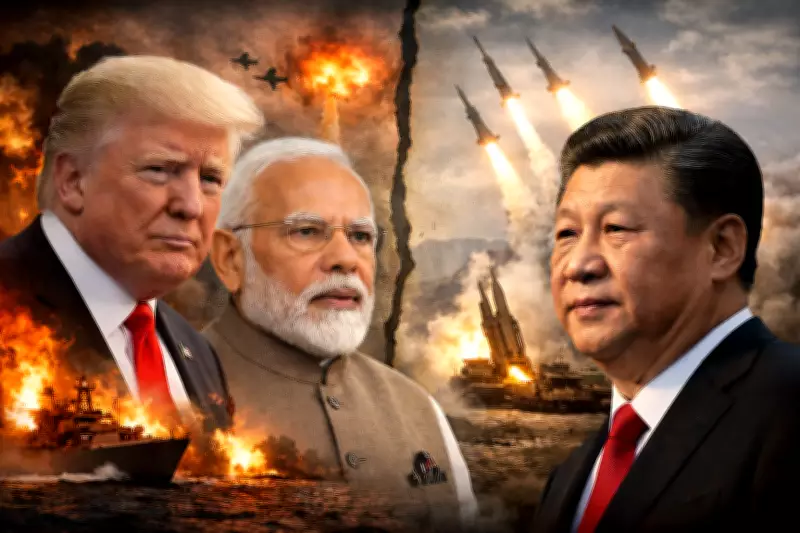
Iran War's Strategic Impact: China's Military Reassessment in Real-Time
At first glance, the United States' military campaign against Iran appeared to follow a familiar pattern—overwhelming airpower, precision strikes, and rapid dominance projection. However, weeks into the conflict, the battlefield narrative has grown increasingly complex. Iran maintains de facto control over the critical Strait of Hormuz, global oil flows remain under persistent threat, and Washington finds itself navigating a conflict without a clear strategic endpoint.
Thousands of kilometers away in China, this war is being observed not as a distant crisis but as a live military laboratory. From missile interception gaps to force mobilization challenges and command disruption vulnerabilities, Beijing is meticulously dissecting every phase of the conflict. These lessons are far from academic exercises—they are being directly integrated into China's long-term military planning, particularly concerning Taiwan scenarios.
Five Critical Lessons from an Unfolding Conflict
On March 3, China's military publication, China Military Bugle, distilled the Iran conflict into five stark lessons that reflect Beijing's structured interpretation of the war through its own strategic vulnerabilities and ambitions:

- The deadliest threat is the enemy within
- The costliest miscalculation is blind faith in peace
- The coldest reality is the logic of superior firepower
- The cruelest paradox is the illusion of victory
- The ultimate reliance is self-reliance
Lesson One: Internal Threats and Military Purges
For President Xi Jinping, the first lesson carries deep personal and political significance. China's leadership has long feared that internal weaknesses—including corruption, factionalism, and ideological drift—pose greater threats than external adversaries. The ongoing purge within the People's Liberation Army (PLA) reflects this heightened anxiety.
Senior military figures, including Central Military Commission members Generals Zhang Youxia and Liu Zhenli, have been removed from their positions. Remarkably, 41 out of 47 top PLA generals since 2022 have reportedly been purged or investigated. This represents not routine discipline but systemic restructuring.
The Iran conflict reinforces this priority, demonstrating that high-speed, high-stakes military operations leave minimal room for internal disloyalty or inefficiency. Beijing appears determined to ensure that, should it face a major conflict, its command structure remains tightly controlled and ideologically aligned.
Lesson Two: Diplomacy's Limitations and Defense Spending
The second lesson—"blind faith in peace"—stems from the timing of the conflict. Iran was widely believed to be engaged in diplomatic processes when it came under attack. For Beijing, this reinforces a long-standing suspicion: negotiations do not guarantee security.
China's response manifests in its defense spending priorities. The country has increased its 2026 military budget by 7%, allocating approximately RMB 1.91 trillion (around $277 billion) to the PLA. This reflects not merely deterrence but a strategic shift toward preparing for worst-case scenarios, even during periods of diplomatic engagement.
Lesson Three: Firepower's Decisive Role and Modernization Push
The Iran conflict has reaffirmed the decisive role of superior firepower in modern warfare. The coordinated operations of the United States and its allies demonstrate how intelligence, speed, and precision can overwhelm defenses. However, the war simultaneously exposes the limits of such dominance.
China is taking careful note. Its military modernization push—focused on mechanization, informatization, and intelligentization—aims to ensure it can both replicate and counter such capabilities. Advanced weapons systems, AI-driven warfare, and network-centric operations are becoming central to PLA doctrine. Yet, as the war demonstrates, firepower alone cannot guarantee strategic success.

Lesson Four: The Illusion of Victory and Strategic Objectives
Perhaps the most ambiguous yet revealing lesson is the "illusion of victory." Despite early tactical gains, the US campaign struggles to translate battlefield success into strategic control. Iran's persistent grip over the Strait of Hormuz has transformed what appeared to be a swift operation into a drawn-out contest.
The absence of clearly defined end goals has compounded these challenges. For Beijing, this serves as a critical warning: military victories can create new problems when political objectives remain unclear. This lesson holds particular relevance in the Taiwan context, where any conflict would carry immense geopolitical consequences.
Lesson Five: Self-Reliance as Strategic Survival
The final lesson—self-reliance—connects directly to China's economic and strategic vulnerabilities. Approximately 45% of China's oil imports pass through the Strait of Hormuz, meaning any disruption there carries immediate implications for its economy.
This reality has reinforced Beijing's push for "strategic material security," including stockpiling critical resources and reducing dependence on external supply chains. In prolonged conflict scenarios, resilience—not merely strength—could determine ultimate outcomes.
Missile Defense Gaps: A Strategic Recalibration
Beyond these broad lessons, one area stands out with particular significance: missile warfare. The Iran conflict has revealed the sheer scale of missile exchanges in modern warfare and the strain they place on defense systems.
According to analysis cited in Chinese military circles, existing missile defense systems—particularly midcourse and terminal-phase interceptors—face "nearly insurmountable challenges" against large-scale ballistic missile attacks. This realization is prompting a fundamental shift in strategic thinking.
Instead of relying solely on ground-based systems, Chinese strategists now emphasize boost-phase interception—targeting missiles immediately after launch. During this initial stage, missiles move slower, demonstrate less maneuverability, and emit strong infrared signatures, making them easier to track and destroy.
The proposed solution is ambitious:
- Deploy fighter jets and drones near potential launch zones
- Equip them with air-launched interceptors
- Intercept missiles in their earliest phase
Such a system would not only improve interception rates but also ensure that debris falls closer to launch sites, reducing collateral damage.
Expanding Threat Perception: From US to India
China's missile defense rethink extends beyond the United States. The threat landscape, as viewed from Beijing, continues to widen significantly:
- US deployments including the Typhon missile system in Japan and the Philippines
- Taiwan's growing arsenal, including US-supplied systems
- South Korea's Hyunmoo missiles
- India's Agni series ballistic missiles
These developments contribute to what Chinese analysts describe as a "comprehensive missile threat environment." For Beijing, this necessitates preparation for multi-directional challenges across an expansive battlespace.
The Taiwan Factor: Timeline Confusion and Strategic Clarity
Taiwan remains central to China's long-term strategic calculations. While the PLA's 2027 centenary has often been interpreted as a potential invasion deadline, US intelligence offers a more nuanced assessment. According to their analysis, Chinese leaders do not currently plan to execute an invasion of Taiwan in 2027, nor do they maintain a fixed timeline for achieving unification.
Simultaneously, the broader objective remains unchanged: China publicly insists that unification with Taiwan is required to achieve its goal of 'national rejuvenation' by 2049. This dual messaging has created confusion among analysts, with some questioning whether China's private planning aligns with its public statements.
Watching America: A Real-Time Military Classroom
Former US CENTCOM commander Joseph Votel highlighted how closely China is studying the conflict: "I think they're paying very close attention to this. They're learning how we respond to counterfire. They're very closely following our air tactics and how we're working with the Israelis on that. They're looking at the targets we're going after, and trying to understand the scheme of fires associated with all of this."
He added: "They'll be watching what our readiness rates are throughout all of this, and our ability to marshal forces and how quickly we can do this. So I think they're absorbing a lot just about how we're operating." This represents not passive observation but active, systematic learning.
The Indo-Pacific Question: US Force Redistribution
One of the most closely monitored aspects of the conflict involves the redeployment of US forces. Assets from the Indo-Pacific region, including the 31st Marine Expeditionary Unit, have been redirected to the Middle East.
Votel observed: "I think they're paying attention to what this is doing to our readiness in other areas, frankly. We continue to move resources out of the Asia-Pacific, and they certainly are taking note of that." For China, this raises a critical strategic question: can the United States sustain simultaneous commitments across multiple regions?
Decapitation Strikes: Strategic Insights and Risks
The US-Israel campaign has provided valuable insights into decapitation strategies—targeting leadership and command structures. China has long considered similar approaches in potential Taiwan scenarios.
However, analysts warn of significant risks. As one observer noted: "For China, the US-led campaign may prove a valuable lesson in how to disrupt continuity of government and the military chain-of-command during an invasion of Taiwan. But it may yet become a cautionary tale of what can go wrong after a successful decapitation strike."
The analysis continued: "Assassinating a democratically elected leader and installing a Beijing proxy may not coerce Taiwanese into submission, but steel their resolve to fight the new occupiers." Furthermore, "If the US and Israel cannot succeed in changing the Iranian regime and gaining the support of the Iranian people, he will have little prospect of doing so in Taiwan."
The Missile Gap: A Potential Strategic Window
Perhaps the most consequential takeaway involves missile inventories. As defense analyst David Axe pointed out: "The so-far lopsided conflict offers important lessons for the Asia-Pacific. It has revealed just how many munitions it takes to attack and defend during a back-and-forth bombardment."
Regarding defensive shortages, he noted: "US and allied forces have expended perhaps 2,000 very expensive missile interceptors that US industry builds at rates far too low to immediately replenish inventories." This creates a potential strategic imbalance, with Axe warning: "That may be the best time for Beijing to strike." He concluded: "Thanks to the war on Iran, they simply won't have enough interceptors for years to come. Victory in the east is less assured than ever."
From Hormuz to Taiwan: Strategic Consequences
Should the United States remain entangled in the Middle East, the strategic consequences could extend far beyond the region. As analyst Sam Roggeveen cautioned: "The worst case will be highly advantageous for Beijing. The US may have triggered a cycle of escalation that provokes Tehran to use thousands of cheap drones or even ground forces against one of its near neighbours; it may bring an even more repressive and extremist government to power that races to nuclear-weapons capability; or it may provoke a civil war and create a failed state. All these scenarios entangle the US further in the Middle East. And in the process, it will have expended precious stocks of munitions that will weaken its deterrent against China."
The Iran war represents more than a regional conflict—it serves as a strategic mirror for global powers. For China, it exposes the complex realities of modern warfare, including its substantial costs, operational complexities, and strategic uncertainties. From missile interception gaps to the risks of military overextension, Beijing is absorbing lessons that could fundamentally shape its future strategic decisions.
The critical question moving forward is not whether China is learning from these developments, but how it will ultimately act upon these lessons. As the conflict continues to unfold around the Strait of Hormuz, its strategic echoes may one day resonate across the Taiwan Strait, potentially reshaping the geopolitical landscape of the Asia-Pacific region.





