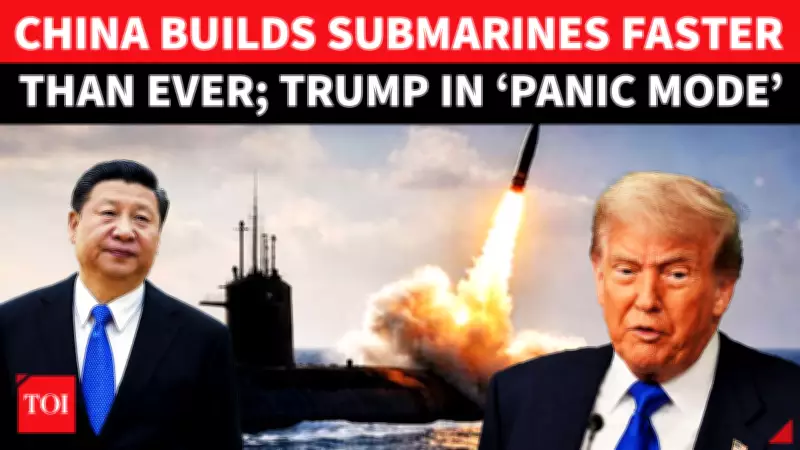
China's Accelerated Submarine Production Alarms Washington Amid US Delays
A new report from the International Institute for Strategic Studies has highlighted a significant shift in the undersea military balance between the United States and China, raising concerns in Washington. The analysis reveals that between 2021 and 2025, China launched more nuclear-powered submarines than the United States, marking a notable departure from historical trends where American naval dominance was unchallenged.
Quantitative Shift in Submarine Fleet Dynamics
While the United States Navy maintains a substantial numerical and technological advantage, particularly in areas such as stealth capabilities and operational experience, China's expanded production capacity is creating momentum. The steady rollout of ballistic-missile submarines and attack submarines demonstrates Beijing's commitment to enhancing its undersea warfare capabilities.
Satellite imagery has confirmed major upgrades at key Chinese shipyards, indicating a sustained industrial focus on submarine construction. These facilities have undergone significant expansion, allowing for increased production rates that surpass previous benchmarks.

American Production Challenges and Strategic Implications
Concurrently, United States submarine programs are grappling with production shortfalls and delays that threaten to undermine Washington's qualitative edge. Analysts note that although American submarines remain technologically superior, the rising number of Chinese hulls in the Indo-Pacific region could gradually reshape regional naval calculations.
The growing disparity in production rates has prompted strategic reassessments within defense circles, with particular attention to how China's submarine fleet expansion might influence maritime security dynamics in contested waters.
Broader Context of Naval Competition
This development occurs against a backdrop of intensifying great power competition, where naval capabilities serve as critical indicators of military reach and deterrence. The submarine domain represents a particularly sensitive aspect of this rivalry, given the strategic value of undersea assets for both conventional and nuclear missions.
Key factors in this evolving balance include:
- China's focused investment in submarine construction infrastructure
- American challenges in maintaining production schedules for next-generation submarines
- The strategic importance of submarine numbers in regional conflict scenarios
- Technological advancements that might offset numerical disadvantages
While Washington retains advantages in submarine technology and crew proficiency, the report suggests that China's accelerated production timeline could narrow these gaps over time, potentially altering the strategic calculus in the Indo-Pacific region.