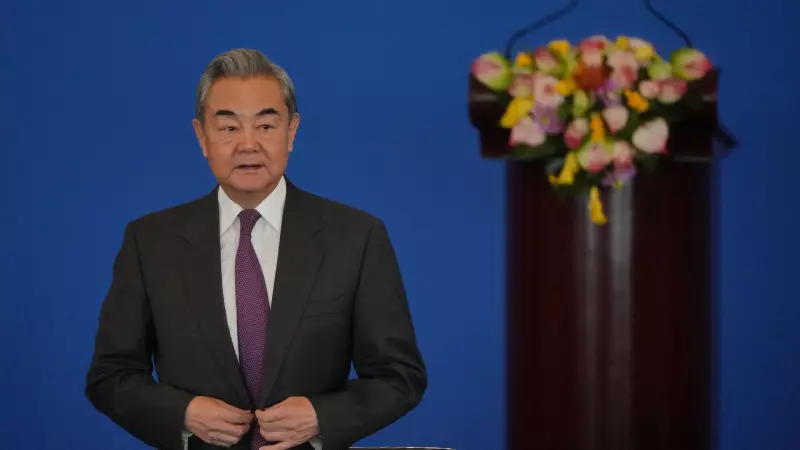
In a significant diplomatic assertion, China's Foreign Minister Wang Yi has claimed that tensions between India and Pakistan were among the hotspot issues where Beijing played a mediating role this year. This claim, made on December 30, 2025, stands in direct contrast to India's consistent position that all matters with Pakistan are resolved strictly through bilateral channels.
China's Assertion of Mediation Role
Speaking at the Symposium on the International Situation and China's Foreign Relations in Beijing, Wang Yi outlined what he termed as the "Chinese approach to settling hotspot issues." He stated, "Following this Chinese approach... we mediated in northern Myanmar, the Iranian nuclear issue, the tensions between Pakistan and India, the issues between Palestine and Israel, and the recent conflict between Cambodia and Thailand."
Wang Yi framed this within a broader narrative of a turbulent global landscape, noting that "local wars and cross-border conflicts flared up more often than at any time since the end of WWII." He emphasized China's "objective and just stance" focused on addressing both symptoms and root causes to build lasting peace.

India's Firm Rejection of Third-Party Role
India's stance on the matter has been unequivocal and long-standing. New Delhi has consistently maintained that there is no place for any third-party intervention in matters relating to India and Pakistan. This position was reiterated specifically regarding the May 7-10, 2025, conflict, referred to as Operation Sindoor.
The Indian Ministry of External Affairs (MEA), in a press briefing on May 13, 2025, clarified the resolution mechanism. It stated, "the specific date, time and wording of the understanding was worked out between the DGMOs (Director General of Military Operations) of the two countries at their phone call on 10th May 2025, commencing at 15:35 hours." This statement explicitly highlighted the direct, bilateral military dialogue that led to a ceasefire, implicitly rejecting any external mediation.
Operation Sindoor and China's Controversial Support
The context of Wang Yi's claim is critical. The Operation Sindoor conflict was a period of intense military engagement between India and Pakistan in early May 2025. During this time, China's role came under intense scrutiny, particularly its military assistance to Pakistan.
On the first day of the conflict, May 7, China's Foreign Ministry issued a statement saying, "China finds India’s military operation early this morning regrettable," while calling for restraint. In an apparent reference to the Pahalgam terrorist attack that preceded the conflict, it added, "China opposes all forms of terrorism."
However, China's active military support to Pakistan during the operation became a major point of contention. Indian military officials, including Deputy Chief of Army Staff Lt General Rahul R Singh, later asserted that Beijing used the conflict as a "live lab" and extended all possible support to Pakistan, employing strategies akin to the ancient "36 stratagems," such as "killing with a borrowed knife." China, a supplier of over 81% of Pakistan's military hardware, declined to directly address these charges.
Broader Diplomatic Context and SCO Invitation
In the same speech, Wang Yi also touched upon the positive momentum in India-China relations. He noted, "China-India relations showed a good momentum," and highlighted Beijing's invitation to Prime Minister Narendra Modi to attend the Shanghai Cooperation Organisation (SCO) summit held in Tianjin in August 2025. He described the summit as a "resounding success."
Wang Yi concluded this segment by stating that China's engagement with neighbouring countries had entered a new stage of building a community with a shared future at a faster pace. He also commented on the expansion of BRICS, calling the "20-member BRICS family" more prosperous.

The Chinese Foreign Minister's remarks underscore the divergent narratives between Beijing and New Delhi on regional conflict resolution. While China seeks to position itself as an indispensable mediator for global and regional hotspots, India firmly upholds the principle of bilateralism in resolving disputes with its neighbours, particularly Pakistan. This fundamental difference in approach is likely to remain a defining feature of the complex triangular dynamic between the three Asian powers.